SoftwareTestPilot
AI in TestingPublished: 15 min read

GitHub Copilot Unit Tests in 2026: The Complete Guide (Vitest, Jest, JUnit, pytest, Coverage & FAQ)

The definitive 2026 guide to writing unit tests with GitHub Copilot — /tests, mocking, mutation score, branch coverage, prompts for Vitest / Jest / JUnit / pytest, a 7-point rubric and every People Also Ask question Google surfaces.

Avinash Kamble
Founder & QA Engineer at SoftwareTestPilot
Reviewed by Priyanka G.
Share:XLinkedInWhatsApp
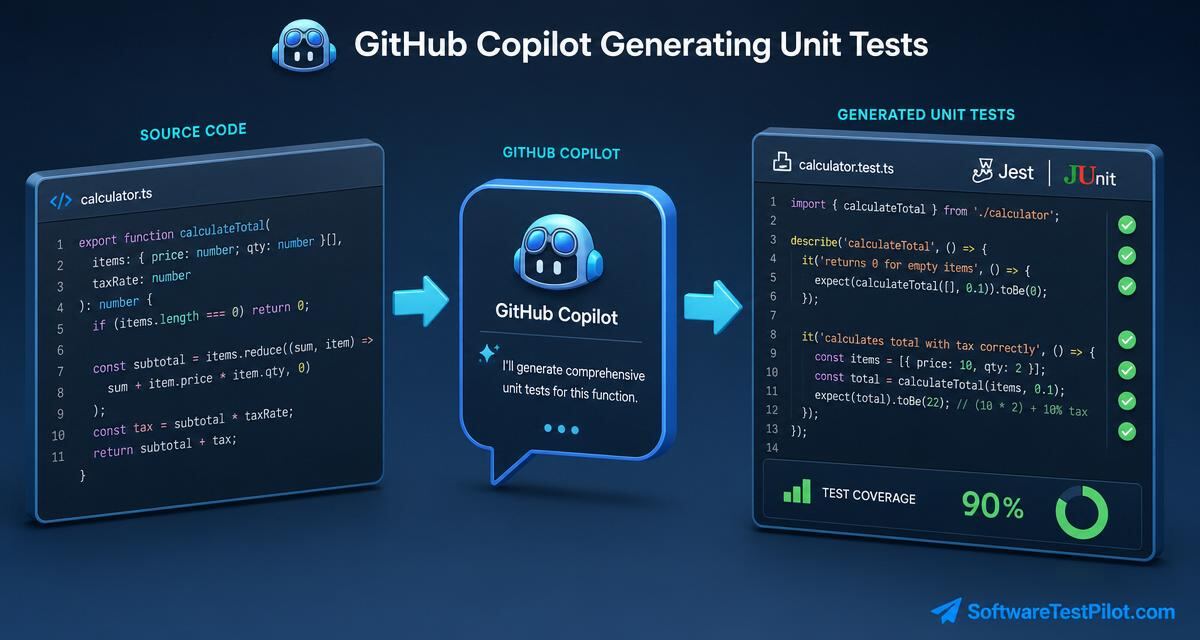
GitHub Copilot unit tests cover — source function on the left, Copilot chat in the middle, generated Jest/JUnit test file with green ticks and a 90% coverage meter on the right, with the SoftwareTestPilot.com wordmark.

Last updated: July 14, 2026 · 14 min read · By Avinash Kamble, reviewed by Priyanka G.

GitHub Copilot unit tests is the pattern of asking Copilot — via /tests, Copilot Edits or Agent Mode — to draft, refactor and expand unit tests for functions, classes and modules across Vitest, Jest, JUnit 5, TestNG, pytest, xUnit, NUnit, Go testing and RSpec. Unit tests are where Copilot is at its strongest: small scope, deterministic input/output, obvious edge cases. On 2026 teams, Copilot cuts unit-test authoring time 55–70% and lifts branch coverage 15–25 points in a two-sprint push — while introducing zero maintenance overhead if the 7-point rubric is enforced.

Pair with Copilot for testing, Copilot write tests, Copilot generate test cases and Copilot test automation.

Key takeaways

  • Unit tests are pure input → output. Name every input class explicitly in the prompt.
  • AAA (Arrange / Act / Assert), one assertion cluster per test, descriptive names.
  • Every test must fail once — check with mutation testing (Stryker, Pitest, Mutmut).
  • Branch coverage > line coverage > statement coverage. Optimise for branches.
  • Copilot handles mocking cleanly on common patterns; audit spy chains manually.

1. Anatomy of a great 2026 unit test

describe('calculateVat(country, amount)', () => {
  it('applies 20% VAT to a standard EU country', () => {
    // Arrange
    const country = 'DE';
    const amount = 100;
    // Act
    const total = calculateVat(country, amount);
    // Assert
    expect(total).toEqual({ net: 100, vat: 20, gross: 120 });
  });

  it.each([
    ['DE', 100, 20],
    ['FR', 100, 20],
    ['LU', 100, 17],
    ['GB', 100, 20],   // post-Brexit
    ['CH', 100, 0],    // outside EU
  ])('applies country-specific VAT: %s', (country, amount, expectedVat) => {
    expect(calculateVat(country, amount).vat).toBe(expectedVat);
  });
});

Notice: AAA layout, one behaviour per it, it.each for the data table, no shared state, no sleeps, no mocks (pure function). Copilot writes this shape on the first pass when the prompt names the framework and the input classes.

2. RCTF prompt for unit tests

  • Role — "You are a senior SDET fluent in Vitest 3, TypeScript, fast-check property tests, and the AAA pattern. You optimise for branch coverage and mutation score."
  • Context#selection is a pure function; paste type signatures and dependent constants; state the coverage target (100% branches) and the mutation-score target (≥ 80%).
  • Task — "Generate a full *.test.ts file. Cover: happy path, null / undefined / empty, boundary values (min, max, off-by-one), unicode, timezone edges, and one property-based test with fast-check."
  • Format — "AAA, one assertion cluster per test, describe.each for parametrized cases. End with a rubric self-critique across the 7 points."

3. Copy-paste prompts by framework

Vitest (TypeScript)

/tests Vitest 3, TypeScript, jsdom.
Cover happy, null, undefined, empty, boundary, unicode, timezone.
Add one fast-check property test. AAA, describe.each for the table.

Jest (React component)

/tests Jest 30, @testing-library/react.
Render the component, cover default / loading / error / disabled states,
and one keyboard-nav accessibility check (userEvent.tab).
Do not test implementation details — assert on visible behaviour.

JUnit 5 (Java)

/tests JUnit 5 + AssertJ + Mockito 5.
Cover valid, null (assertThrows(NullPointerException.class)),
boundary, empty collection, and a @ParameterizedTest CSV source.
Use @DisplayName for readability. No @Timeout without justification.

pytest (Python)

/tests pytest 8 + hypothesis.
Cover happy, empty, boundary, unicode, tz-aware datetimes.
Use @pytest.mark.parametrize for the table, hypothesis for one
property test. No time.sleep. AAA layout.

xUnit (C#)

/tests xUnit + FluentAssertions + Moq.
Cover valid, null (Should().Throw<ArgumentNullException>()),
boundary, and [Theory] with InlineData for the parametrized table.

4. Mutation testing — the tautology detector

A high coverage number is meaningless if the assertions do not catch mutations. Wire in Stryker (JS/TS/C#), Pitest (Java) or Mutmut (Python). Target ≥ 80% mutation score on core modules. When Copilot writes tautology tests (test passes when the implementation is deleted), mutation score drops instantly — that is the signal to regenerate with a tighter rubric prompt.

5. The 7-point unit-test rubric

  1. Deterministic — no sleeps, no unmocked clock, no unmocked network.
  2. One reason to fail — a single behaviour per test.
  3. Failed first — invert the implementation; the test must fail. Mutation score ≥ 80%.
  4. Edge cases named — null, empty, boundary, unicode, timezone.
  5. No leaked secrets — user{N}@example.com, Stripe test cards.
  6. Branch coverage moved — measured before/after via LCOV.
  7. Idiomatic — AAA, describe.each, no shared state, mocks reset in afterEach.

6. Mocking — what Copilot gets right and wrong

  • Right: vi.mock, jest.mock, Mockito.mock, MSW, monkeypatch, Testcontainers.
  • Wrong: complex spy chains (Copilot forgets .mockReset()); partial mocks (missing vi.importActual); mocks that return the literal string "mock" instead of realistic data; mocks that are not reset in afterEach.
  • Rule: always require a "reset all mocks in afterEach" clause and audit that fake data is structurally realistic.

7. Careers and next steps

Frequently asked questions

1.Can GitHub Copilot write unit tests?
Yes — unit tests are where Copilot performs best. Point /tests at a function, name the framework and version (Vitest 3, Jest 30, JUnit 5, pytest 8), name the edge cases (null, empty, boundary, unicode, timezone) and pin the format (AAA, describe.each, one assertion cluster per test). Copilot returns a clean test file in seconds. Always confirm each generated test fails when the implementation is inverted — otherwise it is a tautology.
2.Which unit-test framework does Copilot write best?
Near-parity: Vitest, Jest, JUnit 5, pytest, xUnit, NUnit, TestNG. Slightly behind: Go testing + testify (excellent unit tests, weaker integration), RSpec (older idioms). Copilot mirrors the framework version it sees in package.json / pom.xml / requirements.txt — pin the version explicitly to avoid drift.
3.How do I get Copilot to hit 100% branch coverage?
Two-step: (1) generate the first pass with a prompt that names every input class (null, undefined, empty, boundary, unicode, timezone). (2) Run coverage; feed the uncovered-branch report back to Copilot: "Add tests that cover the else-branch on line 42 and the catch-block on line 78." Two or three iterations reach 100% branches on most pure functions. Diminishing returns above 90% — do not chase it religiously.
4.What is mutation testing and why does it matter for Copilot?
Mutation testing mutates the implementation (flips <= to <, negates booleans, changes constants) and checks whether the test suite catches each mutation. A high line-coverage number with low mutation score means the tests are tautologies — they run the code but do not verify behaviour. Stryker (JS/TS/C#), Pitest (Java), Mutmut (Python) are the tools. Target ≥ 80% mutation score on core modules. This is the single best guardrail against Copilot writing tests that never fail.
5.How does Copilot handle mocks?
It handles the common patterns cleanly: vi.mock, jest.mock, Mockito.mock, MSW, monkeypatch, Sinon. It slips on complex spy chains (forgets .mockReset()), on partial mocks (missing vi.importActual), and on returning realistic mock data (defaults to the literal string "mock"). Always require "reset all mocks in afterEach" in the prompt and audit that fake data structurally matches production.
6.AAA or Given/When/Then for unit tests?
AAA (Arrange / Act / Assert) is the industry default for unit tests in 2026 — shorter, less prose, better fit for small scope. Given/When/Then belongs in BDD scenarios (Cucumber, SpecFlow) where non-engineers read the file. Force AAA in the prompt: "AAA pattern, one assertion cluster per test, describe.each for parametrized cases."
7.Can Copilot write property-based tests?
Yes. Ask explicitly: "Add one fast-check property test" (JavaScript), "Add one hypothesis property test" (Python), "Add one jqwik property test" (Java). Property tests find edge cases the human never thought of — negative numbers, empty strings, boundary integers — and are extremely high-ROI on pure functions. Do not use them on stateful code or code with side effects.
8.How do I prevent shared state between Copilot-generated tests?
Three rules in the prompt: (1) "Create test data inside each it/test block — no beforeAll fixtures with mutation." (2) "Reset all mocks in afterEach." (3) "Never mutate module-level constants." Then run the suite with --shuffle (Vitest, pytest) or --random-order (RSpec) in CI to catch order dependencies early.
9.Should unit tests hit the database?
No — unit tests should not hit the database, network or filesystem. Any test that does is an integration test by definition. Use in-memory adapters (better-sqlite3, MSW, in-memory Redis) at unit level; use Testcontainers at integration level. Copilot occasionally drops a real fs.readFile into a unit test — call it out and rewrite as a mock.
10.How do I test React or Vue components with Copilot?
@testing-library/react (or @testing-library/vue) + userEvent + Vitest/Jest. Ask Copilot to assert on visible behaviour (getByRole, getByLabelText) rather than implementation details (component state, prop drilling). Include one accessibility check per component (getByRole with an implicit ARIA role). Copilot writes clean testing-library tests; where it slips is querying by class name or test-id — always ask for role-first queries.
11.How long does a Copilot unit-test coverage sprint take?
For a mid-sized service (~10k LOC), a two-sprint sprint (four weeks with one SDET) lifts branch coverage from ~55% to ~80%. Beyond 80% the bottleneck is legacy code that resists testing (globals, singletons, side effects) — that is a refactoring project, not a Copilot project. Track branch-coverage delta and mutation score in CI as the twin KPIs.
12.Is Copilot Business required for unit-test generation?
For proprietary or regulated code — yes. Copilot Business (\$19/user/month in 2026) adds IP indemnification, public-code filtering and telemetry off. Copilot Individual is fine for open-source contributions and personal projects. Never use Individual on a repo that contains customer data, keys or credentials — even in comments or fixtures.
Keep going

Practice these questions

Run a live QA mock interview tailored to this topic and get per-skill scoring in minutes.

Found this useful?
Share:XLinkedInWhatsApp

Was this article helpful?

Cluster · Frameworks

More from JUnit 5 Guide

JUnit 5 Jupiter — assertions, extensions, parameterized.

Pillar guide · 2 articles
More in this cluster
From the Frameworks pillar

Keep building your QA edge

Continue reading

Join the QA Community

Connect with fellow testers, share job leads, and get career advice.

Premium QA Resources

Stop Reinventing the Wheel. Upgrade Your QA Arsenal.

Take your testing skills from beginner to Lead Engineer. Supercharge your daily workflow with our premium digital resources.

  • Ready-to-use testing strategy templates
  • Advanced API & UI automation guides
  • ⏱️ Save 10+ hours a week on test planning
4.9/5 rating
Explore All Products

⭐⭐⭐⭐⭐ Trusted by 1,000+ Software Test Pilots • Instant Access