
ChatGPT for Unit Testing in 2026: The Complete Playbook (Jest, JUnit, Pytest, Coverage & FAQ)
The definitive 2026 guide to unit testing with ChatGPT — generate Jest/Vitest, JUnit 5, xUnit and Pytest tests from source or diff, hit meaningful coverage (branch + mutation), mock cleanly, avoid over-mocking, 12 prompts, a 7-point review rubric and every PAA question Google surfaces.

Last updated: July 14, 2026 · 17 min read · By SoftwareTestPilot
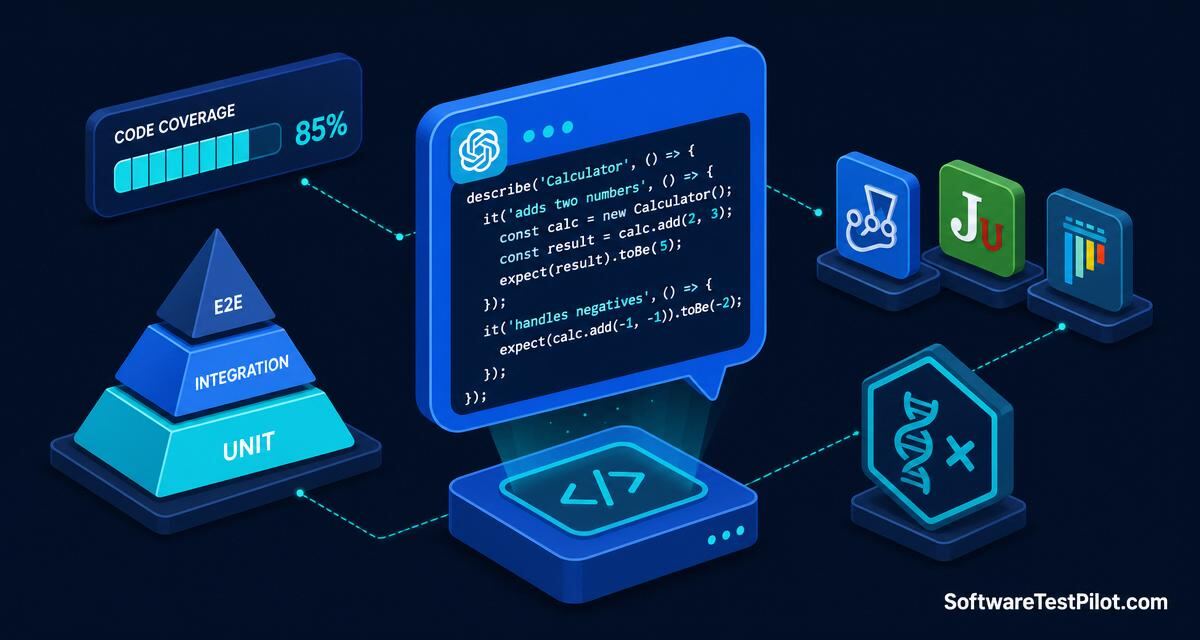
ChatGPT for unit testing in 2026 means using OpenAI's models — with Claude Opus 4.5 and Gemini 2.5 Pro plus GitHub Copilot's Test Generation Agent — to generate genuinely useful unit tests in Jest, Vitest, JUnit 5, xUnit, Pytest, Go's testing package or RSpec, from source or from a PR diff. Done well, ChatGPT lifts meaningful branch coverage by 20–40 points and cuts new-feature test authoring time by 60–80%. Done badly, it generates hundreds of trivially-passing tests that inflate line coverage while catching nothing.
Pair with GitHub Copilot for QA, ChatGPT test case generation and the QA automation 2026 guide.
Key takeaways
- Target branch coverage + mutation score, never just line coverage.
- Feed one file at a time (or one PR diff hunk) — not the whole repo.
- Force ChatGPT to test behavior, not implementation. Refactoring should not break tests.
- Reject tests that mock the function under test, assert nothing meaningful, or hard-code random values.
- Wire a mutation-testing pass (Stryker, PIT, mutmut) monthly to catch fake coverage.
1. What coverage target actually matters
Metric              | Signal                              | 2026 target
--------------------+-------------------------------------+-------------
Line coverage       | Weakest — passes on trivial tests   | ≥ 80% (side effect)
Branch coverage     | Real — every if/else executed       | ≥ 75%
Function coverage   | Every function invoked at least once| ≥ 90%
Mutation score      | Strongest — tests actually assert    | ≥ 60% (great: 80%)
Assertion density   | Assertions per test — quality proxy | 2–5
Optimising line coverage alone is what produced the "AI-generated 10k tests, escape rate unchanged" horror stories in 2024–25. Optimise mutation score, branch coverage and assertion density instead.
2. Master prompt: source file → unit tests
You are a senior software engineer fluent in [Jest 30 / Vitest 4 /
JUnit 5 / Pytest 8 / xUnit / Go testing / RSpec 4] and test-behavior
(black-box) discipline.

Context:
- Source file: [paste]
- Language + framework versions: [paste]
- Existing test file (if any): [paste]
- Business rules the code enforces: [paste 3-6 bullets]
- Public API surface only: [list exported names]
- Forbidden imports (framework internals, DB, network): [paste]

Task: produce unit tests that:
- Test the PUBLIC API only. Do not test private methods directly.
- Cover every branch (if / else / switch / early return)
- Include boundary + negative cases (null, empty, max, min, unicode)
- Use meaningful test names: "returns X when Y"
- Assertion density 2-5 per test
- Use test doubles only for I/O boundaries; NEVER mock the function
  under test
- Deterministic — no Math.random, no Date.now, no network, no time
  zones. Inject clocks and randomness via parameters or fakes.

Format: full test file. End with:
- Branch coverage estimate per function
- A self-critique against the 7-point rubric.
3. Prompt: PR diff → unit tests for changed code only
You are a senior engineer. Given this PR diff: [paste].
Generate unit tests that cover ONLY the changed lines and their
new branches. Do not add tests for unchanged code. If a changed line
introduces a new branch, cover both sides. If a changed line removes
a branch, delete the corresponding old test.
Emit as a diff patch against the existing test file.
4. Prompt: clean mocking (avoid over-mocking)
You are a senior engineer. Given this file: [paste].
Return the LIST of external dependencies that must be mocked
(DB, network, filesystem, clock, random, third-party API). For each:
- What to mock (interface / module)
- What NOT to mock (pure functions, value objects, framework internals)
- Suggested test double style (stub / fake / mock / spy)
- 1-line reasoning

Rules:
- Never mock a pure function that is under test.
- Never mock the standard library unless testing time / random.
- Prefer in-memory fakes to mocks for repositories.
5. Prompt: mutation-testing gap → new tests
You are a senior engineer fluent in mutation testing (Stryker / PIT /
mutmut).
Given: [paste mutation report showing survived mutants].
For each survived mutant:
- Explain the mutation (e.g. changed < to ≤)
- Write a new test that would KILL the mutant
- Return as a diff patch

Reject any test that also kills the mutant by asserting on
implementation detail (line-number, private state) — assert on
observable behavior only.
6. Prompt: refactor over-mocked or brittle tests
You are a senior engineer. This test is brittle:
[paste test].
Symptoms: [snapshot / private-method assertion / over-mocked /
tests implementation / requires golden update on every refactor].

Refactor the test to assert on observable behavior. Rules:
- No snapshot testing unless the value is a serialised public contract.
- No private-method access.
- No assertions on the number of times a stub was called unless
  interaction is the tested behavior.
- Keep the same coverage; reject if branch coverage drops.
7. The 7-point review rubric
- Every branch of the changed code is covered.
- Public API only — no private-method assertions.
- Tests are deterministic (no wall-clock, no random, no network).
- Assertion density 2–5 per test; no assertion-free tests.
- No mocks on the function under test; mocks only at I/O boundaries.
- Test names describe behavior ("returns X when Y"), not implementation.
- Mutation score ≥60% on the changed code (run monthly).
8. Governance and safe use
ChatGPT Enterprise or Team with training-off for anything touching proprietary source; Azure OpenAI, AWS Bedrock or self-hosted Llama 4 for regulated codebases. Never paste secrets, hard-coded credentials or PII from fixtures. Cross-check governance against the NIST AI RMF.
9. ROI, rollout and honest limits
Honest 2026 ranges: new-feature unit-test authoring 60–80% faster, branch coverage +20–40 points on brownfield modules, mutation score +15–30 points when the mutation-gap prompt is standard. Where it still fails: business rules with tacit knowledge (invented-plausible-but-wrong assertions), heavily-mocked legacy code (produces more over-mocked tests), and any file over ~500 lines pasted in one go (fragments coverage).