SoftwareTestPilot
AI in TestingPublished: 14 min read

GitHub Copilot Write Tests in 2026: The Complete How-To (VS Code, Chat, Agent Mode & FAQ)

The definitive 2026 how-to for making GitHub Copilot write clean, deterministic tests — /tests, /fix, @workspace, Agent Mode, prompt patterns, a 7-point rubric, common failures and every People Also Ask question Google surfaces.

Avinash Kamble
Founder & QA Engineer at SoftwareTestPilot
Reviewed by Priyanka G.
Share:XLinkedInWhatsApp
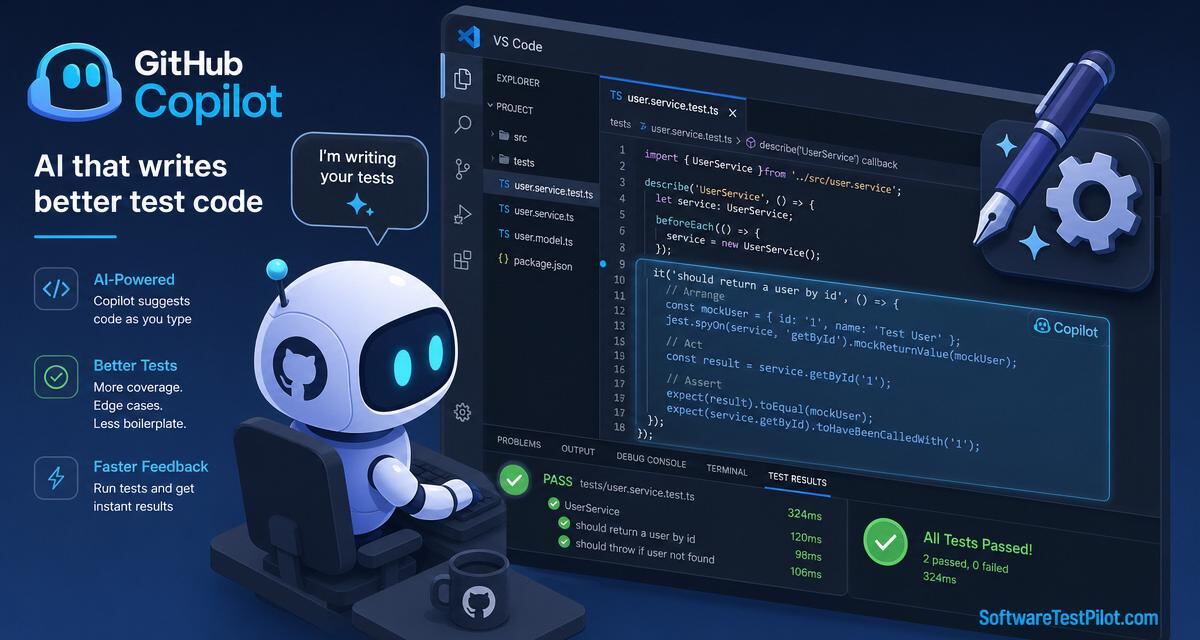
GitHub Copilot writing tests cover — Copilot chat producing ghost-text test code inside VS Code with green passing tests and a pen-and-gear icon, and the SoftwareTestPilot.com wordmark.

Last updated: July 14, 2026 · 14 min read · By Avinash Kamble, reviewed by Priyanka G.

GitHub Copilot write tests is the everyday workflow of asking Copilot — via /tests, Copilot Edits, Agent Mode or an inline prompt — to draft, refactor or extend a test file, then reviewing and merging as a QA engineer or SDET. Done well, Copilot writes a clean unit test in 30 seconds, an integration test in a minute, and an E2E spec in three minutes; done badly, it fills the repo with tautology tests that never fail. This how-to is the shortest path to the first pattern and the surest way to avoid the second.

Pair with Copilot for testing, Copilot unit tests, Copilot test automation, Copilot Playwright and Copilot Selenium.

Key takeaways

  • /tests for unit, @workspace for integration, Agent Mode for coverage sprints and E2E.
  • Prompt with RCTF (Role, Context, Task, Format) — never with a one-liner.
  • Every test must fail once before it passes.
  • Ban sleeps, xpath, shared state and real PII in the prompt itself.
  • Copilot writes; a human reviews against a 7-point rubric.

1. Setup — one-time steps before Copilot writes a single test

  1. Install the Copilot and Copilot Chat extensions.
  2. Sign in with a Copilot Business or Enterprise seat (not Individual for work code).
  3. In Settings, set "Suggestions matching public code" → Block.
  4. Add the framework and version to package.json or pom.xml — Copilot reads it as context.
  5. Create an existing tiny test (or copy tests/example.test.ts) so Copilot picks up your conventions.
  6. Add docs/ai-usage.md with your RCTF template and 7-point rubric.

2. The three canonical workflows

Workflow A — /tests on a selection

  1. Open the source file, highlight the function or class.
  2. Open Copilot Chat and type /tests followed by the RCTF prompt.
  3. Accept the diff into a new *.test.ts file next to the source.
  4. Run the suite; comment out the implementation to confirm the tests fail.
  5. Review against the rubric; regenerate if two or more criteria fail.

Workflow B — @workspace for integration

@workspace Generate integration tests for the /orders POST endpoint.
Cover 201, 400, 401, 403, 409, 500. Use the tests/setup.ts test-db
helper. Supertest + Vitest. AAA, one assertion cluster per test.

Workflow C — Agent Mode for a coverage sprint

Goal: raise branch coverage of src/services above 80% without touching
production code. Budget: 30 minutes, max 20 files. Rubric: deterministic,
one reason to fail, failed first, edge cases named. Emit a coverage
delta at the end.

3. Prompt patterns that consistently produce clean tests

  • Name the framework and version. "Vitest 3.2, jsdom environment, MSW 2 for HTTP" beats "write tests" every time.
  • Name the edge cases. null, undefined, empty, boundary, unicode, timezone, concurrency, permission denied.
  • Pin the shape. "AAA pattern, one describe per behaviour, one assertion cluster per test."
  • Forbid the bad stuff. "No sleeps. No xpath. No real emails. No Date.now() without a clock."
  • Ask for the self-critique. "End with a rubric self-critique across: deterministic, one reason to fail, failed first, edge cases, secrets, coverage delta, idiomatic."

4. The 7-point review rubric

  1. Deterministic — no sleeps, no unmocked network, no unmocked clock.
  2. One reason to fail — a single behaviour per test.
  3. Failed first — invert the implementation once; the test must fail.
  4. Edge cases named — null, empty, boundary, unicode, timezone covered.
  5. No leaked secrets — user{N}@example.com, Stripe test cards.
  6. Coverage delta — measured, moved in the right direction.
  7. Idiomatic — expect(locator).toHaveText, not manual polling; describe.each, not copy-paste.

5. Common failure modes and how to fix them

  • Tautology tests. Test passes even when the implementation is deleted. Fix: enforce the "failed first" rubric; add mutation testing (Stryker, Pitest).
  • Sleeps everywhere. Fix: ban them in the prompt; grep in pre-commit.
  • Shared state. Test order matters. Fix: reset mocks in afterEach; recreate data per test.
  • Invented constants. Copilot fills in plausible-but-wrong error codes. Fix: paste the real constants in the prompt Context block.
  • Assertion drift. toBeTruthy instead of toEqual(expected). Fix: require an explicit expected value in the assertion.

6. Careers, salary and interviews

Every QA and SDET job description in 2026 lists "AI-assisted testing" as a requirement. See the QA salary guide, the SDET career roadmap, the AI mock interview, the free ATS resume review and live roles on the QA Jobs Radar.

Frequently asked questions

1.How do I make GitHub Copilot write tests?
Open the source file in VS Code, highlight the function, open Copilot Chat and type /tests followed by an RCTF prompt: Role (senior SDET, Vitest), Context (the framework version, the AC, the edge cases), Task ("generate a suite covering happy path, null, empty, boundary, unicode, timezone") and Format ("AAA, one assertion cluster per test, end with a rubric self-critique"). Accept the diff, run the suite, then comment out the implementation to confirm the tests actually fail.
2.What is the /tests command?
A Copilot Chat slash command that generates a full test file for the currently-selected code or the file you reference with #file. It auto-detects the framework in the repo (Vitest, Jest, JUnit, pytest, Playwright, Cypress) and follows the existing test conventions. Pair it with an explicit edge-case list and a 7-point rubric self-critique to get production-quality output on the first pass.
3.Can Copilot write tests for existing code I did not write?
Yes — this is one of the highest-ROI uses. Point /tests at a legacy function, add /explain first to seed the chat context, then ask for tests covering the branches you can see in the coverage report. On a two-sprint coverage sprint, teams routinely lift branch coverage 15–25 points on legacy code. Always confirm each generated test fails when the implementation is inverted — that is the tautology check.
4.How do I make Copilot cover edge cases?
Name them in the Task block. "Cover null, undefined, empty array, boundary values (min, max, off-by-one), unicode strings, timezone edges (UTC vs local), concurrency, and one permission-denied path." If you leave it implicit, Copilot writes 3 happy-path tests. Follow up with "regenerate with an eye on mutation score" to force assertions that catch boundary flips and sign flips.
5.Does Copilot write good integration tests?
With @workspace scope, yes. Give it the route handler, the test-db helper, the mocking library (MSW, Testcontainers) and the status-code matrix. It will produce clean supertest / REST Assured / pytest-django tests. Always require a cleanup block (afterEach → truncate) and forbid shared fixtures — Copilot's default is to leak state between tests.
6.Should I let Copilot Agent Mode write tests unattended?
Only within a bounded goal, budget and rubric. "Raise branch coverage of src/services above 80%, max 30 minutes, max 20 files touched, no changes to production code, emit a rubric self-critique." Then review the PR against the 7-point rubric. Fully unattended merges introduce tautology tests that silently rot the suite.
7.How do I stop Copilot from writing flaky tests?
Three prompt clauses: (1) "No sleeps or waitForTimeout — use framework auto-wait." (2) "No shared state — recreate data per test and reset mocks in afterEach." (3) "No unmocked network or clock." Add a repo-wide grep in the pre-commit hook (sleep, Thread.sleep, waitForTimeout) that fails the commit on any match. Flaky specs cost more than the tests save.
8.Can Copilot write tests in Java, Python and C#?
Yes. JUnit 5 and TestNG (Java), pytest (Python), xUnit / NUnit (C#) are near-parity with JavaScript for Copilot quality. Go testing + testify, RSpec (Ruby) and PHPUnit are close behind. Always pin the language, framework and version in the prompt — otherwise Copilot drifts to the latest API and breaks on your pinned dependency.
9.How do I get Copilot to use my project's conventions?
Two levers: (1) an existing tiny test in the repo that Copilot can pattern-match on — file naming, describe wording, custom matchers, fixture imports. (2) An explicit rule in the Task block: "Use the existing tests/setup.ts fixture. Match the naming convention in tests/services/*.test.ts." Copilot copies conventions it sees; it invents them when it does not.
10.Does Copilot handle mocking well?
For the common patterns — Vitest vi.mock, Jest jest.mock, MSW, Testcontainers, Sinon — yes. It struggles with complex spy chains and partial mocks; audit that mocks return realistic data (not the literal string "mock") and reset in afterEach. Ask explicitly for "reset all mocks in afterEach" or you will get order-dependent flakes.
11.Is it safe to let Copilot see my source code?
On Copilot Business or Enterprise, yes — telemetry is off by default, prompts and completions are not retained beyond real-time processing, and IP indemnification applies. Never use Copilot Individual on proprietary or regulated codebases. For source that contains PII in comments or fixtures, redact before enabling Copilot on that repo.
12.How much time does Copilot save on writing tests?
Realistic 2026 numbers: unit-test authoring drops 55–70%, integration-test authoring drops 40–50%, E2E scaffold drops 60–70%, flake-fix time drops 30–50%. Diminishing returns kick in past 80% coverage — the bottleneck moves to fixing tests, not writing them. Budget a 15% review overhead against the raw savings.
Keep going

Practice these questions

Run a live QA mock interview tailored to this topic and get per-skill scoring in minutes.

Found this useful?
Share:XLinkedInWhatsApp

Was this article helpful?

Cluster · AI in Testing

More from GitHub Copilot QA

Copilot prompts, locator generation, test scaffolding.

Pillar guide · 8 articles
More in this cluster
From the AI in Testing pillar

Keep building your QA edge

Continue reading

Join the QA Community

Connect with fellow testers, share job leads, and get career advice.

Premium QA Resources

Stop Reinventing the Wheel. Upgrade Your QA Arsenal.

Take your testing skills from beginner to Lead Engineer. Supercharge your daily workflow with our premium digital resources.

  • Ready-to-use testing strategy templates
  • Advanced API & UI automation guides
  • ⏱️ Save 10+ hours a week on test planning
4.9/5 rating
Explore All Products

⭐⭐⭐⭐⭐ Trusted by 1,000+ Software Test Pilots • Instant Access