How Students Can Build a QA Testing Portfolio That Gets Interviews
Learn how students and freshers can build a QA testing portfolio with test cases, bug reports, API tests, SQL queries, and an automation project on GitHub.

Last updated: July 1, 2026 · 9 min read · By Avinash K
A QA testing portfolio is one of the best ways for students to stand out. Many freshers write the same resume lines: knowledge of manual testing, SDLC, STLC, Selenium, Java, SQL, and Postman. Recruiters see these words every day. A portfolio proves that you have actually used the skills.
You do not need a big enterprise project. You need small, clean, realistic examples of testing work. A good portfolio can include test cases, bug reports, exploratory notes, API tests, SQL queries, automation scripts, and a short explanation of your testing approach. This article shows exactly what to build.
SoftwareTestPilot tip: Pair this article with our AI Mock Interview, Resume ATS Review, QA Jobs Radar, and interview hubs for Selenium, API testing, and SQL for testers.
What a QA portfolio should include
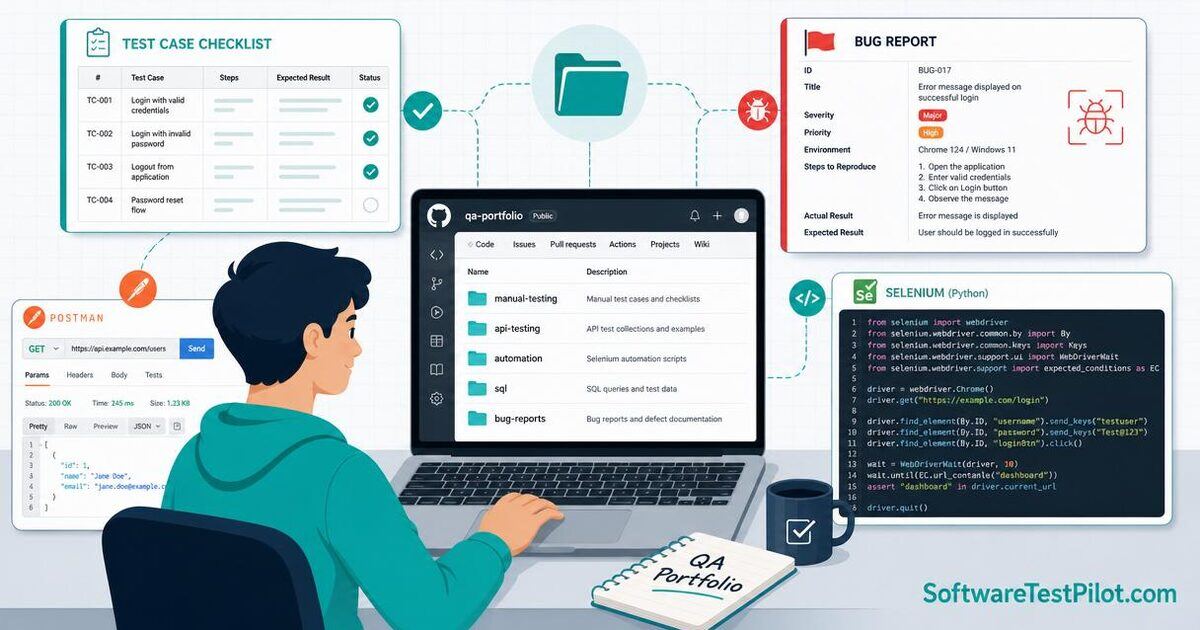
A strong beginner portfolio should have five parts: manual test case documents, sample bug reports, an API testing collection, SQL practice, and one automation project. If you can add a short test strategy document, even better. Each part should be easy to open and understand.
Think like a hiring manager. They should be able to visit your GitHub or portfolio page and quickly see how you think as a tester. Use clear folder names, README files, screenshots, and simple explanations. Our freelance QA portfolio guide covers the same idea at a senior level; students can borrow the structure and simplify it.
Project 1: Manual testing of a demo app
Choose a public demo app such as an ecommerce demo, banking demo, todo app, or booking app. Write test scenarios for login, search, cart, checkout, profile, and error messages. Include positive, negative, boundary, and usability cases.
Create a spreadsheet or markdown file with test case ID, title, precondition, steps, data, expected result, actual result, status, and priority. This shows that you understand test design and documentation. Our how to write test cases for a login page guide is a good template.
Project 2: Bug report samples
Find real issues in demo sites or create realistic bug report samples based on testing practice. A good bug report includes title, environment, steps to reproduce, expected result, actual result, severity, priority, screenshots, and notes.
Do not write vague titles like ‘button not working.’ Write specific titles like ‘Checkout page shows incorrect total after removing coupon from cart.’ Specific writing makes you look professional.
Project 3: API testing with Postman
Use a public API or demo backend. Create collections for GET, POST, PUT, DELETE, authentication, validation errors, and negative scenarios. Add assertions for status code, response body, schema, response time, and business rules. Our Postman API Testing Tutorial walks through the exact structure.
Export the Postman collection and add it to GitHub. Include a README explaining how to import and run it. This is very useful because many QA fresher interviews now include API questions — practise them on the API testing interview hub.
Project 4: SQL for testers
Create a small database practice file with tables like users, orders, products, and payments. Write queries for joins, counts, filters, duplicates, null checks, and data validation. You can include the schema and sample queries in a markdown file.
SQL is a strong differentiator for freshers. Many candidates say they know SQL, but few can explain how they would verify order status or user data after a test. Rehearse with the SQL interview questions hub.
Project 5: Automation framework
Create a small Selenium, Playwright, or Cypress project. Automate three to five important flows: login, search, add to cart, form validation, and logout. Use stable selectors, assertions, waits, and a simple folder structure. Start from our Selenium WebDriver Guide or the Playwright Testing Tutorial.
Do not overcomplicate the framework. A clean beginner project is better than a copied advanced framework you cannot explain. Your README should explain tools used, how to run tests, and what scenarios are covered. Add a simple GitHub Actions workflow so tests run on every push.
How to present the portfolio
Use GitHub as the main home. Create a pinned repository called qa-testing-portfolio. Inside it, create folders for manual-testing, api-testing, sql, automation, and bug-reports. Add a main README with your name, skills, project summary, and links.
Add the portfolio link to your resume, LinkedIn, and job applications — and check your resume through the Resume ATS Review before sending it out. In interviews, be ready to walk through one test case, one bug report, and one automation test. Confidence comes from building it yourself.
Portfolio checklist
Before sharing, check spelling, formatting, broken links, and clarity. Remove copied content. Use your own examples and explanations. Add screenshots only when helpful. Keep sensitive data out. Make sure every file has a purpose.
A portfolio does not need to be perfect. It needs to be honest, readable, and practical. Hiring managers appreciate candidates who show effort and ownership.
Sample portfolio README structure
Your portfolio README should make the reviewer’s job easy. Start with a short introduction: who you are, what QA role you are targeting, and what skills the portfolio demonstrates. Then add a project table with columns for project name, testing type, tools used, and link. After that, include setup instructions for automation and API collections.
A good README might say: “This portfolio contains manual test cases for an ecommerce demo app, bug reports with screenshots, Postman API tests for user and order endpoints, SQL validation queries, and a Selenium Java mini framework.” That single paragraph tells the recruiter exactly what to expect.
Add a section called “What I learned”. Mention practical lessons like choosing stable locators, writing clear expected results, validating API responses, and separating severity from priority. These reflections make the portfolio feel human and original. They also prepare you for interview questions because you have already explained your thinking in writing.
Weekly execution plan for students
Use a simple weekly rhythm so learning becomes measurable. On Monday, choose one topic and read or watch only enough to understand the basics. On Tuesday, practise the topic on a small example. On Wednesday, write notes in your own words. On Thursday, improve one portfolio file. On Friday, answer interview questions related to that topic. On Saturday, review mistakes and clean your GitHub. On Sunday, rest or lightly revise.
This rhythm prevents passive learning. It also creates visible progress every week. After four weeks, you will have notes, test cases, bug reports, API checks, SQL queries, or automation code instead of only browser history. Recruiters cannot see how many videos you watched, but they can see what you created.
If you are studying with college or a job, reduce the size but keep the habit. Even thirty focused minutes per day can build momentum. The key is consistency. QA careers are built by steady practice: reading requirements carefully, testing thoughtfully, documenting clearly, and improving after feedback.
How to turn this into a real career advantage
Reading one article or finishing one course is not enough by itself. The students who get interviews usually do three things consistently. First, they learn the concept. Second, they practise it on a small public project. Third, they explain the work clearly on GitHub, LinkedIn, and their resume. This simple loop is more powerful than collecting ten certificates without proof of skill.
For every topic you study, create one visible output. If you learn test case design, publish a test case document for a demo ecommerce site. If you learn Selenium, push a small framework to GitHub. If you learn API testing, share a Postman collection with positive and negative scenarios. If you prepare for ISTQB, write notes in your own words and create a small cheat sheet. These outputs show recruiters that you did more than watch videos.
Also keep your language practical. Do not write “expert in automation” if you only completed one beginner course. Write what you can actually do: “Created Selenium tests for login and search using Java, TestNG, explicit waits, and Page Object Model.” Honest, specific statements build trust faster than big claims.
Common mistakes students should avoid
The first mistake is jumping between too many resources. Pick one course or plan, finish it, and build something from it. The second mistake is studying only theory. QA is a practical job. You must practise writing test cases, finding bugs, using tools, and explaining issues. The third mistake is ignoring communication. A clear bug report and a clean test summary can separate you from other freshers.
Another mistake is waiting until you feel fully ready before applying. You will never feel completely ready. Once you have a basic portfolio, a resume, and interview practice, start applying through the QA Jobs Radar while you continue learning. Real interviews teach you what to improve.
Final preparation note
Before you publish this learning on your resume or LinkedIn, review it like a tester. Check whether the links open, whether the project instructions work, whether screenshots are readable, and whether your claims match the actual work. Small details matter. A clean portfolio and honest explanation can create a better impression than a long list of unfinished skills.