How to Build a QA Testing Portfolio That Actually Wins Freelance Clients in 2026
A working QA portfolio is the difference between $30/hr and $80/hr clients. Here's exactly what to include, how to structure it, and the artifact ideas that close deals.

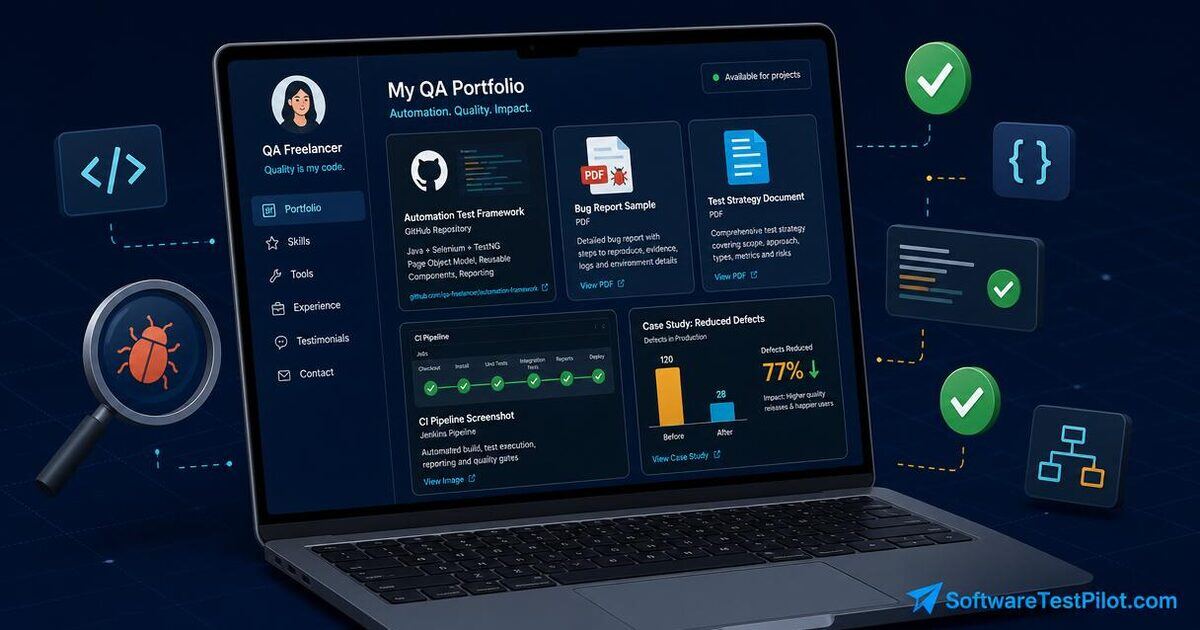
Last updated: June 30, 2026 · 13 min read · By Avinash K
Here's an uncomfortable truth: in 2026, a QA tester without a portfolio is invisible to the clients who actually pay well. Resumes tell clients what you say you can do. LinkedIn tells them what you've done in title form. A portfolio shows them what you can actually deliver — and that's the only thing that closes contracts above $70/hr.
The good news is that a working portfolio isn't a huge project. It's six to ten focused artifacts that answer one question for the client: "Can this tester actually do the job I'm trying to hire for?" If you can answer that question convincingly, you'll be in the small minority of freelance testers who get hired without competing on price.
This guide walks through exactly what to include, how to structure your portfolio, where to host it, and the artifact ideas I've seen close the most contracts. Pair it with our QA Engineer Resume Guide and the Freelancing for QA Engineers complete guide.
What a QA portfolio actually is
Forget the developer-style portfolio with flashy animations, hover effects, and dark-mode toggles. A QA portfolio is something simpler — a small, well-organized collection of proof artifacts.
Strong QA portfolios in 2026 contain six to ten artifacts that cover four bases:
- Test planning — show how you think before you start clicking.
- Test execution — show how you actually do the work.
- Bug reporting — show how you communicate findings.
- Automation — show real code you've shipped.
That's it. You don't need 50 artifacts. You don't need a personal blog with 100 articles. You need six really good things that tell a clear story.
The mistake I see most often is treating the portfolio like a résumé — long, exhaustive, listing every project the tester has ever touched. Hiring managers scan, find one or two artifacts that prove competence, and either reach out or move on. Make those one or two artifacts impossible to miss.
Artifact ideas that close clients
1. A real test plan (PDF or Notion page)
Pick a popular public app — Notion, Linear, a banking app, an e-commerce checkout — and write a test plan as if you'd been hired to QA it. Don't pick something obscure. The client wants to see you handle a real product.
What to include: scope and out-of-scope (most beginners skip this; including it signals seniority), risk-based prioritization, test approach, entry/exit criteria, test data strategy, environment matrix. A good test plan is 4–6 pages.
2. A bug report walkthrough (Loom video)
Find a real bug in a public app and document it like you would for a paying client, then record a 4-minute Loom walking through your process. Cover: clear action-oriented title, numbered repro steps, expected vs. actual, environment details, screenshots + console logs + HAR file, severity/priority reasoning, suggested fix area. Template patterns are in our How to Write Test Cases for a Login Page guide.
3. A GitHub repo with automation code
Even if you're primarily a manual tester, ship something. Options:
- A Playwright suite of 10 tests using our Playwright Page Object Model in TypeScript template.
- A Cypress suite hitting a public API.
- A REST Assured or Karate API test suite.
- An Appium sample against a public demo app.
Bonus points: a clean README, a GitHub Actions CI badge with green builds, an HTML test report in /reports, and POM/fixture organization that signals architectural thinking.
4. A QA case study
The most underrated portfolio artifact. A 600–900 word write-up of a real project: Context (app, team, deadline), Challenge (what was broken or risky), Approach (how you scoped and tested), Outcome (numbers: defect reduction, release time saved, coverage added). Anonymize for NDAs. Case studies signal seniority more than any certification.
5. A traceability matrix sample
A clean Google Sheet linking requirements to test cases to automation status to execution results. Most freelance testers don't bother. Clients in fintech, healthtech, govtech love it because compliance teams will eventually ask for it. 90 minutes to build, pays off for years.
6. An exploratory testing charter + session report
Use the format from James Bach's Rapid Software Testing: charter (time-boxed mission), areas explored, bugs found, issues/questions, follow-up notes. Most testers don't know what exploratory testing actually is (versus ad hoc clicking). Demonstrating that you do puts you in a small, well-paid bracket.
7. A short YouTube/Loom on your testing process
Title it something specific: "How I'd test a checkout flow in 2 hours" or "My first 30 minutes testing an unknown API." Both portfolio and lead generation. Easy to link in proposals — see How to Write a Winning QA Proposal.
How to structure your portfolio site
You don't need a custom React app. You need clarity. Three options:
Option A: Notion or Super.so
Fastest to build (one weekend). Clean, scannable. Great for non-developers. Use Super.so on top of Notion if you want a custom domain.
Option B: GitHub Pages + Markdown
Free hosting, signals technical comfort, easy version control. The right choice if your portfolio includes code repos anyway.
Option C: WordPress, Astro, or Next.js
Best for SEO if you'll also blog. More design control, higher maintenance overhead.
Whichever you choose, your homepage needs six things:
- Hero line — one sentence on who you help and how. Example: "I help B2B SaaS teams ship faster with zero P1 escapes."
- Niche summary — three bullets on your specialty
- Portfolio grid — six to ten artifacts, each with a one-line outcome
- Process — how a client engages with you in three steps
- Testimonials — even two short ones meaningfully change conversion
- Contact CTA — Calendly link, email, LinkedIn
Once live, run the resume version through our Resume ATS Review to align keyword game.
What to leave out
A few things that quietly hurt portfolios:
- Every certification badge you've ever earned. Pick the one or two strongest. A grid of 15 badges signals insecurity, not credibility.
- A 30-tool skill cloud. Pick eight you can confidently demo in a live conversation.
- Stock photos of laptops, magnifying glasses, or "quality assurance" word art. They make your site look like a 2014 template.
- "I'm passionate about quality" mission statements. Every QA portfolio has one. None of them mean anything.
- A "download my resume" PDF as the primary CTA. Resumes are for HR. Portfolios are for hiring managers.
A focused portfolio with eight strong artifacts converts much better than one with thirty mediocre ones.
SEO and discoverability wins
Your portfolio doubles as inbound marketing. Moves that compound:
- One blog post per quarter on a specific testing problem you solved
- Embed your Loom videos with proper titles and descriptions
- Add an
og:imagetag so LinkedIn shares look professional - Submit your site to Google Search Console
- Add structured data for
PersonandServiceschemas
Within 6–12 months, you can have inbound clients finding you via search.
The beginner problem: building with no clients
"How can I build a portfolio if I haven't been hired yet?" The answer is simpler than people think. Invent the experience. Pick a public app, treat it like a client, and ship the artifacts as if you were paid for the work.
- Choose a SaaS app with a free trial (Linear, Notion, Cal.com)
- Spend two hours doing real exploratory testing
- Write the test plan, file the bug reports, build the automation as if it were a contract
- Publish all of it
This isn't "fake" experience. It's a portfolio of actual testing work — just on a self-assigned client. Hiring managers care about quality of thought, not who paid you.
How to use your portfolio in proposals
A small move that triples your win rate. When you send a proposal, don't link to your entire portfolio site. Link to the one most relevant artifact.
"For your Cypress migration job, here's a similar repo I built — same problem (flaky waits), same solution (proper retry + network mocking): [link]."
Specific links convert three to four times better than generic homepage links. The client is busy. They'll click one link, maybe two. If you give them five, they click zero. Curate for them. Pricing context in Freelance QA Tester Rates: How Much to Charge.
Maintenance cadence
A portfolio rots fast. Keep it alive:
- Weekly: Note wins, bugs found, lessons learned — raw material for later.
- Monthly: Update one artifact with fresh metrics or a new case study.
- Quarterly: Publish one new case study or Loom video.
- Annually: Audit the whole site. Kill anything older than 18 months. Tighten the messaging.
Most portfolios die because nobody touches them after launch. Set a recurring calendar reminder.
What to do this week
- Pick the public app you'll use as your "self-assigned client."
- Block four hours this weekend to ship one artifact — start with the test plan.
- Push it to a public Notion page or GitHub repo.
- Share it for peer feedback in the QA Network before you go further.
- Practice talking through your artifact on the AI Mock Interview — clients will ask, and you should sound confident.
Two weekends of focused work is enough to build a portfolio that meaningfully shifts your earning potential for the next three years.