How to Set Up a Freelance QA Testing Business in 2026 (The Boring Stuff That Actually Matters)
Going freelance as a QA tester? The no-nonsense 2026 guide to setting up legally — LLC vs sole proprietor, contracts, invoicing, taxes, insurance, and the tools that actually work.

Last updated: June 30, 2026 · 13 min read · By Avinash K
Here's the part of freelancing nobody warns you about: by month three, the QA work itself is maybe 60% of your actual job. The other 40% is invoicing, taxes, contracts, software subscriptions, follow-up emails, and the gradual realization that nobody is sending you a W-2 next April.
The freelance QA testers I've seen succeed long-term have one thing in common — they treat the business side with the same rigor they bring to test planning. They have systems. They have insurance. They have an accountant. They know which deductions matter. And they don't have to scramble in March because they've been setting aside taxes all year.
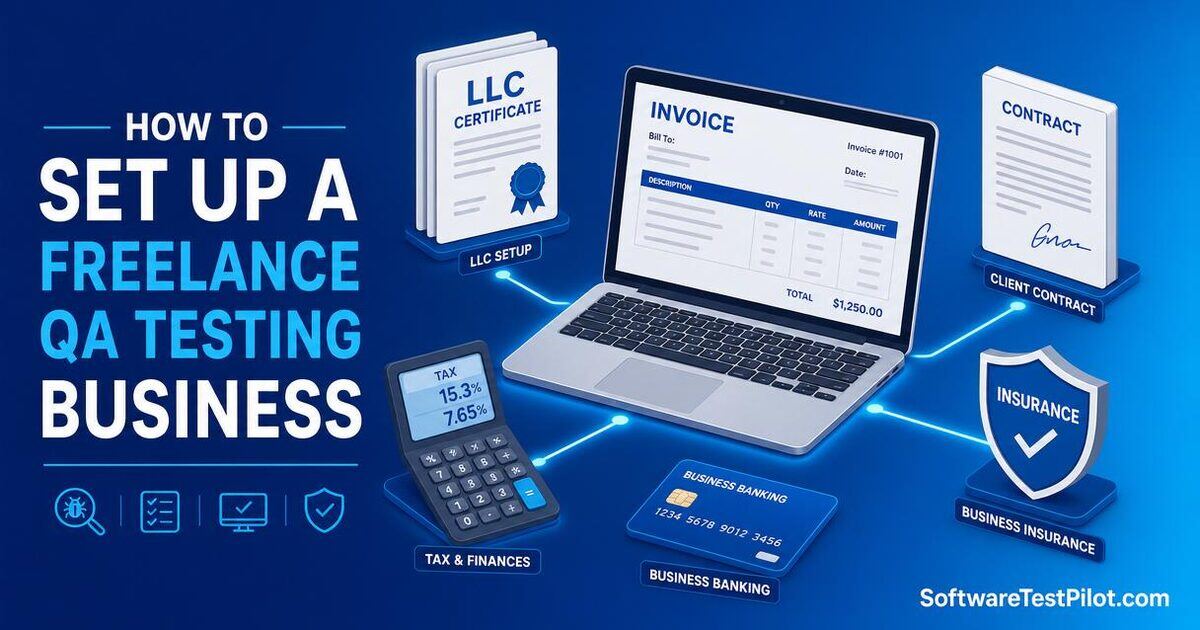
This guide walks through the operational setup — legal structure, banking, contracts, invoicing, taxes, insurance, software, and operating cadence. Pair it with our Freelancing for QA Engineers complete guide for the broader picture. Whether you're in the US, UK, EU, or India, the principles transfer.
Step 1: Decide what kind of business you actually want
Before you incorporate anything, get clear on what shape your business is going to take. There are roughly three paths, and they have very different setup requirements.
Solo freelancer. You do all the work. Income caps somewhere around $200K/year because you can only bill so many hours. Most testers start here.
Productized consultant. Fixed-scope offerings like audits, framework builds, release sign-offs. Income ceiling is higher because you can charge for outcomes rather than time. Requires real marketing effort.
Boutique agency. You hire other testers to deliver under your brand. Highest income ceiling, but it's a different kind of work — you're now managing testers, not testing. Many freelancers never want this, and that's fine.
Most testers I see start as solo freelancers and gradually add productized offerings over 18–24 months. The agency transition is a different career entirely. Pick the path that fits the kind of life you want.
Step 2: Pick a business name and brand
You have two reasonable options here, and they have different long-term implications.
Use your personal name. "Priya Sharma QA Consulting." This is the right choice if you're selling expertise — your clients are hiring you, not a brand. The downside is it's harder to sell or scale the business later.
Use a brand name. "QualityForge Labs" or something similar. Easier to scale, easier to bring in other testers eventually, sounds more like a business when you send invoices. The downside is that brand-building takes longer.
Whichever you pick, do these four things this week:
- Check
.comdomain availability (still matters in 2026 for credibility) - Check LinkedIn, GitHub, X handle availability
- Run a trademark search in your country
- Buy the domain immediately — $12 is well spent before you commit further
Step 3: Choose your legal structure
The right structure depends on your country and how much you expect to earn. Here's the practical breakdown.
United States
Sole proprietorship is the simplest. Income flows through your personal tax return. Zero setup cost. Fine to start. The downside is unlimited personal liability — if a client sues, your personal assets are on the table.
LLC (single-member) gives you liability protection while keeping pass-through taxation. Costs $50–$500 to set up depending on state. I'd recommend this once you're earning above $30K/year from freelancing.
S-Corp election (filed on top of an LLC) is a tax optimization. Once your profit clears about $80K/year, electing S-Corp lets you split income between salary and distributions, saving roughly 7–10% in self-employment tax. Talk to a CPA before doing this — it adds complexity.
C-Corp is for raising investment. You almost certainly don't need this as a freelance tester.
United Kingdom
Sole trader is the UK equivalent of sole proprietorship. Simple, self-assessment tax filing.
Limited company offers more protection and a few tax advantages. Worth considering above about £40K/year.
Umbrella company is common for inside-IR35 contracts (which a lot of UK contractors deal with). They handle the tax and payment processing for a fee.
European Union
Country-specific (Einzelunternehmer in Germany, auto-entrepreneur in France, etc.). Most EU testers start as sole traders and incorporate around €50K/year.
India
Sole proprietorship / LLP / Private Limited Company are the three main options. GST registration becomes mandatory above ₹20L turnover. Most freelance testers operate as proprietorships with a current account until they cross that threshold.
The general rule: stay simple until complexity is forced by your tax bill or liability exposure. And before you incorporate anything, hire an accountant. A good one will save you 10x their fee in the first year.
Step 4: Bank account and payment setup
Open a separate business bank account, even as a sole proprietor. This is non-negotiable. Mixing personal and business money creates tax hell at year end and makes deductions much harder to defend if you're audited.
For international payments (which you'll deal with constantly as a remote freelancer):
- Wise Business — multi-currency accounts, low FX fees. The best general-purpose tool for international freelancers.
- Mercury (US only) — startup-friendly, free, integrates with most accounting tools.
- Payoneer — common for withdrawing from Upwork or Fiverr.
- Deel / Remote.com — for clients who want to engage you as a contractor through their platform.
- Stripe — let clients pay invoices by card.
Set up at least two payment paths. Platforms have outages, and you don't want a single failed payment processor to mess up your cash flow.
Step 5: Contracts and legal templates
Never start work without a signed contract — not even for "small" projects. The smaller projects are usually the ones that end in payment disputes.
Your minimum contract pack:
- Master Services Agreement (MSA) — governs the overall client relationship
- Statement of Work (SOW) — per-project scope, deliverables, price
- NDA template — for confidential information shared during sales calls
- Independent Contractor Agreement — if you ever subcontract work to other testers
Where to get them:
- Hire a lawyer for the first MSA. Costs $300–$800 in the US, but you'll use this template for years.
- Templates from Bonsai or HoneyBook are reasonable starters if budget is tight.
- Avoid free templates from random blogs. They often miss IP assignment, liability caps, or termination terms.
Key clauses that should never be missing:
- Payment terms — Net 14 or Net 30, with late fee language
- Scope change procedure — how does the client request additional work, and how is it priced?
- IP assignment — what does the client own (the deliverables) vs. what you retain (your testing frameworks, methodologies)?
- Liability cap — typically 1x the fees paid. Without this, a single bad bug could expose you to unlimited damages.
- Termination terms — usually 30-day notice with a kill fee for fixed-price work
Step 6: Pricing and invoicing system
You need three things working together:
- A pricing page or rate card (even if internal-only — see our Freelance QA Tester Rates guide for the framework)
- Invoice templates with sequential numbering
- Time tracking for hourly work, milestone tracking for fixed-price work
Tools that work in 2026:
| Tool | Use Case | Notes |
|---|---|---|
| Harvest / Toggl | Time tracking | Both integrate with invoicing tools |
| FreshBooks / Wave / Zoho Books | Invoicing + basic accounting | Wave is free and works fine |
| Bonsai | All-in-one freelance ops | Contracts + invoicing + time tracking in one tool |
| QuickBooks (US) | Full accounting at scale | Pairs with most CPAs |
| Notion | Client CRM, SOPs | Free for solo use |
One discipline that's saved me from cash flow problems: invoice within 24 hours of work completion. Don't wait for "end of month." Slow invoicing is the single biggest cash flow killer for freelancers, and there's no good reason for it.
Step 7: Taxes (the boring part that actually matters)
Pretax discipline isn't optional. The freelancers who get into trouble are always the ones who treated taxes as a year-end problem.
- Set aside 25–35% of every invoice into a separate tax savings account. The day the money lands.
- File quarterly estimated taxes in the US (April, June, September, January).
- Track every deductible expense — home office, internet, software, courses, devices, conferences, even portions of your phone bill.
- Get a CPA or chartered accountant within your first six months.
A good accountant pays for themselves 5x over in deductions and saved penalties. Don't DIY this past year one. The hours you'd spend wrestling with tax software are worth more spent on billable work.
Deductible categories most freelancers underclaim:
- Home office (square footage method, simplified $5/sq ft method in the US)
- Software subscriptions (anything used for the business)
- Courses and certifications (yes, that OSCP prep counts)
- Hardware (the laptop, the second monitor, the test devices)
- Coworking memberships
- Health insurance premiums (in some structures)
- Retirement contributions (SEP-IRA or Solo 401(k) in the US)
Set aside two hours every month for bookkeeping. Don't let receipts pile up.
Step 8: Insurance (don't skip this)
Often skipped, occasionally catastrophic. The four insurance types every freelance QA tester should consider:
Professional liability / Errors & Omissions. Critical for QA. Covers you if a client sues over a missed bug that caused downtime or financial loss. Annual cost: $500–$1,500 for a solo freelancer.
General liability. Standard small business coverage. Covers things like a laptop stolen at a client site. $300–$700/year.
Cyber liability. Important if you handle client data, test environments, or credentials. $1,000–$3,000/year. Increasingly required by enterprise clients in 2026.
Health insurance. Country-dependent. In the US, marketplace plans plus an HSA are common for freelancers. In countries with universal healthcare, this isn't a concern — but it's the single biggest reason US testers stay in W-2 jobs longer than they should.
Total annual insurance cost for a solo QA contractor: $600–$2,000. Worth every penny.
Step 9: Software stack
A minimalist 2026 freelance QA stack:
- CRM: Notion or HubSpot (free tier)
- Time tracking: Toggl
- Invoicing: Wave (free) or FreshBooks
- Email: Google Workspace ($6/month)
- Calendar booking: Cal.com or Calendly
- Contracts/e-sign: Bonsai, HelloSign, or Docusign
- Project management: Linear, Notion, or Trello
Keep your total monthly software spend under $150 in year one. You don't need every tool. Start lean and add things only when you feel the pain of not having them.
Step 10: Your online presence
Three things you absolutely need from day one:
- A portfolio site. Doesn't need to be fancy. See How to Build a QA Testing Portfolio for Freelance Work.
- A professional LinkedIn profile. Updated headline, recent posts, clean recommendations. See our How to Build a Real QA Network guide.
- A GitHub profile with at least one public testing repo. Even manual testers should have this — it signals "I can code if needed."
Optional but powerful: a blog with SEO articles on your niche. This is the slowest-compounding investment, but it's also the one that builds real authority over 18–24 months.
Step 11: Build your sales pipeline
A freelance business with one client isn't a business — it's a job with worse benefits. Aim for:
- 3 active clients minimum
- 5 qualified leads in conversation at any time
- 20+ warm relationships in your network you check in with periodically
Channels to build over the first 6 months:
- LinkedIn outbound — 5–10 personalized messages per week to ideal clients
- Content — one article or video per week on your niche
- Community presence — the QA Network, Slack groups, Discord servers, meetups
- Referrals — every closed contract should end with "who else do you know that might need this kind of help?"
- One marketplace (Upwork, Toptal, or Arc.dev) as a backstop for slow months
For the playbook on converting projects into recurring revenue, see How to Find Long-Term QA Consulting Clients.
Step 12: Operating cadence
The freelancers who don't burn out have rhythms. Here's the weekly cadence I see actually work:
- Monday: Plan the week. Review pipeline. Send out any overdue invoices.
- Daily: Track time. Do one business development activity (outreach, post, follow-up).
- Friday: Review the week's wins. Send weekly status updates to retainer clients. Reconcile bookkeeping.
- Monthly: P&L review. Transfer tax savings. Identify one process improvement.
- Quarterly: Pricing review. Pipeline audit. Long-term planning.
Most chaos in a freelance business comes from inconsistent rhythms. Pick a day for invoicing. Pick a day for sales. Don't try to do everything every day.
First 90-days checklist
If you're starting today, here's the explicit checklist:
- Business name + domain purchased
- Legal structure formed (or registered as sole proprietor)
- Business bank account opened
- Accountant hired
- Contract templates in place
- Invoicing tool set up
- Insurance quotes gathered
- Portfolio site live
- LinkedIn updated with new positioning
- First 3 outbound outreach sequences sent
- First contract signed and invoiced
What to do this week
If you read this and feel overwhelmed, just pick the three smallest steps:
- Buy your domain. Even before you know what you're doing with it.
- Open a business bank account (yes, even as a sole proprietor).
- Find an accountant — ask other freelancers in the QA Network for recommendations.
The business infrastructure feels like overhead, but it's actually the foundation. The freelancers who skip it always pay later, usually right when they're closing their biggest contract. Get the boring stuff in place now so future you can focus on the interesting stuff.