How to Start Freelance Software Testing on Upwork in 2026 (Honest Step-by-Step Guide)
Thinking of freelancing on Upwork as a QA tester? Here's the no-fluff 2026 guide — how to pick a niche, build a profile that actually gets seen, write proposals that don't get ignored, and land your first five clients.

Last updated: June 30, 2026 · 13 min read · By Avinash K
If you're reading this, you've probably already spent an evening or two scrolling Upwork's QA listings, bouncing between excitement ("$80/hr for Playwright? Sign me up") and doubt ("there are 47 proposals already, what's the point?"). I've talked to dozens of testers going through exactly this loop, and the truth is messier than the YouTube success stories make it sound.
Yes, you can absolutely build a real freelance career on Upwork in 2026. No, it won't happen in two weeks. And the testers who quietly clear $90K–$140K a year on the platform aren't doing anything magical — they're just doing a handful of unglamorous things right while everyone else races to the bottom on price.
This guide walks you through exactly what those things are. Pair it with our Freelancing for QA Engineers complete guide and the Freelance Software Tester Rate guide once you've finished here.
Is Upwork still worth it in 2026?
Short answer: yes, but with a caveat. Upwork has changed a lot since the pandemic-era gold rush. The platform is more competitive, AI-summary filters mean copy-paste proposals get ignored, and clients have gotten savvier about pricing.
What hasn't changed is the sheer volume of work. On a typical Tuesday morning in 2026, you'll see anywhere from 300 to 600 fresh QA-related postings — everything from "we need someone to smoke test our checkout for two days" to "looking for a fractional QA lead to own our release process." That kind of variety simply doesn't exist on smaller curated platforms.
The other thing Upwork still does well is reduce risk. The escrow system, the dispute process, the milestone-based payments — none of it is perfect, but compared to chasing invoices from a stranger you met on LinkedIn, it's a relief. For your first three or four clients, that protection alone is worth the platform fee.
So if you're starting from scratch and don't already have a network, Upwork is still the fastest way to get from "I think I could freelance" to "I have my first paid contract." Just go in with realistic expectations.
Step 1: Don't skip the niche decision
This is the part most people rush, and it's the single biggest reason new freelancers struggle. If your profile says "QA Tester | Manual Testing | Automation | API | Mobile | Performance | Selenium | Cypress | Postman | JMeter," the algorithm has no idea what kind of jobs to show you, and clients have no idea what you actually do. You'll get matched to everything, which means you get hired for nothing.
Pick one thing. Here's roughly what each niche pays in 2026, based on what I've seen testers actually closing on the platform:
| Niche | Avg. 2026 hourly rate | Demand level |
|---|---|---|
| Mobile app testing (iOS/Android) | $35–$70 | High |
| API & backend testing | $45–$90 | Very High |
| Test automation (Playwright, Cypress, Selenium) | $50–$110 | Very High |
| Performance testing (k6, JMeter, Gatling) | $60–$120 | High |
| Security testing | $70–$150 | Very High |
| AI / LLM application testing | $65–$130 | Exploding |
| Accessibility (WCAG 2.2/3.0) testing | $50–$95 | Growing |
If you're genuinely torn, here's a quick test. Look at your last six months of work — the bugs you found, the tools you used, the conversations you had with developers. What kept coming up? That's your starting niche. You can always pivot later, but pick something today.
One niche worth flagging: AI and LLM testing. If you've spent even a few weekends learning Promptfoo or DeepEval and understand things like prompt regression and hallucination evals, you're in a tiny pool of qualified testers. Demand is wildly outpacing supply. Our AI in Software Testing guide is a solid starting point if this is new to you.
For a deeper dive into rates by region and skill, the Freelance Software Tester Rate guide has the full breakdown.
Step 2: Build a profile that actually gets seen
Your profile is doing two jobs at once. It needs to rank in Upwork's search results when clients search "Playwright automation" or "API tester," and it needs to convince a human to message you instead of the 30 other testers who showed up.
Let's start with the title. The formula that works in 2026:
[Niche] QA Engineer | [Primary Tool], [Secondary Tool] | [Specific Outcome]So instead of "Senior QA Engineer with 8 years experience," you'd write something like "Mobile QA Engineer | Appium, XCUITest | Cut Release Bugs by 60%."
The first version is generic. The second is searchable, specific, and gives a hiring manager a reason to click. Tiny change, big difference in click-through.
For your overview, the first 280 characters are what shows up in search previews — treat them like a tweet. Lead with the value you create, drop one or two concrete proof points with numbers, then ease into the longer story. Don't open with "Hello! I am a passionate QA engineer who loves quality." Nobody finishes that sentence.
You'll also need 3 to 6 portfolio items, even if you've never done a single Upwork job. This is the part where most beginners get stuck — "I have no client work to show." Doesn't matter. Pick a public app, treat it like a client, and build the artifacts:
- A sample test plan in PDF format (one I keep recommending: write one for the Notion app or a public banking app's login flow)
- A bug report with screenshots, console logs, and network HAR file attached
- A GitHub repo with a small Playwright suite or Cypress example
- A short Loom walkthrough of how you'd approach exploratory testing on an unknown app
- A Postman collection for a public API like Stripe or GitHub
Once your profile is up, run the underlying resume through our Resume ATS Review to make sure your keyword game matches what Upwork's algorithm and client searches expect.
Step 3: Pass the Upwork certifications (they actually matter now)
In late 2024, Upwork started giving real search-ranking weight to its Certified Talent badges. By 2026, they're table stakes for serious QA freelancers. The ones to grab first:
- Manual Testing Fundamentals
- Test Automation Basics
- API Testing with Postman
- Whatever specialty cert maps to your niche
Each takes around an hour or two. None of them will teach you anything you don't already know if you're an experienced tester, but they nudge you up the search ranking. Worth the morning.
If your fundamentals feel rusty, our Selenium Interview Questions, API Testing Interview Questions, and SQL Interview Questions pages are good warm-ups before you take the certification quizzes.
Step 4: Pricing without selling yourself short
I've watched too many qualified testers land their first Upwork job at $12/hour because they were nervous about being rejected. Don't do this. The clients who hire at $12/hour are also the ones who leave one-star reviews, ghost you on payment, and treat you like a vending machine.
Here's a realistic glide path that actually works:
- First 3 jobs: Price 25–30% below your target rate. Goal here is reviews, not income.
- After 5+ five-star reviews: Move to your target rate. Existing clients stay at the old rate; new ones pay the new one.
- After Top Rated badge: Bump rate another 15–25%.
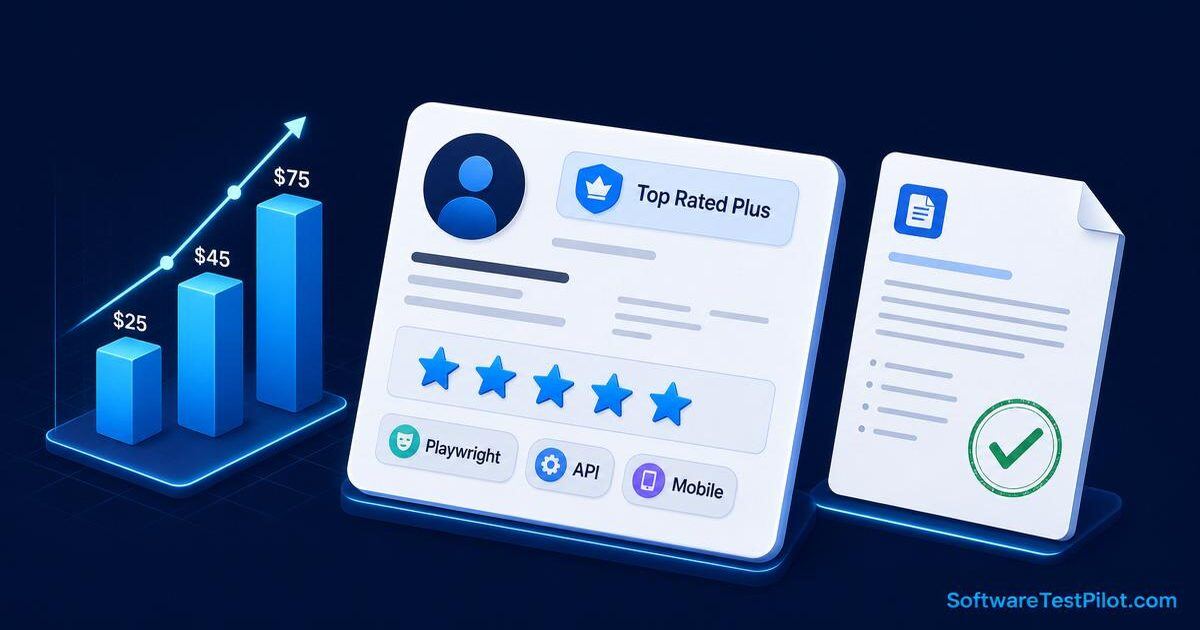
For a mid-level tester in 2026, this typically looks like $25/hr → $45/hr → $65/hr over about nine months. Not overnight, but steady.
The full pricing logic, including niche multipliers and a formula you can plug your own numbers into, lives in our Freelance QA Tester Rates guide.
Step 5: Writing proposals that don't get filtered out
This is where most beginners lose. In 2026, most Upwork clients run incoming proposals through an AI summarizer that surfaces the top three or four for human review. If your proposal reads like a template, the summary will reflect that, and you'll be silently filtered out.
The seven-line structure that's been working:
- A specific hook that proves you actually read the job post
- One proof story with a real number in it
- Your proposed first concrete step
- One smart clarifying question
- Logistics — rate, availability, timezone
- Soft CTA
- Sign-off
Here's a real example of a proposal that won a Cypress automation gig recently:
Hi Marcus — your post mentions flaky checkout tests in your existing Cypress suite. That's almost always either retry logic or test data isolation, and both are quick to diagnose.
I stabilized a 240-test Cypress suite for a fintech client last quarter and dropped flakiness from 18% to under 2% in two weeks.
First step I'd propose: a 90-minute audit of your spec files and CI logs. I'd ship a written report with the top 5 root causes and a fix priority list.
Quick question — are these tests running in parallel in CI, or sequentially?
Rate: $75/hr. Available to start this week, EST hours.
Happy to share the audit report from my fintech project on a 15-minute call.
— Priya
That's 130 words. It mentions the client's exact pain, proves with a number, proposes a small first step, shows curiosity, and respects their time. Nothing about "passion for quality" or "8 years of experience."
For more proposal templates by job type — automation, API, mobile, performance — see How to Write a Winning QA Proposal on Fiverr & Upwork.
Step 6: Using Connects without wasting them
Upwork's Connects system in 2026 charges between 4 and 16 Connects per bid, depending on how competitive the job looks. New freelancers blow through their monthly allowance in a week by bidding on everything.
The discipline that pays off:
- Only bid on jobs posted less than 6 hours ago with fewer than 10 proposals. The closer you are to the top of the stack, the better your odds.
- Skip jobs where the client has "no hires" and "low budget" tagged. They're tire-kicking.
- Save Boosted Proposals (which cost extra Connects) for jobs over $1,500 in scope. Below that threshold, boosting doesn't move the needle.
A focused freelancer can typically spend under 80 Connects a week and still land one or two contracts.
Step 7: Turning first clients into repeat work
This is the part that separates testers who grind and testers who build a business. Most beginners chase shiny new clients. The ones quietly earning $8K–$12K a month on Upwork get 60–70% of their revenue from repeat work.
After every contract, do three things:
- Send a closeout report — one page, plain English, summarizing what you tested, what you found, and what's still at risk going forward.
- Suggest a logical next engagement — a monthly regression retainer, an automation buildout, a release sign-off retainer.
- Ask for the review and the referral in the same message — most clients are happy to give both if you make it easy.
For the long-game version of this — moving from one-off Upwork contracts to retainer-based consulting — see How to Find Long-Term QA Consulting Clients.
Mistakes I see over and over
A few patterns that come up almost every time I review a new freelancer's profile:
- Copy-paste proposals. The AI summarizers in 2026 catch these reliably. You'll see your reply rate fall off a cliff.
- Skill stuffing. Listing 25 skills used to help with search. Now it hurts you. Pick eight you can defend in a 30-minute live conversation.
- Ignoring the Job Success Score. One bad client can drag your JSS down 8 to 12 points and tank a whole month of work. Be more selective than you think you need to be.
- No video intro. Profiles with a 60-second Loom or Upwork video intro convert two to three times better. It takes 20 minutes.
- Pricing fixed when you should price hourly. For new freelancers, fixed-price jobs are scope-creep traps. Stick to hourly until you've built scoping muscles.
A realistic 90-day roadmap
If you want a week-by-week version of the plan:
| Week | Focus |
|---|---|
| 1 | Niche selection, profile, portfolio assets |
| 2 | Certifications, first 20 proposals |
| 3–4 | First contract (small, fixed-price ideally under $500 just to break the seal) |
| 5–8 | 3–5 contracts, building reviews |
| 9–12 | Raise rate, pitch retainers, apply for Rising Talent badge |
Most clients in 2026 also run a 30-minute live screening call before signing. Practice them in advance with our AI Mock Interview — same kind of questions, same time pressure.
What to do this week
If you take nothing else from this guide, do these four things in the next seven days:
- Pick a single niche and rewrite your Upwork title to match it.
- Build two portfolio artifacts (test plan + GitHub repo) and link them in your profile.
- Send 10 proposals using the 7-line structure above. Track which ones reply.
- Join the QA Network and ask other freelancers to review your profile before you go further.
Freelancing is a slow build. The testers I see succeed treat the first 90 days as setup and the next nine months as compounding. By month 12, you'll either know it's working or you'll have a clearer sense of why it isn't — and both of those are valuable data. Browse live QA contracts on QA Jobs Radar while you build.