
Freelancing vs. Full-Time QA: An Honest Comparison for 2026
Should you stay full-time or go freelance as a QA engineer in 2026? An honest, numbers-backed comparison covering pay, stress, growth, and risk.

Last updated: June 30, 2026 · 15 min read · By SoftwareTestPilot
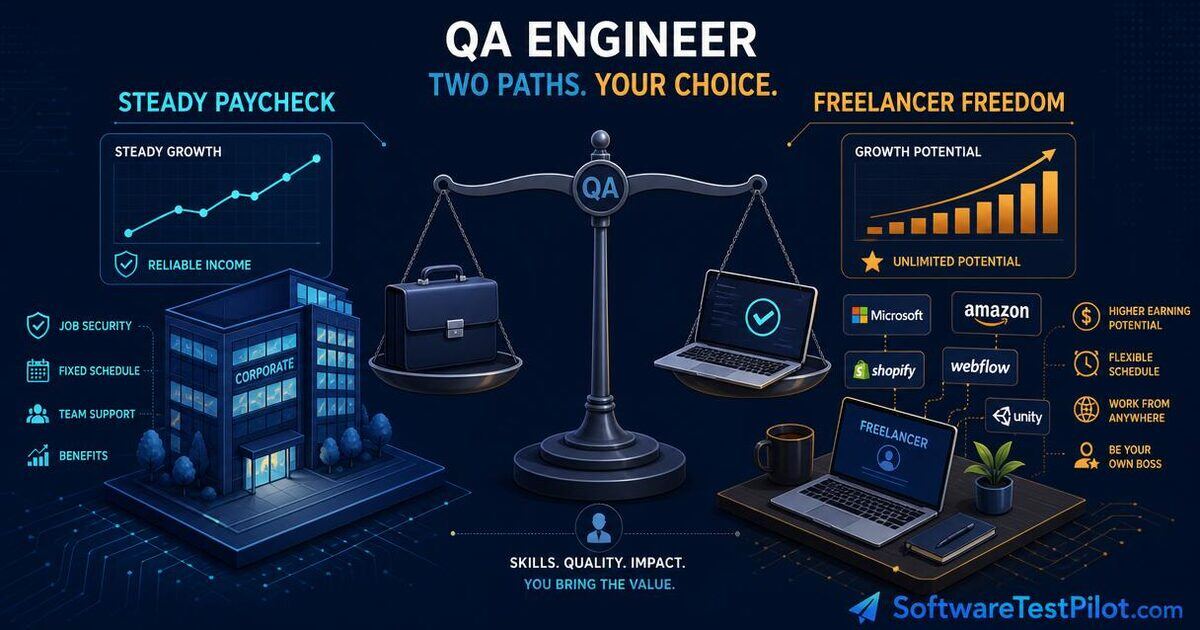
Every QA engineer eventually asks the same question: should I go freelance, or stay on payroll? Most answers fall into one of two camps — freelance evangelism ("be your own boss, set your own hours") or salaried defensiveness ("benefits, stability, no taxes to file"). Both miss the nuance, and both leave you no better equipped to actually decide.
I've coached testers in both directions — full-timers who went freelance and never looked back, and freelancers who happily returned to payroll after two years. The honest answer is that the right path depends on a handful of personal variables, and the math is almost never what you'd expect on the surface.
This guide is the realistic, numbers-backed comparison for 2026. Pair it with the QA Engineer Salary Guide and the Freelancing for QA Engineers complete guide.
The headline: both can work, both can fail
There's no objectively correct answer here. The right path depends on:
- Your career stage and current skill depth — see SDET Career Roadmap
- Your risk tolerance, not in theory but in practice (how do you sleep during a quiet month?)
- Your geography — taxes, healthcare, and cost of living radically change the math
- Your financial obligations — mortgage, kids, dependents, debt
- Your personality — specifically, your tolerance for selling and self-promotion
There are good fits and bad fits, not winners and losers. The mistake is assuming one path is objectively superior.
The money comparison (realistic 2026 numbers)
Three scenarios for a mid-senior QA engineer. All numbers in US dollars; adjust regionally using our Freelance Software Tester Rate guide.
Scenario A: Full-Time SDET at a Mid-Sized Tech Company
- Base salary: $130,000
- Bonus + equity (expected value): $20,000
- Benefits (healthcare, 401k match, PTO, etc.): ~$25,000 value
- Total comp: ~$175,000
- Actual take-home after federal + state tax: ~$98,000
Scenario B: Freelancer With Marketplace Gigs (Upwork + Fiverr)
- Gross: $130,000 (40 weeks × 30 billable hours × $108 avg rate)
- Platform fees: -$15,000
- Self-employment tax + income tax: -$33,000
- Health insurance (individual, self-paid): -$8,000
- Software + tools + subscriptions: -$3,000
- Net take-home: ~$71,000
Scenario C: Freelance Consultant With 3 Long-Term Retainers
- Gross: $220,000
- Taxes + self-employment: -$58,000
- Health insurance + retirement contributions: -$15,000
- Business expenses (accountant, software, travel): -$8,000
- Net take-home: ~$139,000
The lesson nobody wants to say out loud: marketplace freelancing barely beats full-time once you factor in benefits and self-paid healthcare. Long-term consulting beats full-time by a lot — but most freelancers never make it there. The freelancers I've seen quit and return to payroll were almost all stuck at Scenario B, grinding marketplace work without ever making the jump to retainer-based consulting.
The path from B to C is laid out in How to Find Long-Term QA Consulting Clients. It's not optional — it's the whole game.
Beyond money: what you're really choosing between
Even when the money lines up, the shape of the two careers is very different.
Stability vs. autonomy
Full-time: Paycheck every two weeks regardless of your mood, the market, or whether you got food poisoning last weekend. The psychological benefit is enormous and usually underestimated.
Freelance: You decide when, on what, with whom. Also enormous — but the cognitive load is real. Every Sunday night you're at least lightly thinking about pipeline.
Career progression
Full-time: Title trajectory matters. Junior SDET → Senior → Staff → Principal opens director and VP roles freelancers can't easily get back on. See the SDET Career Roadmap.
Freelance: "Progression" means rate increases, deeper specialization, and bigger client logos. A real ladder, just a different one — and it doesn't translate to a Director title on LinkedIn.
Skill development
Full-time: Deep mastery of one codebase, one stack, one product. T-shaped expertise that goes very deep in one direction.
Freelance: Wide exposure across many products, stacks, and team cultures. Comb-shaped expertise — multiple shorter teeth instead of one deep one.
Stress profile
Full-time stress: Politics, reorgs, layoffs, performance reviews, on-call rotations, the boss you didn't choose.
Freelance stress: Pipeline anxiety, late payments, taxes, scope creep, no PTO, nobody to back you up when you're sick.
Roughly equal stress when measured by anxiety meds prescribed — but it manifests differently. Freelance stress is spikier; full-time stress is steadier and more political.
The tax reality in 2026
This is often the deciding factor, especially in the US.
Full-time
- Taxes withheld automatically
- One annual filing, usually 90 minutes with TurboTax
- Limited deductions (retirement, HSA, charitable)
- Generally simple — for most people, truly painless
Freelance
- Quarterly estimated taxes (US)
- Higher effective rate due to self-employment tax (~15.3% in the US, on top of income tax)
- A wide universe of deductions: home office, internet, software, courses, travel, equipment, even part of your phone bill
- You need an accountant — budget $800–$2,500/year — and it's worth every penny
The deductions are real and meaningful, but they don't fully offset the self-employment tax burden. Anyone telling you "freelance taxes are basically the same" hasn't done quarterly filings. Full operational setup in our Freelancing for QA Engineers guide.
Benefits: the hidden six figures
This is the part new freelancers chronically underestimate, and it's usually what surprises them most by month nine.
| Benefit | Annual Value (US, mid-senior) |
|---|---|
| Healthcare (family) | $14,000–$22,000 |
| 401k match (5%) | $6,000–$10,000 |
| PTO (3 weeks) | $7,500 |
| Sick leave | $2,000 |
| Disability + life insurance | $2,000 |
| Stock / RSUs | $10,000–$50,000+ |
| Learning budget | $2,000 |
Total non-salary benefits often range $40,000–$90,000 per year.
Freelancers must self-fund all of this out of the same hourly rate that's already paying their rent. A six-figure freelance rate isn't equivalent to a six-figure full-time salary — it's roughly equivalent to a $70–80K salary in real take-home, unless you're at the higher rate ranges. Cross-check with our QA Engineer Salary Guide and QA vs Developer Salary comparison.
Lifestyle differences you don't read about
Freelance reality
- Work from anywhere (true)
- Take Wednesday off (true, if cash flow is planned)
- Choose your clients (eventually — usually 18+ months in)
- Loneliness is a real factor that nobody warns you about — counter it with the QA Network and peer Slack groups
- Most freelancers work more total hours than full-time employees, especially in the first two years
Full-time reality
- Predictable structure can be liberating, not constraining
- Team culture and friendships matter more than people admit
- Career capital (titles, references, FAANG logos) compounds over time
- 30%+ of your time goes to non-work-work (meetings, planning, politics, performance review prep)
Freelance trades structure for autonomy. Both have a real psychological cost. Pick the one whose cost you can pay without resenting it.
Risk profile
Full-time risks
- Layoffs — extremely real in the 2024–2026 tech market
- Stack obsolescence ("we're sunsetting the QA team and using AI tools")
- Stagnant skills if you stay too long in one place
- Single point of failure: one employer, one income stream
Freelance risks
- Client concentration (one client representing 60%+ of revenue is dangerous)
- Platform deplatforming (an Upwork ban can cut your income overnight)
- Economic downturns hit consulting first
- Burnout from sales and delivery being the same person
Smart freelancers diversify clients. Smart full-timers diversify with side projects, dividend portfolios, and side consulting — see Building Passive Income as a QA Engineer. Single points of failure are the enemy either way.
Who should go freelance
You're a good candidate if:
- You have 5+ years of QA experience under your belt
- You have a niche skill (automation architecture, AI testing, security, performance) — see Freelance API Tester Skills and Building a Niche Security Testing Freelance Practice
- You can tolerate income variance without it wrecking your sleep
- You have 6+ months of expenses saved
- You're comfortable selling and self-promoting — or willing to learn
- You have at least one warm lead before quitting your full-time job
You're not a good candidate (yet) if:
- You hate selling, marketing, or networking
- You're under 3 years of experience — build deeper craft first
- You have no savings
- Your spouse or partner won't tolerate income variance
- You hate writing — freelance is mostly writing (proposals, reports, content, contracts)
If you're a "not yet," that's fine. Most successful freelancers spent two to four years deliberately preparing before they quit.
Who should stay full-time
Stay full-time if:
- You're in a high-equity stage at a growing company with real upside
- You're climbing into management and enjoying it
- Your benefits are exceptional (FAANG-tier packages are hard to match as a freelancer)
- You hate operations — taxes, invoicing, contracts make you genuinely miserable
- You value team and craft over income optimization
- You don't yet have the network to support freelance work
Full-time is not a failure mode. The best full-time SDETs in 2026 are making $250–$400K/year with benefits — better than most marketplace freelancers ever achieve. See QA Engineer vs Software Developer Salary and live roles on the QA Jobs Radar.
The hybrid strategy: side consulting
Many of the smartest QA careers in 2026 look like this:
- Full-time SDET or QA Lead during business hours
- 5–10 hours/week of advisory consulting on the side
- Slowly building a personal brand and client list over 12–24 months
- Eventually converting to full-time freelance with 2–3 retainers already lined up
This de-risks the transition almost completely. Instead of jumping from $150K salary to $0 revenue and hoping, you jump to $5–8K/month already in hand. Check your employment contract for moonlighting and non-compete clauses before doing this — and stay scrupulously honest about which hours you owe to which employer. Pricing playbook in Freelance QA Tester Rates: How Much to Charge.
A decision framework
Answer these five questions honestly, without negotiating with yourself:
- Do I have a niche skill the market is paying a premium for right now?
- Do I have 6+ months of expenses saved in liquid cash?
- Do I genuinely enjoy sales conversations and writing?
- Can I land one freelance client while still employed?
- Am I willing to spend 30% of my time on non-billable activities — sales, ops, content, admin?
If "yes" to all five, you're ready to test freelance. Start the side-consulting hybrid path and reassess in six months. If "no" to two or more, build the missing pieces first. Don't quit until the missing pieces are filled.
What to do this week
Regardless of which direction you're leaning, here are the moves that compound either way:
- Read the Freelancing for QA Engineers complete guide for the full freelance picture
- Anchor your full-time salary expectations with the QA Salary Guide
- Score your resume in the Resume ATS Review — useful for both paths
- Practice interviews with our AI Mock Interview
- Track full-time market signal on the QA Jobs Radar
- Practice technical depth with our Selenium Interview Questions, API Testing Interview Questions, and SQL Interview Questions
The single best investment you can make either way: get your fundamentals sharp. Both freelance and full-time markets reward technical depth far more than path-switching.