
Claude Code Testing in 2026: The Complete SDET Playbook (Agentic Test Generation, Coverage Sprints, Flake Triage & FAQ)
The definitive 2026 guide to Claude Code for testing — Anthropic's agentic CLI for unit + integration + E2E test generation, coverage sprints, mutation testing, flake triage, review rubric and every People Also Ask question Google surfaces.

Last updated: July 14, 2026 · 14 min read · By SoftwareTestPilot
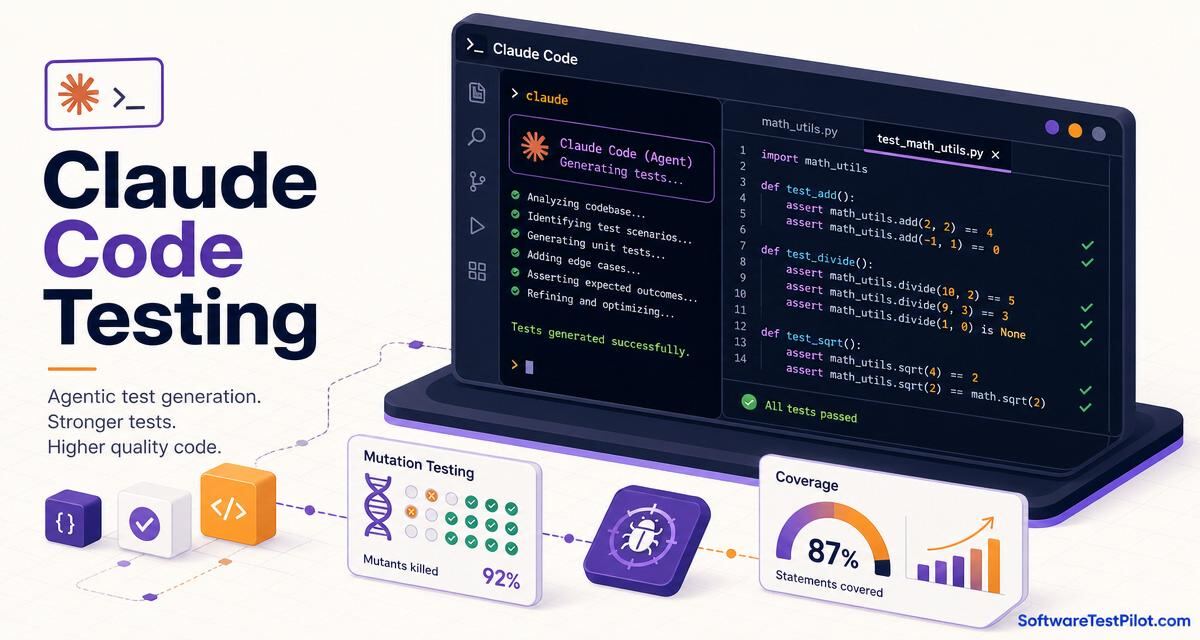
Claude Code testing is the practice of driving Claude Code — Anthropic's agentic CLI (2026, powered by Sonnet 4.5 and Opus 4.5) — to plan, generate, run and iterate on tests directly inside a repository. Unlike a chat sidebar, Claude Code executes tools (bash, edit, git, npm/pnpm, vitest/pytest/playwright) under a human-approved plan and closes the loop from goal → diff → test run → iteration. Measured on 2026 teams, Claude Code moves branch coverage 15–25 points in a focused sprint, cuts flake rate 30–50% with a "no sleeps" prompt, and produces mutation-score-hardened test suites that catch boundary flips, sign flips and empty-collection short-circuits.
This pillar is the SDET's canonical reference before pointing Claude Code at a real repo. Pair with Claude for test automation, Claude for software testing, GitHub Copilot for testing and Copilot unit tests.
Key takeaways
- Claude Code is agentic — it edits, runs and re-runs tests. Give it goals, not step-by-step instructions.
- Always run on a feature branch with a plan-approval step. Never point it at main.
- Frame goals as coverage-delta or mutation-score targets, not test counts.
- Ban
sleep,Thread.sleep,page.waitForTimeoutin the CLAUDE.md so every generated test is deterministic.- Every Claude Code PR carries: coverage delta, mutation-score delta, flake budget, human sign-off.
1. What Claude Code actually is
Claude Code is a terminal-first agentic CLI from Anthropic. It reads and edits files, runs commands, uses git, and iterates on failures — all under a plan you approve before it executes. See the official Claude Code docs. For testing it maps to four workflows:
- Coverage sprints — "lift branch coverage above 80% in src/checkout without touching production code".
- Flake triage — "make tests/e2e/login.spec.ts deterministic; the current pass rate is 19/20".
- Mutation-score lifting — "run Stryker; add assertions that kill the surviving mutants in src/pricing".
- Migration — "migrate the Jest suite to Vitest; keep behaviour identical; open one PR per module".
2. Setup and the CLAUDE.md file
Install per the docs (npm i -g @anthropic-ai/claude-code or the pinned installer). Authenticate with your Anthropic API key. Then add a CLAUDE.md to the repo root — it is the persistent context Claude Code reads on every session. A minimal SDET CLAUDE.md:
# CLAUDE.md — repo conventions for Claude Code

## Frameworks
- Unit: Vitest (not Jest)
- E2E: Playwright TypeScript, getByRole locators only
- API: supertest + Zod schema validation

## Test rules (non-negotiable)
- No sleep(), Thread.sleep, page.waitForTimeout — deterministic waits only
- Every test: Arrange / Act / Assert, one assertion cluster
- Every test must fail once (comment out impl) before it passes
- No real PII — use user{N}@example.com, Stripe test card 4242 4242 4242 4242

## Coverage
- Target: 85% branch on new code
- Enforce via vitest --coverage and codecov delta

## PR conventions
- One module per PR
- PR body: coverage delta, mutation score delta, flake budget
Everything in CLAUDE.md is applied to every prompt. Update it as conventions evolve.
3. Four canonical Claude Code workflows
Workflow 1 — coverage sprint
$ claude
> Lift branch coverage in src/checkout above 80% without touching
  production code. Use Vitest. Run coverage after each file. Open one
  PR per module. Do not exceed 2 hours of wall clock.
Workflow 2 — flake triage
> tests/e2e/login.spec.ts fails 1 in 20 CI runs. Read the last 5 trace
  files under playwright-report/. Identify the race. Rewrite
  deterministically. No waitForTimeout, no retry loops around assertions.
  Prove it with 20 consecutive local runs.
Workflow 3 — mutation-score lift
> Run Stryker on src/pricing. For each surviving mutant, add exactly
  one assertion that kills it. Do not delete or weaken existing
  assertions. Report before/after mutation score.
Workflow 4 — framework migration
> Migrate the Jest suite under src/services/** to Vitest. Behaviour
  must be identical. Keep test names, snapshots and fixtures. Open one
  PR per top-level folder. Run the full suite after each PR.
4. The 7-point rubric for Claude Code PRs
- Deterministic — no sleeps, no
Date.now()without a clock, no network without a mock. - One reason to fail — a single assertion cluster; failure points to one behaviour.
- Failed first — the PR includes evidence the test failed once before it passed (comment-out or mutation).
- Edge cases named — null, empty, boundary, unicode, timezone covered.
- Mutation-hardened — assertions catch boundary flips, sign flips, boolean negation, empty-collection short-circuits.
- Coverage delta measured — LCOV before/after in the PR body; branch coverage moved up.
- No leaked secrets — no real emails, tokens, PANs.
Two or more failures → send Claude Code back with a tighter prompt; do not review-edit line-by-line.
5. Guardrails — running Claude Code safely
- Feature branch only — never point it at main / trunk.
- Plan-approval on — Claude Code shows the plan before executing tools; approve step by step.
- Allowed tools scoped — bash + edit + git + package manager. Deny arbitrary network egress except to registries.
- Secrets out —
.envin.gitignore; use a secret-scan pre-commit hook (gitleaks, trufflehog). - Wall-clock budget — always cap sessions ("do not exceed 2 hours"). Agentic loops without a budget burn tokens.
- Human-in-the-loop merge — every PR gets a normal human review. Never enable auto-merge on Claude Code branches.
6. Governance, PII and IP
Claude in 2026 ships in three surfaces relevant to QA — claude.ai (chat), the Anthropic API + Console, and Claude Code (agentic CLI). All three respect the Anthropic commercial terms: Team / Enterprise plans and API traffic are not used to train models. Practical governance rules:
- Use Claude for Work (Team / Enterprise) or the API — not the free consumer plan — for anything touching customer data.
- Never paste raw production data, HAR files, JWTs, PANs or customer PII. Redact with the rules from the ChatGPT bug report pillar.
- Prefer the API with an audit log; keep prompts and outputs in a QA prompt library under version control.
- Map governance to the NIST AI RMF and the EU AI Act for regulated products.
- Add an "AI attribution" section to your PR / test plan template; a human SDET signs off before merge.
7. ROI — what Claude Code saves on test work
Annual ROI = (Coverage sprints × delta × escape-defects avoided × incident cost)
           + (Flaky-test hours reclaimed × loaded engineering cost)
           + (Framework-migration weeks saved × loaded SDET cost)
           − (API tokens for Claude Code — Sonnet + Opus)
           − (Review overhead: ~15% of "time saved")
Honest 2026 ranges: a 2-week coverage sprint driven by Claude Code moves branch coverage 15–25 points on legacy modules. Flake triage cuts pass-rate variance 30–50%. A Jest→Vitest migration that would take an SDET a full month lands in 3–5 days of Claude Code sessions plus review. Token cost per PR: typically $2–$8; a full coverage sprint costs $50–$200 in API usage.
8. Claude Code vs Copilot Agent Mode vs Cursor
- Claude Code — terminal-first, strongest at long agentic loops, best CLAUDE.md convention support. Ideal for coverage sprints and migrations.
- GitHub Copilot Agent Mode — editor-first (VS Code, JetBrains), tighter integration with the PR workflow, weaker on very long loops. Ideal for in-editor test authoring.
- Cursor / other IDE agents — editor-first with model-choice flexibility. Ideal when a team has already standardised on Cursor.
Most 2026 SDET teams run Claude Code for planned sprints (coverage, migrations, flake triage) and Copilot Agent Mode for daily in-editor work. See the Copilot for testing pillar.
9. What Claude Code means for SDET careers
SDETs who can drive Claude Code to lift coverage and kill flakes without shipping tautologies are the ones dev leads keep on the roadmap. See the QA salary guide, the SDET career roadmap, the AI mock interview, the free ATS resume review and live roles on the QA Jobs Radar.