
LLM Code Review & Bug Detection in 2026: Prompts, PR Bots, Static Analysis & FAQ
The 2026 playbook for LLM code review and bug detection — how to wire ChatGPT, Claude, Gemini and Copilot into PRs to catch bugs, security issues and design smells before humans. RCTF prompts, review rubric, false-positive control and every PAA FAQ.

Last updated: July 15, 2026 · 14 min read · By SoftwareTestPilot
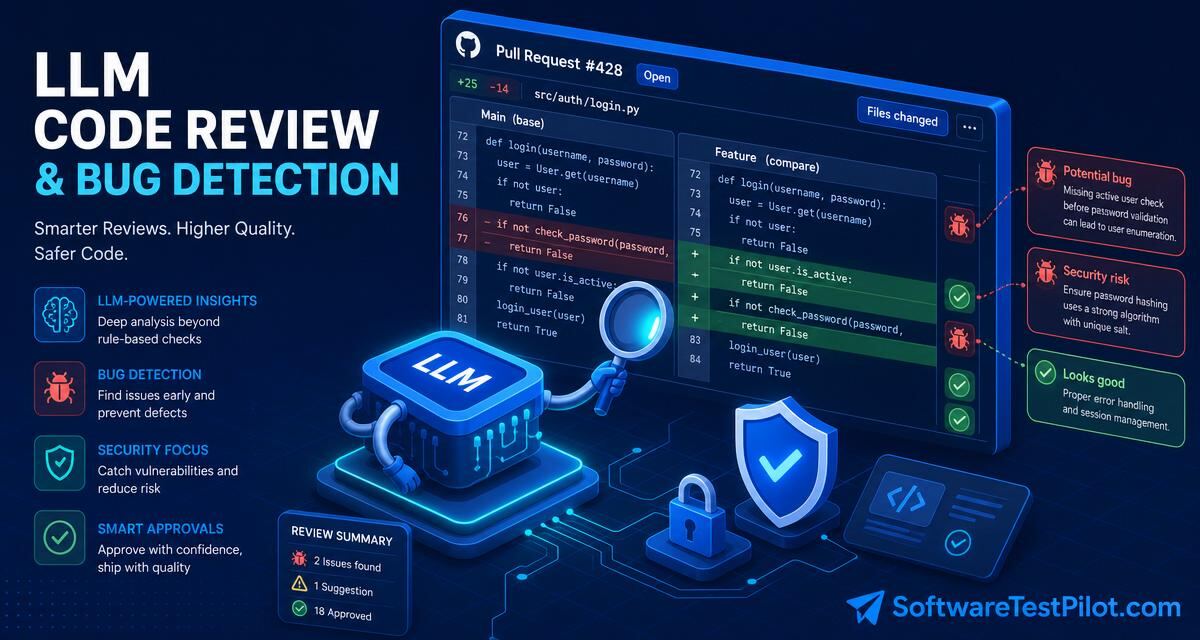
LLM code review is using a large language model as the first reviewer on every pull request — reading the diff, the touched files, the tests and (increasingly) the runtime traces to flag bugs, security issues, design smells and missing tests before a human ever opens the PR. In 2026 this is standard practice at every serious engineering org, but done badly it drowns reviewers in noise and hides the real problems.
This pillar consolidates "LLM code review", "AI bug detection", "AI PR review", "AI code smell detection" and "LLM static analysis". Pair with generative AI unit testing and GitHub Copilot for testing.
Key takeaways
- LLM review augments static analysis — it does not replace ESLint, SonarQube, Semgrep or CodeQL.
- Ground every review in the diff plus the changed files, not the diff alone.
- Enforce a strict output schema: severity, category, file, line, why, suggested fix.
- Suppress low-signal comments (style, formatting) — those are linter territory.
- Track false-positive rate per model per repo. If it exceeds 25%, retighten the prompt.
1. What LLM code review is good at (and bad at)
Good at: spotting missing null/undefined guards, off-by-one boundaries, unhandled promise rejections, missing error paths, obvious security anti-patterns (SQL injection, XSS, insecure JWT handling), missing tests for new branches, unclear variable names, dead code, race conditions in obvious shapes.
Bad at: business-logic correctness (it does not know your product), architectural fit (it does not know your service map), performance at scale (it cannot benchmark), anything that requires reading beyond the model's context window.
The right stack: Semgrep or CodeQL for security rules, ESLint/Ruff/Detekt for style, unit + mutation tests for correctness, LLM as the last layer to catch what rules cannot express.
2. RCTF prompt framework
- Role — "You are a senior SDET / ISTQB-Advanced test analyst. Prioritise risk coverage, boundary values and clarity for a QA lead reviewer."
- Context — paste the requirement, user story, OpenAPI spec, page object or stack trace, plus framework + version and the compliance regime (SOC 2, HIPAA, GDPR, EU AI Act) and coverage target.
- Task — one specific artefact: "Generate 15 test cases", "Draft an IEEE 829 test plan section 4", "Write a Playwright E2E for AC-14 with an @axe accessibility check".
- Format — the exact output shape: markdown table, JSON schema, Gherkin, Vitest .test.ts. End with a rubric self-critique.
3. Prompts for PR review, security scan and test-gap detection
Prompt 1 — Bug-focused PR review
Role: staff engineer reviewing a PR. Focus on correctness bugs and
security. Ignore style — the linter handles it.
Context: [paste diff + changed files + PR description + issue link].
Task: return every likely bug with severity (P0-P3), category (null,
boundary, race, auth, injection, missing-test, error-handling), file,
line, one-line "why", suggested minimal fix.
Format: JSON array of comment objects. If no issues, return [].
Prompt 2 — Security-focused pass
Role: application security engineer. OWASP Top 10 + OWASP API Top 10.
Context: [paste changed files, focus on auth/authz, input validation,
crypto, secrets, dependency changes].
Task: flag any security issue, cite CWE/OWASP category, propose remediation.
Format: same JSON schema as Prompt 1.
Prompt 3 — Test-gap detector
Role: SDET reviewing test coverage for a PR.
Context: [diff + existing test files].
Task: list every new branch, error path or public method that lacks a test.
For each, suggest the test name and one-line intent.
Format: JSON array {file, line, missingTestName, intent}.
Prompt 4 — Explain-this-diff (for reviewer onboarding)
Role: senior engineer summarising a PR for a busy reviewer.
Context: [diff + PR description].
Task: 5-bullet summary — what changed, why, risk, test coverage,
one question you'd ask the author.
Format: markdown bullets, < 120 words total.
4. Review-quality rubric (measure the bot, not just the code)
- Grounded — every comment references a real line in the diff.
- Actionable — includes a concrete fix, not "consider improving".
- Severity-correct — P0/P1 only for real bugs or security; not style.
- De-duplicated — same issue flagged once, not per-line.
- False-positive rate ≤ 25% — measured weekly from reviewer accept/dismiss.
- Recall on planted bugs ≥ 80% — seed known bugs quarterly to validate.
- No hallucinated APIs — every referenced function/type exists in the codebase.
5. Tools that ship LLM code review in 2026
| Tool | Best for | Free tier |
|---|---|---|
| GitHub Copilot code review | Native PR reviews inside GitHub | Included with Copilot Business/Enterprise |
| CodeRabbit | PR summaries + line comments | Free for OSS |
| Graphite Reviewer | Stacked PRs + AI review | Free tier |
| Qodo Merge (ex CodiumAI) | Deep test-gap analysis | Free tier |
| Cursor Bugbot | In-editor + PR bug scanning | Paid |
| Semgrep Assistant | Semgrep rules + LLM triage | Free for OSS |
6. Governance and IP safety
Any LLM workflow that touches product code or customer data must run under governance:
- Enterprise LLM APIs (OpenAI, Anthropic, Google, Azure OpenAI) with a no-training / zero-retention clause. Never a free consumer chat for customer data.
- Redact PII, PANs, JWTs, HARs, secrets and production URLs before any prompt.
- Version prompts in a Git-tracked QA prompt library. Every AI-generated artefact ships with an "AI attribution" line and a human SDET sign-off.
- Map controls to the NIST AI RMF and, for EU products, the EU AI Act.