AI Security & Penetration Testing in 2026: LLM-Assisted DAST, SAST, OWASP & FAQ
The 2026 playbook for AI security and penetration testing — LLM-assisted SAST/DAST, OWASP Top 10 automation, AI red-teaming, prompt-injection testing, LLM app security and every PAA FAQ. Governance-first, tool-neutral.

Last updated: July 15, 2026 · 14 min read · By Avinash Kamble
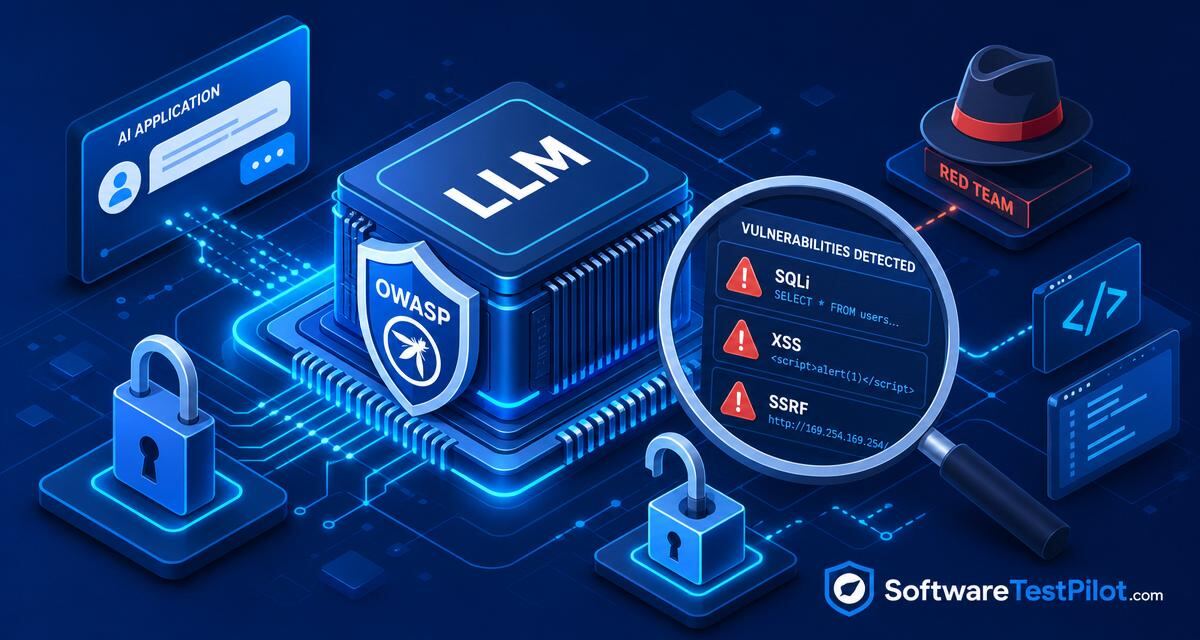
AI security and penetration testing is the practice of embedding LLMs and ML into the AppSec workflow — SAST triage, DAST payload generation, OWASP Top 10 automation, red-team scenario design and, critically in 2026, testing LLM-powered features themselves for prompt injection, jailbreaks and data exfiltration. AI does not replace a pen tester; it multiplies their throughput and lifts junior teams to a strong intermediate baseline.
Consolidates "AI penetration testing", "AI security testing", "LLM red teaming", "AI OWASP" and "AI DAST/SAST". Pair with generative AI API testing and LLM code review.
Key takeaways
- AI is a force multiplier for AppSec, not a replacement for a certified pen tester.
- SAST + DAST + IAST + SCA remain the core stack. LLMs triage, narrate and generate payloads.
- Test LLM features against OWASP LLM Top 10 (prompt injection, data leakage, insecure output handling).
- Never run AI-generated exploit payloads against production without written authorisation.
- Every finding gets CWE + OWASP category + minimum reproducible request.
1. Where AI fits in AppSec
- SAST triage — cut Semgrep/CodeQL/Snyk noise by clustering + prioritising real vs false-positive.
- DAST payloads — generate context-aware payloads (SQLi, XSSi, SSRF, template injection) from endpoint spec.
- OWASP Top 10 checks — auth, access control, misconfig, deserialisation, SSRF.
- API security — OWASP API Top 10 (BOLA, broken auth, mass assignment, rate limit).
- LLM app security — prompt injection, jailbreak, data exfiltration, tool-abuse scenarios.
- Red-team scenario design — chain vulnerabilities into realistic attack narratives.
Reference: OWASP Top 10 for LLM Applications.
2. RCTF framework
- Role — "You are a senior SDET / ISTQB-Advanced test analyst. Prioritise risk coverage, boundary values and clarity for a QA lead reviewer."
- Context — paste the requirement, user story, OpenAPI spec, page object or stack trace, plus framework + version and the compliance regime (SOC 2, HIPAA, GDPR, EU AI Act) and coverage target.
- Task — one specific artefact: "Generate 15 test cases", "Draft an IEEE 829 test plan section 4", "Write a Playwright E2E for AC-14 with an @axe accessibility check".
- Format — the exact output shape: markdown table, JSON schema, Gherkin, Vitest .test.ts. End with a rubric self-critique.
3. Prompts for AppSec (SAST triage, DAST, OWASP LLM)
P1 — SAST finding triage
Role: application security engineer, CWE/CVSS-fluent.
Context: [paste Semgrep/CodeQL finding + surrounding code + call graph].
Task: verdict = true-positive / false-positive / need-context. If TP, cite
CWE, CVSS 3.1 vector, exploitability and 3-line remediation.
Format: JSON {verdict, cwe, cvss, exploit, fix}.
P2 — DAST payload generator
Role: pen tester, OWASP Top 10 specialist.
Context: [endpoint + params + auth model].
Task: generate 10 payloads across SQLi, reflected XSS, SSRF, XXE,
template injection, path traversal. For each, one-line rationale.
Format: markdown table. Never generate payloads for destructive DELETE.
P3 — OWASP LLM Top 10 test set
Role: LLM red-teamer.
Context: our AI feature = [describe]. Model: GPT-5 with tool-calling to CRM.
Task: 15 attack prompts covering LLM01 prompt injection, LLM02 insecure output,
LLM06 sensitive info disclosure, LLM07 insecure plugin, LLM08 excessive agency.
Format: markdown table Attack/Category/Expected block/Actual (leave blank).
P4-P6 (short)
- BOLA test — for each REST endpoint with an ID param, generate a cross-user access test.
- Auth bypass matrix — anonymous, wrong-role, expired token, valid token per endpoint.
- Attack narrative — chain 3 findings into a realistic exploit scenario for the exec summary.
4. Security review rubric
- Authorised — written scope + rules of engagement before any active testing.
- Grounded — every finding cites file/line or endpoint + request/response.
- CWE + OWASP mapped — no vague "security issue" categories.
- CVSS-scored — 3.1 vector, environmental score for the org.
- Reproducible — minimum PoC included, no extra noise.
- Remediation — concrete fix, ideally a patch diff.
- Re-test path — regression test added so the fix does not silently regress.
5. AI-augmented security tools
| Tool | Best for |
|---|---|
| Semgrep Assistant | SAST + LLM triage of findings |
| Snyk DeepCode AI | Whole-file SAST with LLM fixes |
| Burp Suite Pro + Bambdas / AI extensions | DAST with AI-assisted scanning |
| ZAP + AI plugins | Open-source DAST + LLM triage |
| PentestGPT (OSS) | Learning + junior pen-tester co-pilot |
| Garak / Promptfoo | LLM red-teaming (prompt injection, jailbreak) |
| Lakera Guard | Runtime LLM prompt-injection defence + testing |
6. Governance and legal
Any AI workflow that touches product data or code must run under governance:
- Enterprise LLM APIs with a no-training / zero-retention clause. Never a free consumer chat for customer data.
- Redact PII, PANs, JWTs, HARs, secrets and production URLs before any prompt.
- Version prompts in a Git-tracked QA prompt library. Every AI-generated artefact ships with an "AI attribution" line and a human SDET sign-off.
- Map controls to the NIST AI RMF and, for EU products, the EU AI Act.