
AI Test Data Generator in 2026: Synthetic Data, PII-Safe Prompts, GDPR & Tools
How to use AI to generate synthetic test data — realistic, PII-safe CSV/JSON at scale for QA, dev and staging. LLM prompts, schema-aware generators, GDPR/HIPAA guardrails, top tools and every PAA FAQ.

Last updated: July 15, 2026 · 14 min read · By SoftwareTestPilot
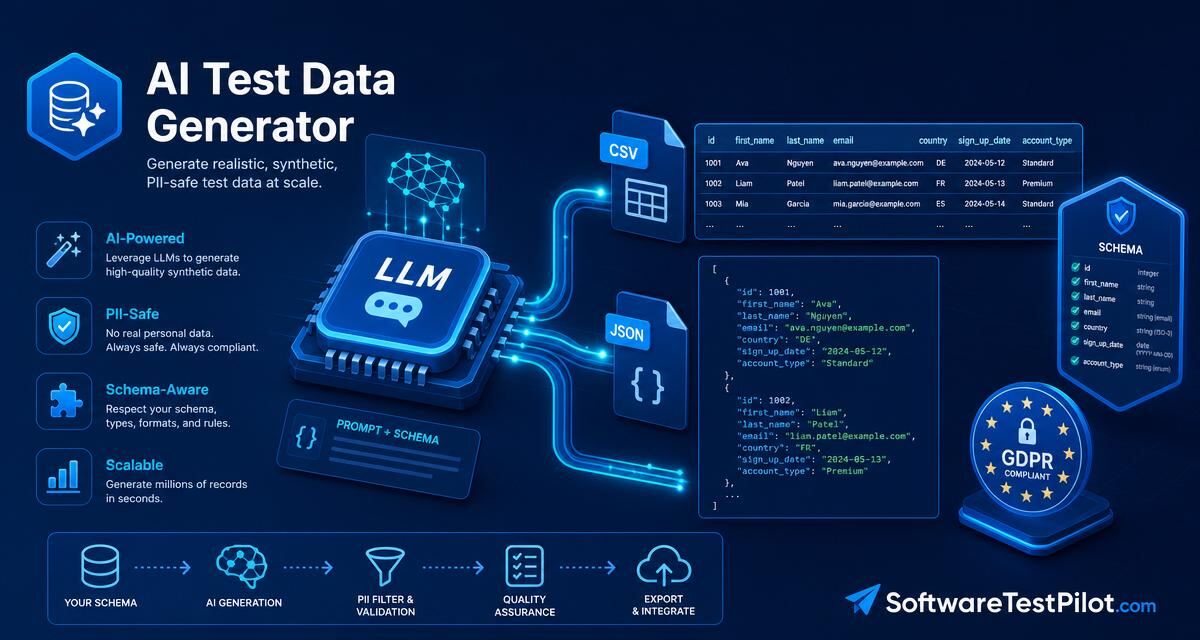
AI test data generation uses an LLM or a dedicated synthetic-data engine to produce realistic, PII-safe test data at scale — millions of rows if you need them — that matches your schema, respects your business rules and covers the edge cases your unit and E2E suites need. In 2026 it is the fastest, cheapest way to solve two problems at once: fresh test data for QA, and privacy-compliant substitutes for production copies.
Consolidates "AI test data generator", "synthetic test data", "GDPR test data" and "AI data generator for QA". Pair with test case generation and API testing.
Key takeaways
- Never anonymise production data by hand — synthesise it instead.
- Ground every prompt in the schema (types, constraints, distributions).
- Ask for edge cases explicitly: nulls, unicode, min/max, RTL, plurals.
- Validate the output against your JSON Schema / Zod / Pydantic before it lands.
- For regulated data (health, finance), pair LLMs with a dedicated synthetic-data engine (Tonic.ai, Gretel, Mostly AI, YData).
1. Why synthetic beats scrubbed production data
Scrubbing production data is expensive, error-prone and one leak away from a GDPR fine. Synthetic data — generated to look like production without being production — sidesteps the whole class of risk. Modern LLMs and vendor engines produce data that matches your schema and statistical shape well enough for functional, integration and performance testing, and often for demoing to prospects.
External reference: the UK ICO anonymisation guidance is the clearest primer for QA leads.
2. RCTF framework
- Role — "You are a senior SDET / ISTQB-Advanced test analyst. Prioritise risk coverage, boundary values and clarity for a QA lead reviewer."
- Context — paste the requirement, user story, OpenAPI spec, page object or stack trace, plus framework + version and the compliance regime (SOC 2, HIPAA, GDPR, EU AI Act) and coverage target.
- Task — one specific artefact: "Generate 15 test cases", "Draft an IEEE 829 test plan section 4", "Write a Playwright E2E for AC-14 with an @axe accessibility check".
- Format — the exact output shape: markdown table, JSON schema, Gherkin, Vitest .test.ts. End with a rubric self-critique.
3. Prompts (CSV, JSON, SQL seed, edge cases)
P1 — CSV synthetic users (PII-safe)
Role: test data engineer, GDPR-conscious.
Context: schema users(id uuid, email text, dob date, country_code text,
plan enum('free','pro','enterprise')). 500 rows.
Task: generate CSV. Distributions: plan 60/30/10, country ISO 3166-1 alpha-2
weighted US/GB/IN/DE/BR. Edge cases: min/max dob, unicode emails, plus-tag
emails, subdomain emails. No real names or real emails.
Format: CSV only, headers on row 1, no prose.
P2 — JSON payloads for API tests
Role: API test data engineer.
Context: OpenAPI schema Order { id, customerId, items[{sku, qty, priceCents}],
totalCents, currency ISO 4217 }.
Task: 20 payloads — 15 valid, 5 boundary/invalid (empty items, negative qty,
totalCents mismatch, unsupported currency, missing customerId).
Format: JSON array only.
P3 — SQL seed with referential integrity
Role: SQL data engineer, PostgreSQL 16.
Context: tables users, orders(user_id FK), items(order_id FK).
Task: 100 users, 300 orders, 900 items. Respect FK. Include 5 users with 0
orders, 3 users with 30+ orders (heavy).
Format: single .sql with INSERTs in dependency order.
P4-P8 (short)
- Localisation matrix — RTL, unicode, plurals for 8 locales.
- Time-series — 90 days of sensor readings with seasonality.
- Fraudulent-looking transactions — for risk-scoring test.
- Chat transcripts — 50 support tickets with intent labels.
- Nested JSON — deeply nested product catalogue for GraphQL tests.
4. Best AI test data tools in 2026
| Tool | Best for | Free tier |
|---|---|---|
| Gretel | Synthetic tabular / time-series with privacy proofs | Yes |
| Tonic.ai | Enterprise DB subsetting + synthesis | Trial |
| Mostly AI | Statistical fidelity for analytics + QA | Yes |
| YData Fabric | Open-source-friendly, notebooks | Yes |
| Faker + LLM | Free, prompt-driven, small volumes | Yes |
| Snowflake / Databricks synthetic UDFs | Warehouse-native synthesis | Included |
5. Test data review rubric
- Schema-valid — passes Zod/Pydantic/JSON Schema without warnings.
- No real PII — no real email, phone, SSN, PAN, address.
- Edge cases — min, max, empty, unicode, RTL covered.
- Referential integrity — FKs valid across tables.
- Distributional fit — matches production shape (heavy vs light users).
- Reproducibility — same prompt + seed = same data.
- PII scan — Presidio / DLP scan returns 0 hits.
6. Governance and GDPR/HIPAA notes
Any AI workflow that touches product data or code must run under governance:
- Enterprise LLM APIs with a no-training / zero-retention clause. Never a free consumer chat for customer data.
- Redact PII, PANs, JWTs, HARs, secrets and production URLs before any prompt.
- Version prompts in a Git-tracked QA prompt library. Every AI-generated artefact ships with an "AI attribution" line and a human SDET sign-off.
- Map controls to the NIST AI RMF and, for EU products, the EU AI Act.