I Reviewed 200 QA & SDET Resumes: 7 Fatal Red Flags That Disqualified 85% (2026)
Hiring manager debrief after reviewing 200 QA & SDET resumes for two remote $145k–$165k roles. The 7 red flags — keyword soup, zero CI/CD ownership, missing metrics, broken GitHub — that killed 85% of applicants.

Last updated: July 1, 2026 · 14 min read · By Avinash K
Last month, our engineering organization opened two remote Senior SDET requisitions offering a $145,000 to $165,000 base salary. Within 72 hours of syndicating the job description across major tech boards and the SoftwareTestPilot QA Jobs Radar, our pipeline was flooded with over 200 applications.
I sat down with a cup of black coffee on a Sunday morning and personally reviewed every single resume — no bots, no HR filters. By Sunday evening:
- 170 resumes (85%) were rejected within 30 seconds.
- 20 resumes (10%) landed in the “Maybe / Secondary Screening” pile.
- Only 10 candidates (5%) received immediate interview invitations.
Most rejected candidates had 5+ years of solid tenure at reputable tech firms. They lost because their resumes contained seven glaring structural and strategic red flags that signalled poor engineering habits, superficial tool memorisation, and inability to operate in modern CI/CD pipelines. Here is the unvarnished feedback.
SoftwareTestPilot tip: Pair this with the 6-second ATS playbook, the $65k → $120k SDET 90-day plan, the $100k+ remote QA companies list, the Resume ATS Reviewer, and the AI Mock Interview.
1. Red Flags 1 & 2 — Keyword soup & zero CI/CD pipeline ownership
+-----------------------------------------------------------------------------------+
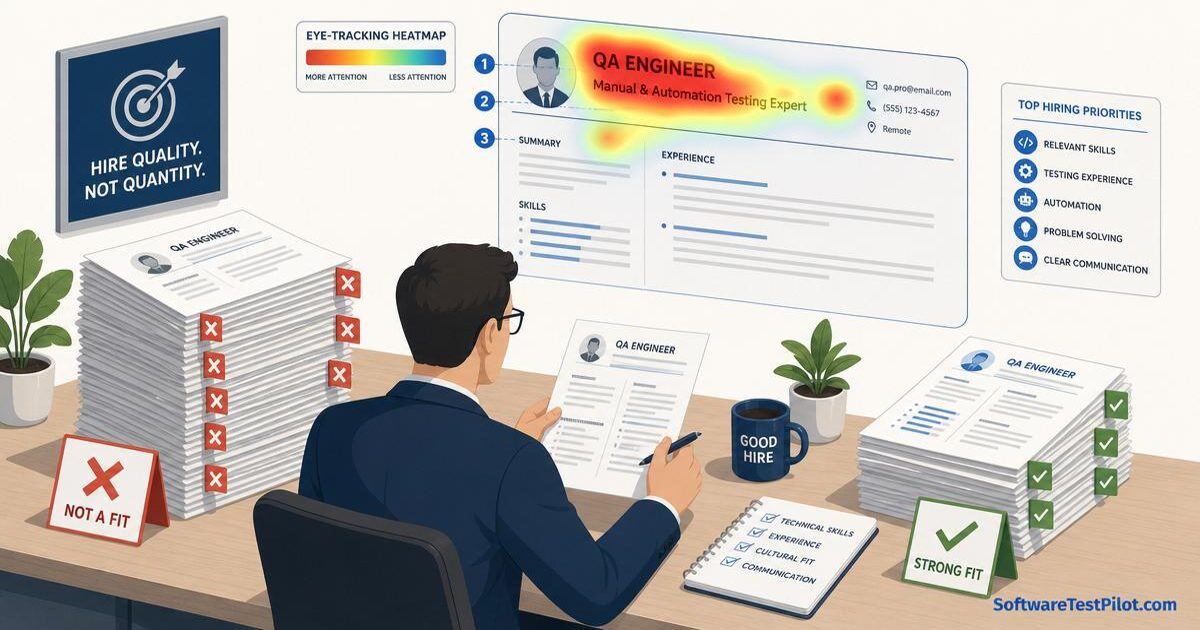
|                        HIRING MANAGER EYE-TRACKING HEATMAP                        |
+-----------------------------------------------------------------------------------+
| [TOP 33% OF PAGE: SUMMARY & SKILLS MATRIX]                                        |
| - Red Flag 1: 40 random tools listed without architectural cohesion.              |
|   (Selenium, Playwright, Cypress, Appium, JMeter, QTP, Postman, SoapUI, Cucumber) |
+-----------------------------------------------------------------------------------+
| [MIDDLE 66% OF PAGE: CHRONOLOGICAL EXPERIENCE]                                    |
| - Red Flag 2: Zero mention of GitHub Actions, Docker, YAML, or PR gating.         |
|   Every bullet describes running tests locally or overnight on Jenkins.           |
+-----------------------------------------------------------------------------------+
Red Flag 1 — Keyword soup without execution proof
More than half the resumes crammed every testing tool ever invented into a giant summary block. One candidate listed 42 distinct tools: Selenium Java, Playwright TypeScript, Cypress JS, Appium, JMeter, k6, LoadRunner, Postman, SoapUI, Cucumber BDD, Jira, TestRail, AWS, Azure, Docker, Kubernetes…
Nobody with 4–5 years of experience is genuinely expert in three competing web frameworks, three load engines, and full DevOps infrastructure. It reads as gaming the ATS, not engineering focus.
The fix: Curate a coherent modern stack, grouped semantically:
- Core Languages: TypeScript, Python, SQL.
- Modern Web Automation: Playwright, REST API fixtures.
- DevOps Infrastructure: GitHub Actions, Docker, Git CLI.
If a tool never appears inside an achievement bullet in your chronological experience, delete it from the summary. Cross-check the pattern used in our ATS parsing deep dive.
Red Flag 2 — Zero CI/CD pipeline ownership
Over 60% of resumes described execution as an isolated off-pipeline activity: “Executed automated regression suite prior to bi-weekly release sign-off.” When we hire a Senior SDET for $150k, we are hiring someone who constructs continuous integration pipelines.
If your resume never mentions YAML workflow files, parallel container sharding, Docker sandboxes, or PR-blocking gates, you're signalling you depend on a DevOps engineer to run your work.
The fix: every role gets at least one bullet like:
“Architected multi-job GitHub Actions CI/CD workflows running containerised Playwright regression across 8 parallel sharded Docker runners, establishing automated pre-merge gating that blocked broken builds in under 5 minutes.”
Study the reference architecture in our GitHub Actions + Selenium CI guide and the end-to-end CI/CD pipeline tutorial.
2. Red Flags 3 & 4 — Tool usage vs. strategy, and no quantified metrics
+-----------------------------------------------------------------------------------+
|                        JUNIOR vs. SENIOR RESUME PHRASING                          |
+-----------------------------------------------------------------------------------+
| JUNIOR TESTER (Task-Oriented & Tool-Focused):                                     |
| - "Wrote automated scripts using Playwright and TypeScript."                      |
+-----------------------------------------------------------------------------------+
| SENIOR SDET (Outcome-Oriented & Metric-Driven):                                   |
| - "Architected component test harness using Playwright, reducing release          |
|   verification time by 75% and preventing 12 P1 production defects."              |
+-----------------------------------------------------------------------------------+
Red Flag 3 — Confusing tool usage with engineering strategy
Junior applicants describe their day by listing tool names: “Used Postman to test API endpoints.” Tool names are implementation details. Senior hiring managers care about architecture and problem-solving.
The fix:
“Designed deterministic API contract verification harnesses using Axios and Playwright APIRequest, asserting complex JSON schemas and OAuth role boundaries before frontend UI builds initiated.”
See the exact factory pattern in the deterministic test data engineering deep dive.
Red Flag 4 — Lacking quantified quality & velocity metrics
Out of 200 resumes, exactly 18 candidates included concrete numbers. The remaining 182 leaned on vague adjectives: “significantly improved test coverage,” “successfully found numerous bugs.” Unquantified claims carry zero weight in engineering leadership.
The fix: inject numeric metrics into every bullet.
- Execution speed: “Reduced end-to-end regression cycle from 36 hours to 42 minutes by migrating legacy Selenium scripts to sharded Playwright containers.”
- Defect escape rate: “Spearheaded API exploratory testing initiatives that reduced P1/P0 defect escape rates to production by 45% over two quarters.”
- Coverage efficiency: “Automated 140 core user journeys, achieving 88% critical-path regression coverage and eliminating 20 hours of manual testing overhead per sprint.”
3. Red Flags 5, 6 & 7 — Manual disguised as SDET, missing NFRs, broken GitHub
+-----------------------------------------------------------------------------------+
|                  THE 3 DEEP-DIVE DISQUALIFIERS                                    |
+-----------------------------------------------------------------------------------+
| RED FLAG 5: MANUAL TESTER DISGUISED AS AN SDET                                    |
| RED FLAG 6: IGNORING NON-FUNCTIONAL QUALITY (SECURITY / ACCESSIBILITY / PERF)     |
| RED FLAG 7: BROKEN OR ABANDONED GITHUB PORTFOLIO REPOSITORIES                     |
+-----------------------------------------------------------------------------------+
Red Flag 5 — Manual tester disguised as SDET
I reviewed 35 resumes titled “Senior SDET” whose bullets described 100% manual QA: “Wrote test cases in Excel,” “Performed manual regression on iOS.” If the title says SDET but there is zero mention of object-oriented code, pull requests, data factories, or pipelines, you're instantly flagged as deceptive.
The fix: be honest — label yourself “Technical QA Engineer / Automation Contributor” during the transition and showcase real automated project implementations. Our $65k → $120k SDET 90-day plan and the manual → SDET migration guide lay out the exact upgrade path.
Red Flag 6 — Ignoring non-functional testing (NFRs)
Modern quality engineering is more than functional UI form submission. On senior resumes I look for awareness of API security (BOLA/IDOR), performance overhead, and accessibility compliance. Resumes ignoring these signal a narrow, junior perspective.
The fix: dedicate at least two bullets across your history to NFR rigor.
“Executed automated performance spike evaluations using Grafana k6, verifying microservice stability under 5,000 concurrent virtual users and isolating memory-leak bottlenecks.”
Reference material: k6 load testing tutorial, OWASP security checklist, and the WCAG 2.2 accessibility testing guide.
Red Flag 7 — Broken GitHub portfolio hygiene
Every GitHub URL on a resume gets clicked immediately. Out of 60 candidates who linked profiles: 40 had only empty default repos or 4-year-old bootcamp forks, 12 had repos that failed to compile or had no README, and only 8 had pristine automation repositories.
The fix: maintain one Showcase Capstone Repository (e.g., playwright-enterprise-test-harness) with:
- A beautifully formatted
README.mdwith an architectural data-flow diagram. - Clean TypeScript using custom fixtures and atomic
data-testidlocators — see the Playwright locators guide. - A functional
.github/workflows/pipeline.ymlwith green build badges.
4. Anatomy of the top 5% resumes — the hiring manager checklist
+-----------------------------------------------------------------------------------+
|                  THE TOP 5% SDET RESUME ANATOMY CHECKLIST                         |
+-----------------------------------------------------------------------------------+
| [x] CLEAN SINGLE-COLUMN FORMATTING                                                |
|     100% text-searchable PDF, zero graphic sidebars, standard 11pt hierarchy.     |
| [x] COHESIVE MODERN TECHNICAL STACK                                               |
|     TypeScript, Playwright, Docker, GitHub Actions, PostgreSQL, REST/GraphQL.     |
| [x] PIPELINE & INFRASTRUCTURE OWNERSHIP PROOF                                     |
|     Sharded parallel CI/CD workflows and automated gating described explicitly.   |
| [x] METRIC-DENSE ACHIEVEMENTS                                                     |
|     Every role contains quantitative speed / defect / coverage metrics.           |
| [x] IMMACULATE GITHUB PORTFOLIO HYGIENE                                           |
|     Direct link to a production-grade automation harness with architectural docs. |
+-----------------------------------------------------------------------------------+
When a resume matching this checklist hits my desk, I instruct recruiting to schedule a phone screen within 24 hours — candidates displaying this level of engineering maturity are exceptionally rare.
5. Auditing your resume before submission
Before applying to your next role, spend 20 minutes running the self-audit above. Do not rely on guesswork or subjective opinions from non-technical friends.
Upload your draft to the SoftwareTestPilot ATS Resume Reviewer — it audits your resume against real engineering hiring rubrics, flags missing CI/CD keywords, passive phrasing, and unquantified bullets before corporate recruiters see them. Once your score passes 90%, rehearse explaining your framework architecture out loud using the SoftwareTestPilot AI Mock Interview. For behavioural rounds, drill the R.A.I.D. framework.
External benchmark: cross-check phrasing against the LinkedIn skill matching guidelines for platform-native alignment.
6. Conclusion & your 24-hour action step
Reviewing 200 resumes in a single weekend reinforced a fundamental truth: the barrier to entry for generic script execution has risen, but demand for elite SDETs who own quality infrastructure has never been higher.
You do not need 30 random tools on your resume to get hired. You need a clean single-column layout, a coherent TypeScript + Playwright stack, quantified achievements proving execution speed and defect reduction, and clear proof of CI/CD ownership.
Your 24-hour action step
Open your resume right now. Delete the generic “Summary” paragraph and replace it with a punchy 3-line executive summary highlighting your core language, primary framework, and CI/CD expertise. Then global-search for “Responsible for” and “Participated in” and replace with active verbs: Architected, Engineered, Spearheaded, Containerised, Accelerated. Audit the updated draft on the ATS Reviewer and start applying to vetted remote six-figure roles on the QA Jobs Radar — cross-referenced with our $100k+ remote employers list.