From $65k QA to a $120k SDET Offer: Exact 90-Day Plan (2026)
The exact 90-day upskilling roadmap that took me from $65k manual QA to a $120k SDET offer — TypeScript, Playwright, CI/CD, portfolio, and the interview loop.

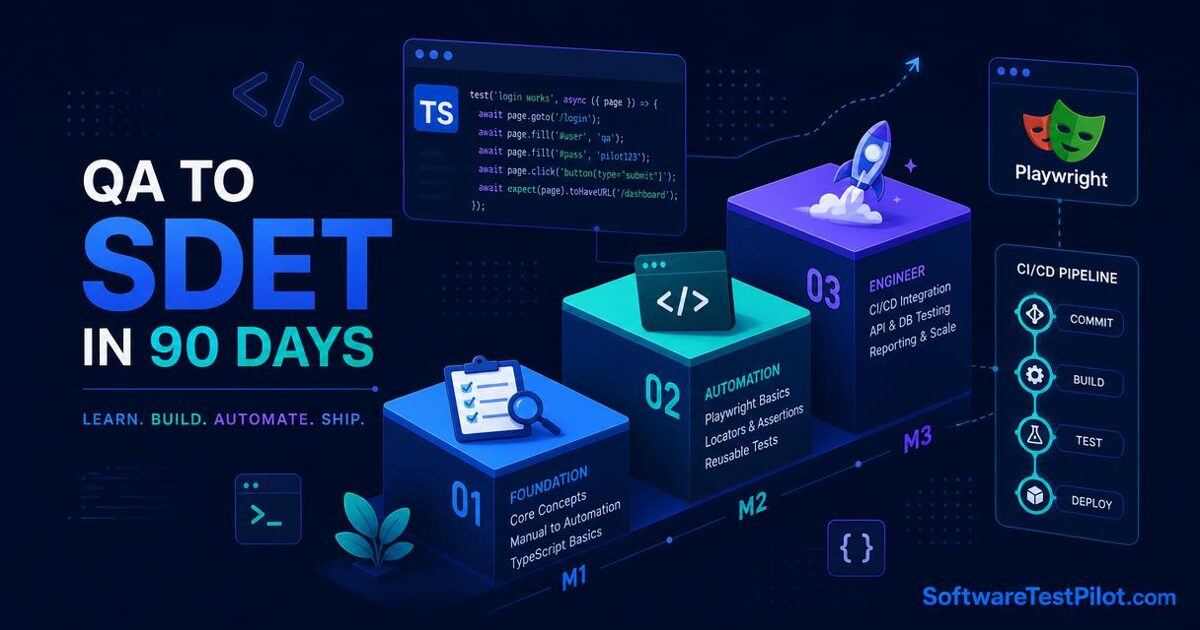
Last updated: July 1, 2026 · 15 min read · By Avinash K
Three years ago I sat at my kitchen table staring at a $65,000 QA pay stub that barely covered rent and student loans. Every sprint I executed 200+ manual test cases, filed Jira bugs, and babysat a brittle recorded-Selenium suite. Whenever I asked about promotion, my director’s answer never changed: “Our SDET tier needs production-grade TypeScript, Dockerized CI, and distributed backend debugging.”
Meanwhile, live requisitions on our internal QA Jobs Radar told a brutal story — generalist QA capped near $75–85k while mid-level SDET roles at cloud/SaaS companies routinely offered $120–150k+ base plus equity. Eighty-eight days after I wrote my first line of TypeScript, I signed a $120,000 SDET offer at a hyper-growth analytics platform. Here is the exact 90-day roadmap, without fluff.
SoftwareTestPilot tip: Pair this plan with our SDET Roadmap 2026, Manual → SDET transition, R.A.I.D. interview framework, AI Mock Interview, and Resume ATS Review.
1. The mindset shift — QA tester vs SDET engineering ownership
Most manual QAs fail at automation because they treat code as a way to automate their existing manual checklist. Writing a slow script that opens a browser, clicks login, and verifies a welcome message does not make you an SDET — it makes you a fragile robotic clicker.
TRADITIONAL QA ANALYST                    MODERN SDET (2026)
"How many bugs did I find after devs?"    "How fast & reliably can devs ship?"
Waits for deploy → runs UI → files Jira   Embeds in PRs → writes API/CI harnesses
Quality gatekeeper outside the workflow   Software engineer for quality infra
An SDET is a software engineer whose product happens to be quality infrastructure, test tooling, and CI pipelines. Companies pay $120k+ for someone who can look at a microservices architecture and build deterministic harnesses that catch regressions in milliseconds inside PRs.
2. Month 1 (Days 1–30) — programming foundations & API mastery
For the first 30 days, cut every UI-automation distraction. No Selenium install. No DevTools recording. No CSS-selector rabbit holes. Master modern TypeScript and programmatic API contract testing.
Why TypeScript in 2026? Playwright, Cypress, Jest, and Vitest all treat it as a first-class citizen. When you write automation in the same language your frontend/backend devs use, you earn immediate code-review credibility.
WEEK 1  TYPESCRIPT & ASYNC/AWAIT CORE
        let/const, strict types, interfaces, unions, Event Loop, Promises
WEEK 2  HTTP NETWORK ARCHITECTURE & SERIALIZATION
        REST verbs, status codes, JSON, JWT bearer auth
WEEKS 3–4  PROGRAMMATIC API CONTRACT TESTING
        Axios / Playwright APIRequest, JSON schema, chained workflows
Code proof: from Postman clicking to programmatic contract testing
Instead of eyeballing Postman responses, write deterministic transactional flows with Playwright’s native APIRequest engine:
// tests/api/userTransactionWorkflow.spec.ts
import { test, expect } from '@playwright/test';

interface UserResponsePayload {
  id: string;
  email: string;
  accountBalance: number;
  createdAt: string;
}

test.describe('Core Financial Transaction API Contract Suite', () => {
  const BASE_URL = 'https://api.softwaretestpilot.com/v1';
  let authToken: string;
  let createdUserId: string;

  test.beforeAll(async ({ request }) => {
    const authRes = await request.post(`${BASE_URL}/auth/token`, {
      data: { apiKey: process.env.TEST_API_KEY, clientSecret: 'secret_dev_token' },
    });
    expect(authRes.status()).toBe(200);
    authToken = (await authRes.json()).accessToken;
  });

  test('Creates user, credits balance, and verifies schema integrity', async ({ request }) => {
    const email = `sdet_${Date.now()}@softwaretestpilot.com`;

    const createRes = await request.post(`${BASE_URL}/users`, {
      headers: { Authorization: `Bearer ${authToken}` },
      data: { email, initialBalance: 500, tier: 'GOLD' },
    });
    expect(createRes.status()).toBe(201);
    const user: UserResponsePayload = await createRes.json();
    createdUserId = user.id;
    expect(user.accountBalance).toBe(500);

    const getRes = await request.get(`${BASE_URL}/users/${createdUserId}`, {
      headers: { Authorization: `Bearer ${authToken}` },
    });
    expect(getRes.status()).toBe(200);
    expect((await getRes.json()).accountBalance).toBe(500);
  });

  test.afterAll(async ({ request }) => {
    if (createdUserId) {
      const del = await request.delete(`${BASE_URL}/users/${createdUserId}`, {
        headers: { Authorization: `Bearer ${authToken}` },
      });
      expect(del.status()).toBe(204);
    }
  });
});
By Day 30 you should be seeding backend DBs, mocking third-parties, and asserting complex JSON schemas entirely from the terminal. Deepen with our Postman → programmatic API guide and API testing interview hub.
3. Month 2 (Days 31–60) — modern web automation & CI/CD
With programming fundamentals solid, spend Month 2 on Playwright architecture and CI integration. Playwright talks to browsers over a bidirectional WebSocket protocol, natively supports multi-tab, and executes far faster than Selenium in cloud runners — see our Playwright complete guide and 2026 Selenium architecture fix.
WEEKS 5–6  ATOMIC COMPONENT PLAYWRIGHT ARCHITECTURE
           data-testid contracts over XPath
           Custom fixtures (DRY dependency injection)
           page.route() for network interception & failure simulation
WEEKS 7–8  DOCKER + GITHUB ACTIONS CI/CD
           Containerize suites inside headless Ubuntu
           Multi-job YAML with parallel sharded browser tests
Build your CI/CD pipeline engine
A $120k SDET does not say “please run my tests locally.” They ship a workflow that runs automatically on every PR. Master this production-grade .github/workflows/sdet-pipeline.yml:
name: SDET Automated Quality Gating Pipeline

on:
  pull_request:
    branches: [ main, develop ]
  push:
    branches: [ main ]

jobs:
  playwright-regression-suite:
    name: Playwright E2E Sharded Execution
    timeout-minutes: 15
    runs-on: ubuntu-latest
    strategy:
      fail-fast: false
      matrix:
        shardIndex: [1, 2, 3]
        shardTotal: [3]
    steps:
      - uses: actions/checkout@v4
      - uses: actions/setup-node@v4
        with:
          node-version: '20.x'
          cache: 'npm'
      - run: npm ci
      - run: npx playwright install --with-deps chromium webkit
      - name: Execute Sharded Playwright Suite
        run: npx playwright test --shard=${{ matrix.shardIndex }}/${{ matrix.shardTotal }}
        env:
          CI: true
          API_BASE_URL: https://staging-api.softwaretestpilot.com
      - name: Upload Playwright Traces on Failure
        if: failure()
        uses: actions/upload-artifact@v4
        with:
          name: playwright-traces-shard-${{ matrix.shardIndex }}
          path: playwright-report/
          retention-days: 7
Showing an engineering manager you understand matrix sharding (--shard=1/3) and automated artifact upload signals a mid-to-senior SWE level instantly. Related: GitHub Actions + Selenium in CI.
4. Month 3 (Days 61–90) — system design & capstone portfolio
Final 30 days: convert skill into overwhelming market proof. Listing “Playwright + TypeScript” is not enough — hundreds of resumes claim that weekly. To bypass HR filters, publish a GitHub capstone engineering portfolio.
Repo: enterprise-qa-automation-harness

/src/fixtures/       DI’d Playwright auth & data fixtures
/src/components/     Atomic UI wrappers using data-testid contracts
/tests/api/          Transactional REST + GraphQL schema suites
/tests/e2e/          Critical user journeys with page.route() mocks
/.github/workflows/  Multi-shard CI/CD YAML pipeline
/docker-compose.yml  Ephemeral DB + mock server stack
README.md            Architecture diagram & execution instructions
What the README must contain
- Architectural data-flow diagram showing how the harness seeds test data via API before UI actions.
- Benchmarks proving your sharded pipeline runs 100 tests in under 4 minutes.
- Local dev commands for tag-scoped runs, e.g.
npx playwright test --grep @smoke.
When I applied for my $120k role, the hiring manager literally said: “We skipped the take-home — your fixtures and CI/CD YAML proved you could contribute on Day 1.” Cross-reference structure with our Playwright + TypeScript framework blueprint.
5. Cracking the SDET coding interview loop
Unlike generalist QA loops focused on behaviors, $120k+ SDET interviews mix DSA screens with test-architecture whiteboarding.
ROUND 1  RECRUITER SCREEN (30m)
         Comp expectations, CI/CD familiarity, stack alignment
ROUND 2  TECHNICAL CODING & ALGORITHMS (60m)
         LeetCode Easy/Medium — strings, arrays, hash maps
ROUND 3  TEST ARCHITECTURE & SYSTEM DESIGN (60m)
         Design a harness for e-commerce / payments
ROUND 4  LIVE PAIR DEBUGGING (60m)
         Fix a broken Playwright/TypeScript suite in a shared IDE
How to prep the algorithmic screen
Do not grind advanced DP or red-black trees. SDET screens focus on pragmatic data manipulation — log-string parsing, array filtering of API JSON, hash-map frequency counting. 45 minutes each morning of Month 3, focused on:
- Two Sum & Valid Anagram (hash map mastery)
- Longest Substring Without Repeating Characters (sliding window)
- Validate IP Address / log trace parsing (string splitting + regex)
Simulate the loop end-to-end in the SoftwareTestPilot AI Mock Interview — it evaluates time complexity ($O(N)$ vs $O(N^2)$), audits architectural justifications, and gives actionable feedback so you stop freezing under pressure. For behavioral warmup: “Tell me about yourself” for QA.
6. Conclusion & your 24-hour next step
Going from $65k manual QA to $120k+ SDET is not luck and does not require a CS degree. It requires a disciplined 90-day mindset shift from manual execution to software engineering ownership: TypeScript & API contracts in Month 1, Playwright + CI/CD in Month 2, portfolio + interview loop in Month 3.
Do this in the next 24 hours: block 90 focused minutes every morning for the next 30 days. Install Node.js + VS Code, then run npm init -y && npm i -D typescript @playwright/test and write your first automated API request test. Once it runs green, upload your resume to the ATS Resume Reviewer and benchmark against active SDET requisitions on the QA Jobs Radar.
Related reading: Honest truth about manual QA salaries in 2026, SDET Roadmap 2026, Playwright complete guide, Postman API testing tutorial. External: Playwright API testing docs, GitHub Actions docs.