
ChatGPT for API Testing in 2026: The Complete Playbook (Prompts, Postman, REST Assured & FAQ)
The definitive 2026 guide to API testing with ChatGPT — turn OpenAPI/Swagger specs into Postman collections, REST Assured suites and Playwright API tests, plus contract, security, auth, rate-limit and error-code coverage, 12 prompts, a 7-point rubric and every PAA question Google surfaces.

Last updated: July 14, 2026 · 17 min read · By SoftwareTestPilot
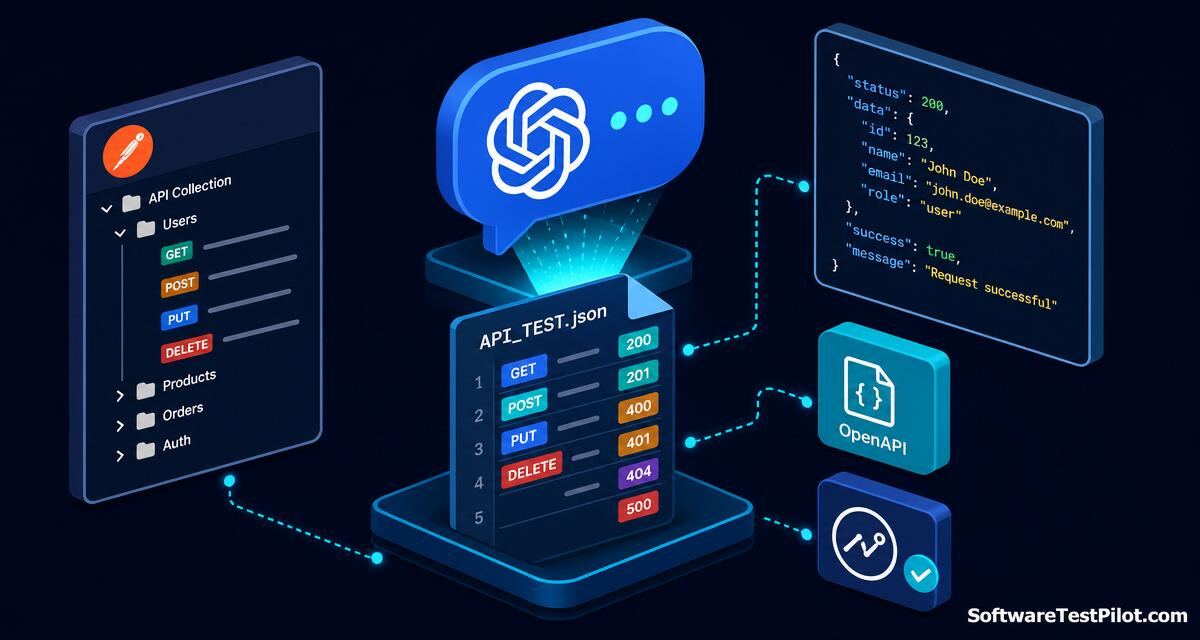
ChatGPT for API testing in 2026 means using OpenAI's models — with Claude Opus 4.5 and Gemini 2.5 Pro — to turn an OpenAPI 3.1 spec, a curl example or a Postman collection into a complete test suite covering happy paths, every documented error code, auth, contract, boundary, rate-limit and security cases. Wire the output to Postman, REST Assured (Java), Playwright API, RestSharp, pytest + httpx or Bruno, and run in Newman / GitHub Actions / Jenkins.
Pair with the GraphQL API testing guide, API testing interview questions and ChatGPT test case generation pillar.
Key takeaways
- Feed ChatGPT the OpenAPI spec — not a paragraph description. Grounded prompts = grounded tests.
- Cover the 8 API-testing dimensions: happy, error codes, auth, contract, boundary, negative, rate-limit, security.
- Never let ChatGPT invent status codes, headers, error schemas or endpoints. Cite the spec.
- Contract testing (response schema matches spec) is non-negotiable in 2026.
- Redact real bearer tokens, API keys and PII from every request/response paste.
1. The 8 dimensions of API test coverage
1. Happy path        — 2xx per operation, per role
2. Error codes       — 400 / 401 / 403 / 404 / 409 / 422 / 429 / 5xx
3. Auth              — no token, expired, wrong role, wrong scope
4. Contract          — response schema matches spec (JSON Schema / OpenAPI)
5. Boundary          — min/max length, min/max value, max array size
6. Negative          — missing field, extra field, wrong type, null
7. Rate limit        — burst + sustained; 429 + Retry-After header
8. Security          — OWASP API Top 10 (BOLA, BFLA, mass assignment, SSRF)
Reference: OWASP API Security Top 10 (2023).
2. Master prompt: OpenAPI 3.1 → Postman collection
You are a senior API QA engineer fluent in OpenAPI 3.1, JSON Schema
and OWASP API Security Top 10.

Context:
- OpenAPI spec: [paste YAML or JSON]
- Auth mechanism: [Bearer / OAuth2 / API key + header name]
- Roles / scopes: [paste]
- Rate-limit policy: [paste or "none documented"]
- Base URL: {{baseUrl}} (Postman variable)

Task: produce a Postman v2.1 collection JSON with one folder per
tag / resource, per endpoint covering the 8 dimensions:
- Happy 2xx (per role)
- Every documented error code
- Auth cases (no token, expired, wrong role)
- Contract assertion (pm.response.to.have.jsonSchema)
- Boundary min/max
- Negative missing/extra/wrong-type
- Rate limit (if documented)
- Security: BOLA (access another user's resource), mass assignment

Use collection variables for baseUrl, token, testUserId. Include a
pre-request script to fetch a fresh token when expired. Include
pm.test assertions with meaningful names.

Format: valid Postman v2.1 JSON. End with a coverage summary and
a self-critique against the 7-point rubric.
3. Prompt: OpenAPI → REST Assured (Java) suite
You are a senior SDET fluent in REST Assured 5.x, JUnit 5 and Allure.
Given: [OpenAPI spec + auth details].

Task: produce a Maven project skeleton with:
- src/test/java/api/ with one class per resource
- Base class handling auth, base URI, filters (Allure + logging)
- @ParameterizedTest for boundary + negative cases
- JSON Schema validation via io.rest-assured:json-schema-validator
- Retryable auth token cache
- pom.xml with rest-assured, junit-jupiter, allure-rest-assured

Format: emit files with paths, in this order: pom.xml, base class,
one resource class as a full example, plus a TODO list of remaining
classes with method signatures.
See the REST Assured Java tutorial for the underlying framework.
4. Prompt: OpenAPI → Playwright API tests (TypeScript)
You are a senior SDET fluent in Playwright APIRequestContext and
TypeScript. Given: [spec + auth].

Task: emit playwright.config.ts + tests/api/ with one spec per resource.
- Use request fixture for auth
- Cover the 8 dimensions
- Use zod for response schema validation
- Use test.step() to segment happy / error / auth / boundary
- Use projects to run against dev / stage / preview

Format: full files with paths.
5. Prompts for contract testing and consumer-driven contracts
You are a senior SDET fluent in Pact and OpenAPI diff.
Given: [consumer expected requests] and [provider OpenAPI].
Produce a Pact consumer test in [pact-jvm / pact-js] plus a matching
provider verification config.
Also produce an OpenAPI diff check (schemathesis or oasdiff) that fails
CI on breaking changes: removed operations, removed required fields,
narrowed enums, changed types.
6. Prompts for OWASP API Top 10 coverage
You are an API security tester fluent in OWASP API Top 10 (2023).
Given: [OpenAPI + auth model].
Produce test cases per applicable Top 10 category:
- API1 BOLA — swap resource IDs across users
- API2 Broken Authentication — expired / tampered / none
- API3 BOPLA / mass assignment — extra JSON fields
- API4 Unrestricted Resource Consumption — huge arrays, deep nesting
- API5 BFLA — user calls admin-only op
- API6 Sensitive Business Flows — bulk endpoints abuse
- API7 SSRF — URLs in JSON, redirect chains
- API8 Security Misconfiguration — CORS, headers
- API9 Improper Inventory — deprecated endpoints still live
- API10 Unsafe Consumption of APIs — 3rd-party spoofing

Format: table with API#, Test title, Setup, Attack, Expected defence,
Severity. Never run against production without written authorisation.
7. Prompts for CI wiring: Newman + GitHub Actions
Produce a GitHub Actions workflow that:
- Runs Newman against the collection on push + PR
- Uses matrix envs (dev, stage)
- Publishes Newman HTML report as artifact
- Fails the job on any pm.test failure
- Posts a Markdown summary comment on the PR with pass/fail counts
- Caches node_modules
- Uses OIDC to fetch env secrets (no static tokens in the workflow)
8. The 7-point review rubric
- All 8 dimensions covered per endpoint.
- Contract assertion (schema validation) on every response.
- Auth cases include no-token, expired, wrong-role and wrong-scope.
- Deterministic setup / teardown; no test order dependency.
- No secrets in the collection or code (env vars only).
- Traceability: each test names the source operationId or endpoint + method.
- PII cleanliness: synthetic data only.
9. Governance and safe use
Never paste real bearer tokens, session cookies, JWTs or API keys — scrub HAR files first. Use ChatGPT Enterprise or Team with training-off. Regulated workloads: Azure OpenAI, AWS Bedrock or self-hosted Llama 4. Cross-check against the NIST AI RMF. Security tests (OWASP API Top 10) run against staging with written scope authorisation only.