Top Skills to Double Your Rate as a Freelance Tester in 2026
The 10 skills that move freelance QA testers from $35/hr to $80+/hr in 2026. Based on real 2026 market demand, with 90-day learning roadmaps for each.

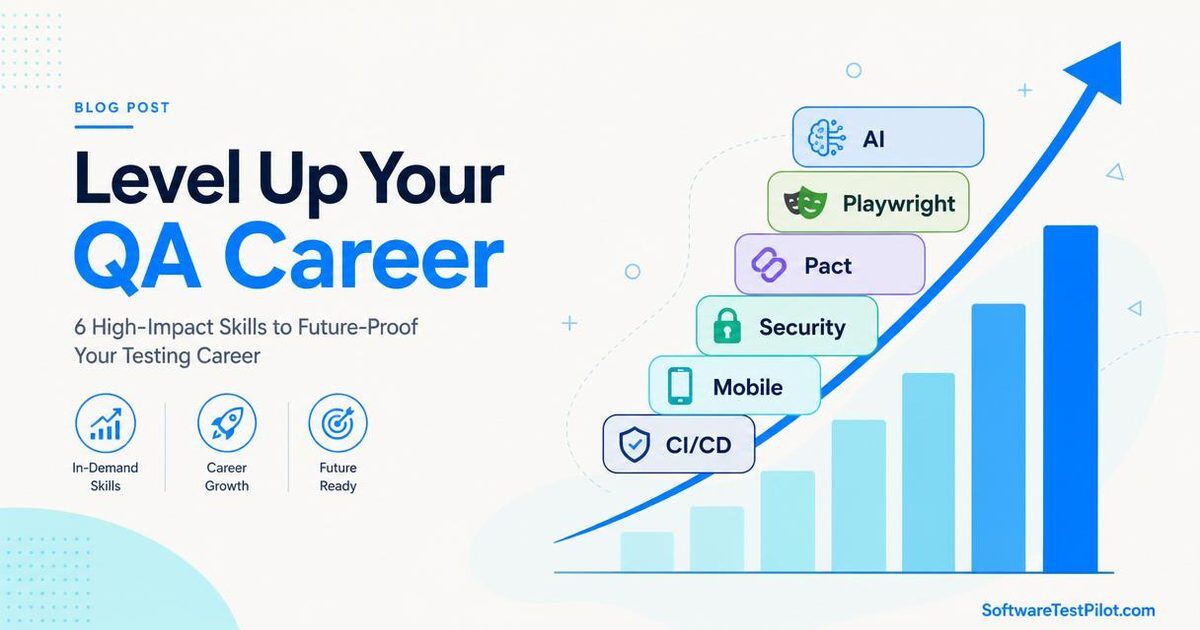
The skills that actually move your rate
Last updated: June 30, 2026 · 14 min read · By Avinash K
Here's the uncomfortable truth I run into almost every week: there are testers with eight years of experience charging $35 an hour, and testers with three years of experience charging $90. The difference isn't seniority. It isn't even raw talent. It's that one of them happens to have a skill the market is paying a premium for right now, and the other one is still selling what was hot in 2019.
If you're stuck in the $25–$40/hr band and you can't figure out why your proposals keep losing to people with similar resumes, this guide is for you. I'm going to walk through the 10 skills that are demonstrably moving freelance QA rates upward in 2026, why each one commands a premium, and what a realistic 90-day path looks like to add it to your offer.
This pairs with the Freelance Software Tester Rate Pricing Guide (which explains the math of what to charge) and the Freelancing for QA Engineers complete guide (which covers the broader business).
How rate-doubling skills actually get selected
Before we go through the list, let me explain the filter I'm using. Not every popular skill moves your rate. Plenty of trendy technologies show up in conference talks and never translate into client budget. The skills that do move rates almost always satisfy three conditions at once:
- Demand is high. A real, recurring set of companies need this solved.
- Supply is low. Most testers can't credibly deliver it yet.
- Value is obvious to the buyer. The skill ties directly to revenue, risk reduction, or compliance — things finance teams already have a budget for.
If a skill fails any one of those three, the rate premium evaporates. Every entry below clears all three as of mid-2026.
1. AI / LLM application testing
This is the single biggest rate-mover of the past two years and it's still the one I'd pick first if you're starting from scratch.
What's actually billable here:
- Prompt regression testing — proving a model upgrade didn't quietly break behavior
- Hallucination evaluation using LLM-as-judge frameworks
- RAG (Retrieval-Augmented Generation) quality testing
- Guardrail and safety testing
- Tools worth knowing: Promptfoo, DeepEval, LangSmith, Ragas
Testers who can build an evaluation pipeline for LLM features are charging $90–$200/hr routinely. Every B2B SaaS company is shipping AI features and almost none of them have a QA process for it. Start with our AI in Software Testing guide and the GitHub Copilot for QA Testers guide.
90-day path:
- Build evals against a public LLM using Promptfoo. Open-source it.
- Document a small RAG quality framework on GitHub.
- Write three LinkedIn posts breaking down a real LLM failure mode you discovered.
- Pitch one existing client on adding a 4-hour "AI eval audit" to your scope.
2. Performance engineering with k6 + cloud
Plain "load testing" is commoditized. What's still rare is performance engineering: automated perf gates in CI, distributed cloud load tests, capacity modeling, and translating results into business language.
- k6 Cloud, JMeter, Gatling, or Locust scripts
- Reading Datadog / Grafana / New Relic traces and tying them to test runs
- Spinning up AWS or GCP load generators on demand
- Performance budgets that block deploys when p95 latency regresses
Senior perf consultants charge $120–$180/hr. Start here: k6 Load Testing tutorial and k6 vs JMeter comparison.
3. Contract testing with Pact
Microservice teams ship integration bugs constantly. Consumer-driven contract testing prevents most of them, but fewer than one in twenty testers can credibly explain Pact at a whiteboard, let alone wire it into CI.
- Pact, Spring Cloud Contract
- Pact Broker setup and version management
- Integration into CI/CD with proper deploy gating
This is the textbook definition of "rare and obviously valuable." $90–$140/hr, and the work tends to convert into long-term retainer engagements. See Microservices Testing Strategy and the API Testing tutorial.
4. Playwright at enterprise scale
"I can write a Playwright test" is now table stakes. The premium skill is architecting Playwright for a large codebase:
- Page Object Models or composition patterns — see Playwright POM in TypeScript
- Parallel sharding and CI cost optimization — see GitHub Actions Selenium CI and Playwright Cloud Testing
- Custom fixtures and dependency injection patterns
- Visual regression integration that doesn't generate false-positive noise
- Network mocking with MSW + Playwright for deterministic flaky-free runs
Senior Playwright architects clear $90–$130/hr consistently. Foundation: Playwright complete guide, Playwright Framework Setup with TypeScript, Playwright Locators. Compare with Playwright vs Selenium.
5. Mobile test automation (real device + cloud)
Mobile QA is hard, expensive, and chronically underserved. Most freelancers won't touch it — which is exactly why rates stay high.
- Appium 2.x for cross-platform flows
- XCUITest (iOS) and Espresso (Android) for native depth
- BrowserStack, Sauce Labs, or LambdaTest device clouds
- CI on Bitrise or Codemagic
Solid freelance mobile automation engineers command $75–$130/hr. See Appium Mobile Testing tutorial and How to Test Mobile Apps as a Freelance QA.
6. Accessibility testing (WCAG 2.2 / 3.0)
The European Accessibility Act drove a sustained demand spike that hasn't slowed, and US-side ADA / Section 508 enforcement is sharper too. Compliance deadlines create urgent budget.
- WCAG 2.2 (and emerging 3.0)
- Tools: axe-core, Pa11y, Lighthouse, Accessibility Insights
- Screen reader testing across VoiceOver, NVDA, JAWS, and TalkBack
- Writing remediation guidance developers can actually act on
Specialists clear $80–$130/hr. Add an IAAP CPACC or WAS certification to skip past the "are you legit?" filter.
7. Security testing (practical AppSec)
This goes well beyond reading the OWASP Top 10. The premium is for testers who can find real vulnerabilities and write a report that doesn't get dismissed.
- Burp Suite Pro fluency — Repeater, Intruder, Logger
- Authenticated scanning that handles complex login flows
- API security testing including auth bypass and IDOR
- Mobile app security basics with MobSF and Frida
Mid-level practical AppSec testers earn $90–$160/hr. Stack OSCP or OSWE on top and you're consistently at $150+. Full path: Building a Niche Security Testing Freelance Practice.
8. CI/CD + test infrastructure engineering
Plenty of QA freelancers write tests. Very few can run those tests well at scale. That gap determines who gets the call when a release pipeline is on fire.
- GitHub Actions, GitLab CI, CircleCI, Buildkite
- Docker and Kubernetes basics — enough to debug a broken container
- Test parallelization, sharding, retry strategies that don't mask real flakes
- Selective test execution (test impact analysis) for big monorepos
This single skill regularly turns a $50/hr automation engineer into an $110/hr SDET overnight. See Shift-Left Testing in DevOps and Test Automation Framework Consulting.
9. Test data engineering
Underrated and ridiculously valuable. Teams burn entire sprints because nobody can produce a realistic dataset for a complex flow. Fix that and you're indispensable.
- Synthetic data generation with Faker or Mockaroo
- Database seeding, fixtures, factories — see SQL Queries Every Tester Should Know
- PII anonymization for staging environments (huge in healthcare and fintech)
- Stateful test environments for complex multi-step flows
Teams shipping financial, healthcare, or B2B products pay a real premium for testers who solve their test-data nightmare without leaking sensitive data into Slack.
10. Communication and stakeholder translation
The skill most testers ignore — and the one I've seen quietly double rates more often than any technical skill on this list.
- Writing executive-readable QA status updates that don't bury the lede
- Quantifying QA wins in dollars or hours saved
- Presenting test strategy to non-technical leadership
- Negotiating scope, timelines, and pushback when a deadline is unrealistic
Freelancers commanding $150/hr+ aren't just technically stronger — they're better at making leaders feel informed and de-risked. Practice this against realistic prompts in our AI Mock Interview.
Skill combos that multiply even faster
Individual skills double rates. Combinations multiply them. Some of the most lucrative stacks in 2026:
- AI testing + Playwright → premium for AI-first SaaS products, often $130+/hr
- API testing + Contract testing → microservices teams' dream, easy retainers
- Mobile + Performance → fintech and gaming pay extremely well here
- Accessibility + Communication → regulated enterprise loves a tester who can talk to legal
- Security + DevOps → "DevSecOps engineer" rate brackets ($130+/hr, sometimes much more)
Pick two skills whose combination tells a coherent story, and you're no longer competing with a thousand other generalists.
How to actually learn these (without quitting your day job)
- Build a public artifact — see How to Build a QA Testing Portfolio for Freelance Work.
- Use it on one paid project, even underpriced once to land the proof case.
- Write a case study about that project. Anonymize if you have to.
- Promote it for four weeks on LinkedIn — one post per week, each angled differently.
- Raise your rate on the next proposal based on this new positioning.
That cycle, repeated every 90 days, is how testers go from $35/hr to $100/hr+ within two years. Not fast, not magic — repeatable and compounding.
Skills the market pays less for in 2026
For balance — not useless, just not what's moving your rate up anymore:
- ISTQB Foundation alone (useful as signal; rarely moves rates by itself)
- Pure manual testing as a standalone offer (commoditized by offshore + AI tools)
- Selenium WebDriver in isolation — still in demand but no longer a differentiator (see Selenium WebDriver guide)
- TestRail and JIRA proficiency on its own (table stakes)
- "Bug reporting experience" as a sellable offer
If your current marketing leans on any of these as the headline skill, that's likely why your rate has been stuck.
12-month compounding plan
| Quarter | Skill Focus | Outcome |
|---|---|---|
| Q1 | Pick one anchor skill (e.g., AI testing). Build a portfolio repo. | First proof project, even unpaid |
| Q2 | Add CI/CD + test infrastructure as a complement | First $70/hr contract |
| Q3 | Layer accessibility OR security as a secondary | First $90/hr contract |
| Q4 | Productize an offer combining the two | First $5K+ fixed-price gig |
By end of year one, your rate floor has roughly doubled — and your ceiling has tripled, because productized offers don't trade hours for dollars the same way hourly work does.
What to do this week
Don't try to add four skills at once. Do this instead:
- Pick one anchor skill from the list above.
- Block 6 hours per week for the next 12 weeks. Calendar it. Treat it like a client.
- Start a public repo or write-up the same day.
- Run your resume through the Resume ATS Review and add the new skill in the right spots.
- Open the QA Jobs Radar and bookmark three roles asking for that skill. They're your target market in 90 days.
Practice technical depth against our Selenium Interview Questions, API Testing Interview Questions, and SQL Interview Questions as you go.