Remote QA Contract Work in 2026: Real Rates, Best Platforms & How to Land Long Engagements
Tired of one-off gigs? Here's the 2026 guide to remote QA contract work — realistic hourly and daily rates, the platforms that actually post real contracts, and how to land 6-month engagements.

Last updated: June 30, 2026 · 14 min read · By Avinash K
There's a sweet spot between freelancing one-off gigs and taking a full-time job that most QA engineers underestimate. It's called contract work, and in 2026 it's quietly become the highest-paying path in the QA career landscape — without the constant proposal-writing grind of gig freelancing or the politics of salaried roles.
A typical mid-career contract QA engineer in 2026 earns anywhere from $70 to $140 an hour on a stable 3 to 12 month engagement, often with a single client. Compared to full-time salaries, that's roughly 1.5–2× the equivalent W-2 take-home in the US, and even better margins in the UK and EU. Compared to gig freelancing, you spend dramatically less time selling and more time delivering.
The catch? Contract work is harder to find. Job boards bury it under full-time listings. Marketplaces lump it in with one-off gigs. And the highest-paying contracts almost never get advertised publicly — they come through networks and direct outreach.
This guide walks through where the work actually is, what it pays, and how to position yourself to land the kind of contracts that fund a real career. Pair it with our Remote QA Jobs guide and the Freelancing for QA Engineers complete guide.
Contract vs. gig freelance vs. full-time
These three terms blur together in everyday conversation, so let me draw a clearer picture.
| Mode | Typical Duration | Pay Model | Sales Effort |
|---|---|---|---|
| Gig freelance (Upwork/Fiverr) | Days to weeks | Hourly, small fixed | Constant pitching |
| Contract | 3–12 months, often renewable | Hourly, daily, or monthly retainer | Periodic per contract |
| Full-time | Permanent | Salary + benefits | One-time hiring loop |
Contract QA sits in the middle. Fewer sales cycles than gig work. More money than salary work. More autonomy than either. For the full freelance vs. full-time split, see Freelancing vs. Full-Time QA: An Honest Comparison.
What remote QA contracts actually pay
Let me give you the numbers without the marketing spin. These are realistic 2026 rates I've seen testers actually closing on.
Hourly contracts
| Role | US/UK Rate | Global Average |
|---|---|---|
| Manual QA (mid-level) | $45–$70/hr | $25–$45/hr |
| QA Automation Engineer | $70–$110/hr | $45–$75/hr |
| Senior SDET | $95–$140/hr | $65–$95/hr |
| Performance Engineer | $100–$160/hr | $70–$110/hr |
| Security Tester | $110–$180/hr | $80–$130/hr |
| Fractional QA Lead | $130–$220/hr | $90–$150/hr |
Daily contracts (more common in UK and EU markets)
- Junior: £200–£350/day
- Mid: £350–£500/day
- Senior: £500–£750/day
- Specialist consultant: £750–£1,200/day
Monthly retainers
- Part-time fractional QA lead: $4,000–$10,000/month
- Full-time interim QA manager: $12,000–$22,000/month
For the full rate logic, regional multipliers, and benchmarking sources, our Freelance Software Tester Rate guide has the deep dive, and our QA Engineer Salary Guide gives you the full-time comparison.
Where to actually find remote QA contracts in 2026
This is where most guides fail you — they list 30 generic job boards. Here's what actually produces contract leads for QA engineers in 2026.
Tier 1: Specialist contract platforms
These platforms exist specifically for contract and fractional work, not full-time hiring.
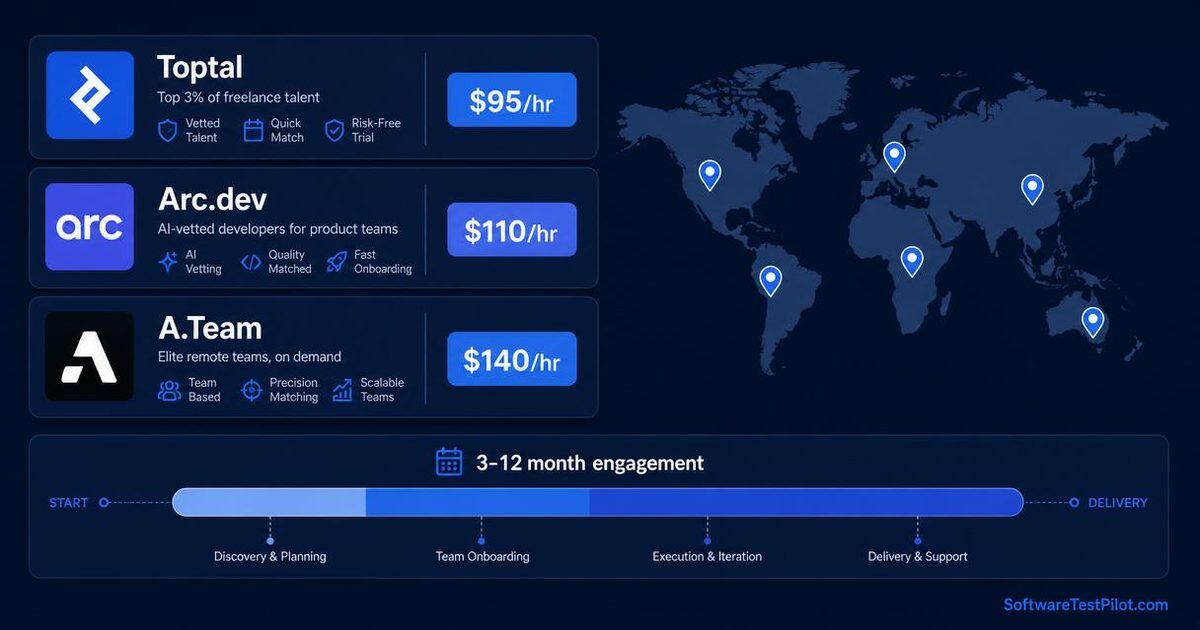
- Arc.dev — long-term contract roles for senior testers. Vetting is meaningful but not brutal.
- Toptal — premium contract work with serious vetting (under 5% pass rate). Once you're in, the work is steady.
- Andela — global talent network, contract assignments with enterprise clients.
- A.Team — fractional teams; QA leads in particularly high demand here in 2026.
- Braintrust — token-based marketplace with transparent fees.
Tier 2: Remote job boards (filter aggressively)
- Weworkremotely.com
- Remoteok.com
- Remote.co
- Wellfound (formerly AngelList Talent) — startups, often contract-to-hire
- Himalayas.app
- Working Nomads
The trick with these boards is to filter aggressively. Most postings are full-time. Look for keywords like "contract," "C2C," "freelance," "fractional," or "1099."
Tier 3: LinkedIn (still underrated for contracts)
LinkedIn is where many of the best contracts get posted, but they're easy to miss. Use this boolean search:
"QA" OR "SDET" OR "Test Engineer" AND ("contract" OR "contractor" OR "C2C" OR "freelance") AND "remote"
Save the search. Set daily alerts. You'll see 5–15 new postings a day, most of which are buried too deep in LinkedIn's regular feed to find organically.
Tier 4: Direct outreach (highest-paying contracts)
The highest-paying contracts almost always come from direct relationships, not job boards. Full playbook in How to Find Long-Term QA Consulting Clients.
The pattern that works:
- Build a target list of 100 companies that fit your ideal client profile (B2B SaaS at Series A/B is usually the sweet spot)
- Find the VP Engineering or CTO on LinkedIn
- Send a research-led, specific message that references something about their company
- Offer a small first step (an audit, a strategy session)
- Follow up 3–4 times across 6 weeks
A 100-company list typically generates 5–10 conversations and 1–3 long-term contracts. For continuous full-time + contract opportunities, our QA Jobs Radar is curated daily.
Contract structures you'll run into
Knowing the names of the contract types will help you negotiate confidently.
Time & Materials (T&M)
Hourly billing, weekly or biweekly invoices. The most common structure. Pros: simple, low risk for both sides. Con: caps your earnings at hours × rate, no incentive to be efficient. T&M is the right structure for your first one or two contracts with a new client.
Fixed-Scope
Defined deliverable, fixed price. Common for audits, framework builds, migrations. Pro: rewards efficiency. Con: scope creep can quietly destroy your margins. Need tight written scopes and a clear change-order process.
Retainer
Fixed monthly fee for a fixed number of hours. The best structure for senior contractors — predictable, defensible, high-margin. The catch is that retainers require trust, which usually means 3–6 months of T&M work first.
Statement of Work (SOW)
A hybrid — defined outcomes with hourly true-up if scope shifts. Common with enterprise clients. Most senior contractors I know move toward SOW + retainer combinations as they get more experienced.
Most freelancers move through this progression naturally: T&M → SOW → Retainer as they build trust with each client.
The legal and tax setup (briefly)
Contract work is more paperwork than gig freelance. A few essentials:
- US: LLC (single-member or S-Corp election once profit clears about $80K). Many contracts require either 1099 or corp-to-corp setup.
- UK: Limited company or umbrella; IR35 still matters in 2026 for determining inside/outside-scope status.
- EU: Sole proprietor (Einzelunternehmer, auto-entrepreneur) or limited company depending on the country.
- India: Sole proprietor or LLP; GST registration kicks in above ₹20L turnover.
- Cross-border payments: Deel, Remote.com, Wise Business are the tools most international contractors use.
Set aside 25–35% of every invoice for taxes from day one. Full operational setup is in How to Set Up a Freelance QA Testing Business.
How to stand out for contract work
Contract clients aren't buying tasks. They're buying risk reduction. They want someone who can plug in, ship, and not require hand-holding.
LinkedIn headline. Something specific and outcome-focused, not generic. Examples that work:
- "Fractional QA Lead helping B2B SaaS teams launch faster with zero P1 escapes"
- "Senior SDET — Playwright + AWS — available for 3–6 month contracts"
Compare to "QA Engineer | Tester | Quality Enthusiast | ISTQB Certified." The first version tells me what you do, who you help, and what outcome you create. The second tells me you have certifications.
Resume. Make sure it parses correctly through ATS systems. Run it through our Resume ATS Review. Contract recruiters often filter by keyword before a human sees your resume.
Portfolio. Contract clients will check your GitHub and your case studies. See How to Build a QA Testing Portfolio for Freelance Work for the artifact set that closes.
Interview patterns to expect
Contract interviews are usually 2 rounds (versus 4–6 for full-time). The shorter loop is one of the under-discussed benefits — you get from "hi" to "signed contract" in 7–14 days, not 8 weeks.
Round 1: Intro call (30 min). Fit, scope, rate. Most rejections happen here, usually on rate or timezone mismatch.
Round 2: Technical discussion (60 min). Sometimes a code review, sometimes a test plan exercise, rarely a leetcode-style screen. Be ready to:
- Whiteboard a test strategy for a hypothetical product
- Discuss an automation framework architecture (patterns from our Playwright Framework Setup with TypeScript guide)
- Explain how you'd reduce flakiness in an existing suite
- Talk through a debugging scenario
Practice realistic mock screens with our AI Mock Interview and refresh fundamentals with the Top 50 Software Testing Interview Questions.
Stacking contracts without burning out
The smart 2026 move isn't one 40-hour-per-week contract. It's two 20-hour contracts, or one 25-hour contract plus a productized side offer.
- Income resilience. No single point of failure. If one contract ends abruptly, you still have income.
- Higher effective hourly rate. When you have two clients, you're more selective with the third.
- Variety. You stay sharper because you're seeing different products and codebases.
The trap: trying to stack too much. Limit yourself to 35–40 total billable hours per week. Burnout kills contracting careers faster than recessions do.
Renewing and extending contracts
Most contracts auto-extend if you do the unspoken parts well. Specifically:
- Send a weekly status update even when nobody asked. One paragraph, what shipped, what's coming, what's at risk.
- Surface risks early, not late. Clients hate surprises. They love proactive communication.
- Quantify wins. "Reduced regression cycle from 3 days to 8 hours this sprint" is much more memorable than "the tests are working well."
- 30 days before contract end, propose the next engagement yourself. Don't wait for the client to bring it up.
A renewing client is worth roughly 5× a new one in unit economics. Build renewal-readiness into your operating system from day one.
The 12-month path to a $200K contract career
If you're committing to contract work as your primary path:
| Quarter | Focus | Outcome |
|---|---|---|
| Q1 | Niche selection, portfolio, first 1–2 short contracts via Upwork/Arc | First $5K–$15K revenue |
| Q2 | Land first 3-month contract; raise rate 20% | $25K–$50K cumulative |
| Q3 | Convert one project to a retainer; start LinkedIn content cadence | $80K–$120K cumulative |
| Q4 | Land a fractional QA lead role; stack with one part-time contract | $160K–$220K cumulative |
By month 12, $200K+ run-rate is realistic for a tester executing this with discipline.
What to do this week
- Update your LinkedIn headline using the patterns above. This is free and takes 10 minutes.
- Apply to one Tier 1 contract platform (Arc.dev, Toptal, or A.Team).
- Save the LinkedIn boolean search for contract roles and set daily alerts.
- Set up your business legally — How to Set Up a Freelance QA Testing Business.
- Connect with active contractors in the QA Network — they'll often surface contract leads informally.
The contract market in 2026 isn't slowing down. Companies have permanently moved toward fractional QA leadership, and the supply of senior contractors hasn't caught up to the demand.