
Stop Learning Selenium First in 2026 (Learn This Instead)
Jumping straight into UI automation is why QA beginners fail. Discover the 2026 foundation stack: HTTP protocols, TypeScript, SQL, Docker and Git.

Last updated: July 1, 2026 · 12 min read · By SoftwareTestPilot
Every week, aspiring QA engineers ask the same question: “Which Selenium course should I take first?” And almost every week, legacy YouTube tutorials give the same 2012 answer — “Install Eclipse, add Selenium JARs, copy an XPath, call driver.findElement().click().”
In 2026, following that trajectory is the #1 reason QA beginners burn out, write unmaintainable scripts, and fail SDET technical screens. When you jump straight into end-to-end browser automation without understanding HTTP protocols, asynchronous JavaScript, or database state, you build a career on sand. Whenever a test breaks from a race condition or network latency, you don’t know how to diagnose the response payload — you just copy-paste Thread.sleep(5000) until CI turns green.
Hiring managers at companies tracked on the SoftwareTestPilot QA Jobs Radar expose that gap in the first ten minutes of a screen. If you want a resilient career that commands $120,000+, put down Selenium WebDriver. Here is the 2026 Test Automation Foundation Stack you must master before ever launching a headless browser.
SoftwareTestPilot tip: Pair this roadmap with our 2026 Selenium architecture fix, Playwright complete guide, Postman → programmatic API tutorial, AI Mock Interview, and Resume ATS Review.
1. The inverted testing pyramid — why UI-first fails
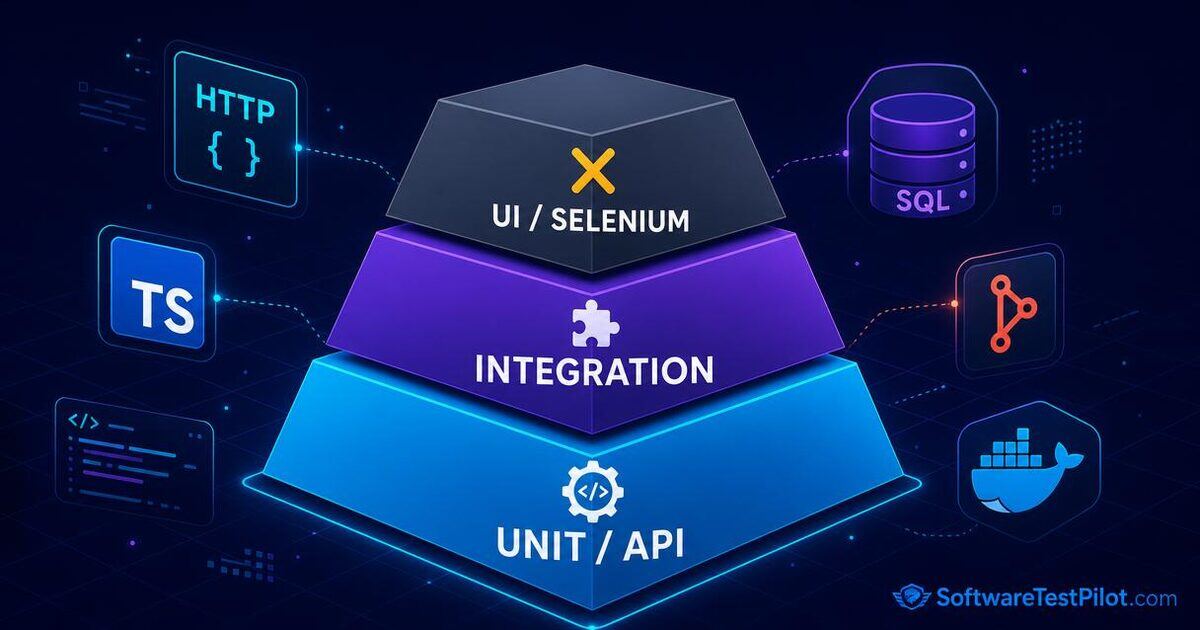
Mike Cohn’s Testing Pyramid still defines healthy coverage ratios in high-performing engineering orgs:
                  /\
                 /  \
                / UI \        <-- 10% End-to-End (slowest, most brittle)
               /------\
              /  API   \      <-- 30% Integration & API contract
             /----------\
            /    UNIT    \    <-- 60% Pure code / sub-second tests
           /--------------\
End-to-end UI automation sits at the very top for a reason — it is the slowest, most expensive, and most volatile layer of a software system. Every UI script depends on dozens of moving parts outside your control:
- DOM rendering mechanics — CSS animations, React/Next.js hydration, responsive shifts.
- Network asynchrony — API latency, CDN loads, third-party analytics scripts.
- Hardware overhead — CPU throttling, browser engine differences, GC pauses.
If you begin your programming journey in an environment where scripts break randomly because an animation took 200 ms too long, you conclude that programming is unpredictable. Start at the network + API layer instead and execution is deterministic — an endpoint either returns a 200 OK in 40 ms or throws a 400 Bad Request. Deterministic environments build engineering intuition; flaky ones destroy it.
2. Pillar 1 — HTTP protocol mastery & DevTools network diagnostics
Before automating web apps, understand how they talk. Every click, form submit, and dashboard view is a graphical wrapper around underlying HTTP/HTTPS transactions. An SDET who understands networking can decide in 30 seconds whether a bug lives in the React frontend or the backend API — just by inspecting network traffic.
+---------------------------------------------------------------+
|                CORE HTTP CONCEPTS EVERY SDET MUST KNOW        |
+---------------------------------------------------------------+
| 1. VERBS   GET / POST / PUT / PATCH / DELETE / OPTIONS        |
| 2. STATUS  2xx success · 3xx redirect · 4xx client · 5xx server|
| 3. HEADERS Content-Type · Authorization: Bearer <JWT>          |
|            Cache-Control · CORS pre-flight                    |
| 4. BODY    JSON serialization, multipart form-data uploads    |
+---------------------------------------------------------------+
Practical drill — Chrome DevTools Network tab
Open any SaaS app, press F12, switch to the Network tab, and filter by Fetch/XHR. Click a button and analyze the four diagnostic panels on the resulting request:
- Headers — request payload headers, CORS policies, response encoding.
- Payload — the exact JSON sent client → server.
- Response — raw server data before frontend rendering transforms it.
- Timing — TTFB bottlenecks and SSL handshake delays.
When an interviewer asks “your test failed in CI, what do you do first?”, the winning answer is always “read the network logs.” Master this and you become an investigative engineer, not a UI guesser. Deep dive: API testing interview questions hub and the MDN HTTP reference.
3. Pillar 2 — TypeScript & the async event loop
Once HTTP clicks, learn a modern production language. In 2026 TypeScript is the lingua franca of web development and automation. Choosing TS over legacy Java means you write tests in the same language as your React/Next/Vue app developers — instant PR-review credibility and shared type interfaces.
PHASE 1  MODERN SYNTAX & TYPE SAFETY
         let/const, strict types, interfaces, unions, optional chaining
PHASE 2  ASYNC ENGINE (THE EVENT LOOP)
         Promises, Promise.all, async/await, try/catch boundaries
PHASE 3  HIGHER-ORDER DATA MANIPULATION
         map / filter / reduce / find, destructuring, JSON.parse
Why async is the #1 blocker for beginners
In synchronous languages, code runs top to bottom. In JS/TS, I/O is non-blocking. Skip await and your assertion on line 3 executes before the network call on line 2 leaves the machine — a textbook flaky false negative.
// Bad: rookie mistake ignoring asynchronous Promise execution
function rookieTestFailure() {
  console.log('1. Starting user registration flow...');
  // Missing await -> returns a pending Promise immediately
  fetch('https://api.softwaretestpilot.com/v1/users');
  // Runs before server responds -> flaky assertion!
  console.log('2. Asserting database user creation...');
}

// Good: senior SDET deterministic asynchronous handling
async function seniorSdetExecution(): Promise<void> {
  console.log('1. Starting user registration flow...');
  try {
    const response = await fetch('https://api.softwaretestpilot.com/v1/users', {
      method: 'POST',
      headers: { 'Content-Type': 'application/json' },
      body: JSON.stringify({ email: 'candidate@softwaretestpilot.com' }),
    });
    if (!response.ok) throw new Error(`HTTP contract failure: ${response.status}`);
    const userData = await response.json();
    console.log(`2. User created deterministically with ID: ${userData.id}`);
  } catch (error) {
    console.error('Critical network execution error:', error);
  }
}
Master async/await, Promises, and exception boundaries before writing a single browser test. Related: Playwright + TypeScript tutorial.
4. Pillar 3 — API-first automation & SQL relational state
With networking and TypeScript solid, learn to verify software quality without a browser at all: programmatic API automation + relational database checks. Business logic lives in backend endpoints and DB tables — the button animation is irrelevant compared to whether inventory was actually decremented in Postgres.
Programmatic API contract verification
Ditch Postman clicking. Write standalone TS suites using Axios or Playwright’s native APIRequestContext:
// tests/api/contractVerification.spec.ts
import { test, expect } from '@playwright/test';

interface OrderPayload {
  orderId: string;
  customerId: string;
  totalAmount: number;
  status: 'PENDING' | 'PAID' | 'CANCELLED';
}

test.describe('Backend E-Commerce API Contract Suite', () => {
  const API_URL = 'https://api.softwaretestpilot.com/v1/orders';

  test('rejects order creation with 401 when Authorization header is missing', async ({ request }) => {
    const response = await request.post(API_URL, {
      data: { customerId: 'cust_99123', totalAmount: 149.99 },
    });
    expect(response.status()).toBe(401);
    expect((await response.json()).error).toBe('Unauthorized Access: Missing Bearer Token');
  });

  test('creates order successfully and returns a valid strict schema', async ({ request }) => {
    const response = await request.post(API_URL, {
      headers: { Authorization: 'Bearer test_jwt_token_2026' },
      data: { customerId: 'cust_99123', totalAmount: 149.99 },
    });
    expect(response.status()).toBe(201);
    const order: OrderPayload = await response.json();
    expect(typeof order.orderId).toBe('string');
    expect(order.totalAmount).toBe(149.99);
    expect(order.status).toBe('PENDING');
  });
});
Relational database state verification (SQL mastery)
Never trust an API return until you verify persistence in the DB layer. Every SDET must be comfortable joining, filtering, and aggregating across Postgres/MySQL:
-- Verify relational integrity across a multi-table checkout transaction
SELECT
    o.order_id,
    c.email AS customer_email,
    o.total_amount,
    p.transaction_status,
    p.settled_at
FROM orders o
INNER JOIN customers c        ON o.customer_id = c.customer_id
LEFT  JOIN payment_ledger p   ON o.order_id     = p.order_id
WHERE c.email = 'sdet_candidate@softwaretestpilot.com'
  AND o.created_at >= NOW() - INTERVAL '1 HOUR';
Combine API automation with SQL verification and you regression-test an entire enterprise backend in under three seconds. Practice more in our SQL interview questions hub and Postman API tutorial.
5. Pillar 4 — Git CLI workflow & Docker containerized sandboxing
The final foundational pillar is infrastructure fluency — Version Control (Git) and Containerization (Docker). Modern automation code lives in the same monorepo as the app. If you can’t manage branches, resolve merge conflicts, or run tests inside a Linux container, your scripts stay marooned on your laptop.
+---------------------------------------------------------------+
|         ESSENTIAL GIT & DOCKER COMMANDS FOR SDETS             |
+---------------------------------------------------------------+
| GIT                                                           |
|  git checkout -b feature/api-test-harness                     |
|  git rebase -i main                                           |
|  git diff --staged                                            |
+---------------------------------------------------------------+
| DOCKER                                                        |
|  docker run -it --rm \                                        |
|    mcr.microsoft.com/playwright:v1.45.0-jammy /bin/bash       |
|  docker-compose up -d postgres redis                          |
+---------------------------------------------------------------+
Senior SDETs obsess over Docker because it eliminates the classic excuse “well, it passed on my Mac.” Immutable container images make local runs and GitHub Actions cloud runners behave identically. Pair with our Docker for Selenium Grid and CI/CD pipeline testing tutorial.
6. How this foundation makes Playwright a 14-day skill
After six to eight weeks on HTTP, async TypeScript, API contracts, and Git/Docker, pick up a modern browser framework like Playwright (see our Playwright installation guide). Watch what happens:
- You don’t struggle with syntax — Playwright commands are simple
awaitPromises. - You don’t write slow UI registration flows — you seed accounts via
requestfixtures in 50 ms before opening the browser. - You don’t hit random StaleElement exceptions — you understand the event loop and enforce atomic
data-testidcontracts.
Advanced Playwright capabilities — network route mocking, multi-tab contexts, visual regression — become a 14-day skill instead of a six-month trial-and-error slog. Deep dive: Playwright complete guide and Playwright locators guide.
7. Conclusion & your 24-hour next step
The 2026 software industry has zero tolerance for fragile copy-pasted UI scripts. Build your house on rock: master HTTP diagnostics, become fluent in async TypeScript, verify business logic through API + SQL, and manage infrastructure with Git and Docker. UI automation then becomes an effortless final layer on a bulletproof engineering skillset.
Do this in the next 24 hours: close the browser tutorials and open a terminal. Initialize a clean Node project (npm init -y && npm i -D typescript @types/node), create index.ts, and write an async function that fetches JSON from a public API, inspects response headers, and parses the payload into a strict TypeScript interface.
Then benchmark your foundation in the AI Mock Interview, tune your resume via the Resume ATS Review, and browse live six-figure SDET requisitions on the QA Jobs Radar.
Related reading: Why 90% of Selenium tests fail in CI/CD, $65k → $120k SDET 90-day plan, SDET Roadmap 2026, Playwright vs Selenium. External: Playwright API testing docs, Postgres JOIN tutorial.