
How Playwright Dethroned Selenium in 2026: Architecture & Benchmark Deep Dive
For the first time in a decade, Playwright surpassed Selenium in NPM downloads, GitHub stars, and enterprise adoption. Here is the WebSocket CDP vs HTTP WebDriver deep dive, with 2026 benchmarks and a migration roadmap.

Last updated: July 1, 2026 · 14 min read · By SoftwareTestPilot
For nearly two decades, Selenium WebDriver was the unchallenged monarch of web automation. Born at ThoughtWorks in 2004, Selenium democratized browser testing across Java, C#, Python, and Ruby. For fifteen years, when an enterprise team announced a new E2E regression suite, the only question was which language binding they would use.
Then Q2 2026 happened. For the first time in software engineering history, Microsoft Playwright officially surpassed Selenium WebDriver across every meaningful adoption indicator we track on the SoftwareTestPilot QA Jobs Radar — NPM weekly downloads, GitHub stars, active contributors, and new enterprise standardization RFCs.
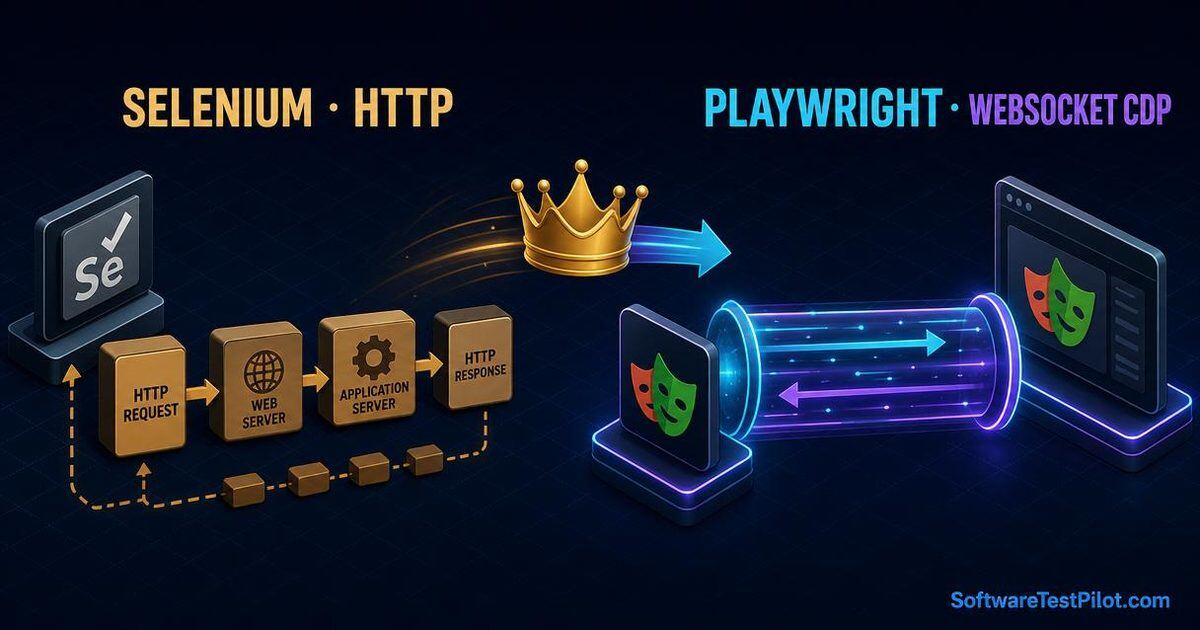
This leadership change was not driven by marketing. It was driven by physics, network protocols, and architectural alignment with modern SPAs. Selenium was architected for static, server-rendered pages over synchronous HTTP. Playwright was architected from scratch for asynchronous WebSockets and the Chrome DevTools Protocol (CDP). Here is the technical deep dive, benchmark data, and migration roadmap.
SoftwareTestPilot tip: Pair this analysis with our Playwright complete guide, the 2026 Selenium architecture fix, our foundation stack roadmap, the AI Mock Interview, and the Resume ATS Review.
2. The core protocol gap — WebDriver HTTP vs WebSocket CDP
+-------------------------------------------------------------------+
|          SELENIUM HTTP REQUEST/RESPONSE LATENCY LOOP              |
+-------------------------------------------------------------------+
|  [Test Script]                                                    |
|      |  HTTP POST /session/{id}/element/click                     |
|      v                                                            |
|  [ChromeDriver Binary]                                            |
|      |  Translates HTTP -> OS browser command                     |
|      v                                                            |
|  [Chrome Process]  --HTTP 200--> back to Test Script              |
+-------------------------------------------------------------------+
The Selenium latency tax
Every browser interaction in Selenium is an isolated HTTP transaction. A simple login (find username → type → find password → type → find submit → click) initiates at least five HTTP REST round-trips. Each requires TCP handshakes, JSON parsing, and driver translation. In a 10,000-action suite that adds 20–30 minutes of pure network latency.
+-------------------------------------------------------------------+
|          PLAYWRIGHT BI-DIRECTIONAL WEBSOCKET STREAMING            |
+-------------------------------------------------------------------+
|  [Playwright Test Engine]  <==WebSocket==>  [Chromium/Firefox/WebKit]|
|                                                                   |
|  Commands stream without renegotiation.                           |
|  Browser pushes DOM mutations, console logs, network frames back. |
+-------------------------------------------------------------------+
The Playwright WebSocket advantage
Playwright opens a single persistent WebSocket into the browser engine — CDP for Chromium, native bridges for Firefox and WebKit. Communication is full-duplex, so the engine knows the exact millisecond a button finishes hydrating. Read Playwright's Page API and the Chrome DevTools Protocol reference.
3. Browser contexts & parallel isolation architecture
How Selenium isolates: heavy OS process spawning
To keep tests clean, Selenium launches a new browser OS process (chromedriver --port=…) per test. Each Chrome process eats 250–400 MB of RAM and 1.5–3.0 s of CPU. Try ten parallel instances on a 4-core CI runner and the OS thrashes into OOM kernel panics.
How Playwright isolates: sub-millisecond browser contexts
+-------------------------------------------------------------------+
|          PLAYWRIGHT BROWSER CONTEXT PARALLEL ISOLATION            |
+-------------------------------------------------------------------+
|  [SINGLE OS CHROMIUM PROCESS]                                     |
|      +--> Context 1  (Worker 1) — unique cookies / localStorage   |
|      +--> Context 2  (Worker 2) — isolated incognito sandbox      |
|      +--> Context 3  (Worker 3) — full network state separation   |
+-------------------------------------------------------------------+
Playwright separates the physical browser instance from the logical browser context. It launches Chromium once, then spawns lightweight contexts per test — each with its own cookies, storage, cache, and network state — in under 20 ms.
4. Speed & reliability benchmarks — Selenium vs Playwright
Our QA engineering team ran an identical 50-scenario regression suite on both frameworks. Environment: GitHub Actions Ubuntu 22.04, 4 vCPUs / 16 GB RAM. App: Next.js 15 + GraphQL e-commerce portal.
| Metric | Selenium 4 (Java) | Playwright (TS) | Improvement |
|---|---|---|---|
| Total suite time (50 tests) | 24 min 18 s | 6 min 42 s | 3.6× faster |
| Clean sandbox launch | 2,150 ms | 18 ms | 119× |
| Peak memory | 11.4 GB | 3.8 GB | 66% less |
| Flaky failure rate | 12% | 0.8% | 15× more reliable |
Why Playwright eliminates flakiness — native auto-waiting
When you call await page.locator('[data-testid="submit"]').click(), Playwright runs an automatic actionability check before firing: element attached? visible? stable (not animating)? enabled? receiving pointer events? Only when all five conditions hold does the click execute. No more WebDriverWait or Thread.sleep().
5. Side-by-side code — network interception & mocking
Selenium 4 — cumbersome CDP wrappers
DevTools devTools = driver.getDevTools();
devTools.createSession();
devTools.send(Fetch.enable(
  Optional.of(List.of(new RequestPattern(Optional.of("*api/v1/payments/charge*"),
    Optional.empty(), Optional.empty()))),
  Optional.empty()
));
devTools.addListener(Fetch.requestPaused(), request -> {
  String mock = "{\"status\":\"SUCCESS\"}";
  devTools.send(Fetch.fulfillRequest(
    request.getRequestId(), 200,
    Optional.of(List.of(new HeaderEntry("Content-Type","application/json"))),
    Optional.of(Base64.getEncoder().encodeToString(mock.getBytes())),
    Optional.empty()
  ));
});
Playwright — native declarative one-liner
import { test, expect } from '@playwright/test';

test('checkout succeeds when payment gateway returns mocked success', async ({ page }) => {
  await page.route('**/api/v1/payments/charge', async route => {
    await route.fulfill({
      status: 200,
      contentType: 'application/json',
      body: JSON.stringify({
        status: 'SUCCESS',
        transactionId: 'tx_mock_playwright_2026',
        authorizedAmount: 299.99,
      }),
    });
  });

  await page.goto('https://softwaretestpilot.com/checkout');
  await page.locator('[data-testid="pay-now-button"]').click();
  await expect(page.locator('[data-testid="order-confirmation-banner"]')).toBeVisible();
  await expect(page.locator('[data-testid="transaction-id"]')).toHaveText('tx_mock_playwright_2026');
});
No base64, no session bindings, no driver conversions. Declare the route, define the contract, run the test. See the full API surface in our Playwright locators guide and the API mocking tools comparison.
6. Enterprise coexistence & migration roadmap
+-------------------------------------------------------------------+
|             4-STAGE ENTERPRISE MIGRATION ROADMAP                  |
+-------------------------------------------------------------------+
| STAGE 1  · FREEZE LEGACY GROWTH (WEEK 1)                          |
|   All new features automated in Playwright/TypeScript. Zero new   |
|   Selenium tests accepted in PRs.                                 |
+-------------------------------------------------------------------+
| STAGE 2  · PARALLEL CI COEXISTENCE (WEEKS 2-6)                    |
|   Legacy Selenium runs nightly. Playwright suite is the blocking  |
|   PR check in GitHub Actions / Jenkins.                           |
+-------------------------------------------------------------------+
| STAGE 3  · STRANGLER FIG REFACTOR (MONTHS 2-4)                    |
|   Rewrite the top 20% flakiest Selenium scripts into atomic       |
|   Playwright suites first — biggest CI wins.                      |
+-------------------------------------------------------------------+
| STAGE 4  · ARCHIVAL & DECOMMISSION (MONTH 6)                      |
|   Retire the legacy Selenium infrastructure once Playwright       |
|   covers core journeys. Reclaim RAM budget.                       |
+-------------------------------------------------------------------+
Interview leverage: As thousands of companies transition their stacks in 2026, candidates who can articulate why Playwright is faster command top-of-market compensation. Pair this article with our Playwright installation guide, the Playwright complete guide, and the AI Interview Coach. Verify your migration achievements land on the page with the ATS Resume Reviewer.
7. Conclusion & your 24-hour action step
Selenium built the foundation of automated quality for two decades — and deserves that respect. But synchronous HTTP loops and heavy OS process spawning are architectural bottlenecks that modern cloud DevOps can no longer absorb. Playwright wins by aligning with modern web architecture: full-duplex WebSocket streaming, sub-millisecond context sandboxing, native auto-waiting, and first-class route mocking.
Your 24-hour action step
Pick one flaky UI regression in your current suite. Rewrite it as a Playwright test (npx playwright test), then run it ten times in parallel:
npx playwright test --repeat-each=10Experience the zero-flake stability firsthand — then browse live six-figure Playwright openings on the SoftwareTestPilot QA Jobs Radar.