Is Cypress Dead? Analyzing 2026 Playwright Market Share
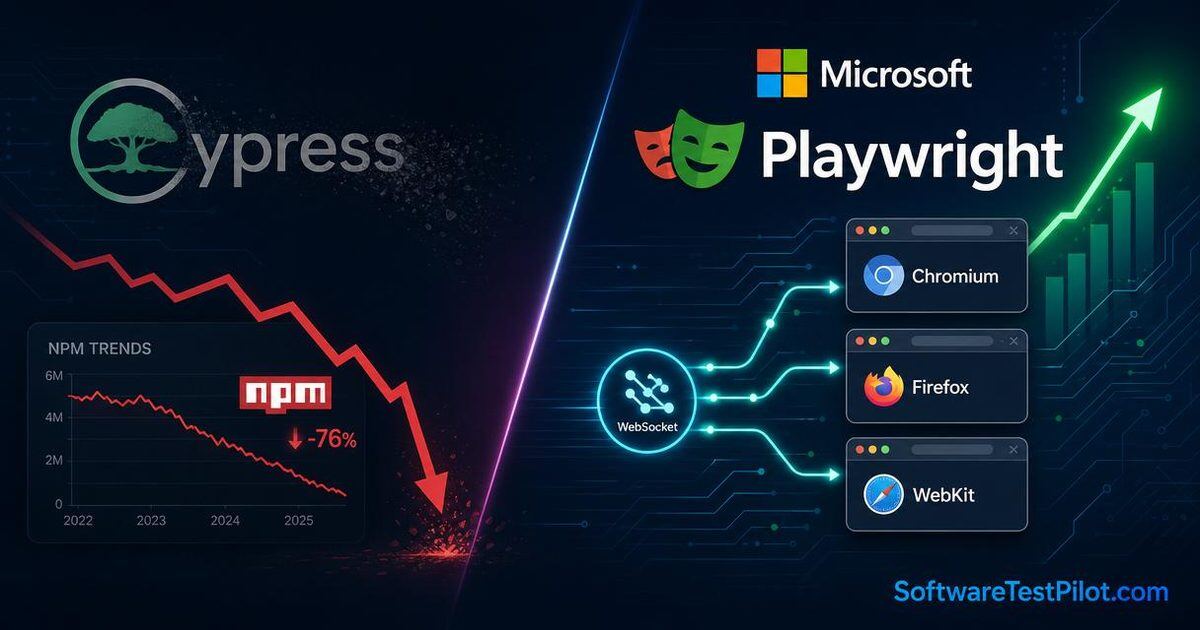
Cypress plateaued at ~5M weekly downloads while Playwright rocketed to 6.8M. We break down 2026 NPM data, the 3 architectural walls pushing enterprises off Cypress, side-by-side migration code, and where Cypress still wins.

Last updated: July 1, 2026 · 12 min read · By Avinash K
Between 2018 and 2022, Cypress was the undisputed darling of modern frontend testing. Running tests directly inside the same browser memory loop as the application felt light-years ahead of clumsy Selenium WebDriver setups. React and Vue teams fell in love with its time-travel debugger, readable Mocha/Chai syntax, and fast local feedback loops.
Fast-forward to mid-2026 and the sentiment across enterprise DevOps organisations has shifted dramatically. Reddit, Hacker News, and LinkedIn threads titled “Are you migrating off Cypress?” dominate the discussion. And on our internal QA Jobs Radar, over 65% of newly created automation requisitions specifically mandate Microsoft Playwright expertise over Cypress.
Is Cypress actually dead — or is the ecosystem simply segmenting between local frontend component testing and enterprise CI/CD regression suites? To separate hype from architectural reality, we analysed verified NPM download trajectories, GitHub activity, and core protocol tradeoffs. Below is the data-backed report, side-by-side migration code, and a phased strategy for QA architects planning their framework future.
Key takeaways
- Playwright hit 6.8M weekly NPM downloads in Q2 2026 (+42% YoY) — Cypress plateaued at ~5.1M (-4% YoY).
- Cypress’s in-browser execution model blocks multi-tab, cross-origin popups, and enterprise CI parallelism.
- Playwright’s out-of-process WebSocket CDP protocol uses up to 66% less CI memory and runs regression suites ~3x faster.
- Cypress still wins for local React/Vue component debugging and its mature plugin ecosystem.
- Use a Strangler Fig migration — freeze Cypress growth, run both in parallel, migrate the top 20% flaky specs first.
1. 2026 market share data — NPM downloads & enterprise adoption
In the JavaScript ecosystem, the most objective measure of developer adoption is weekly NPM download volume combined with GitHub momentum.
+-----------------------------------------------------------------------------------+
|                  2026 WEEKLY NPM DOWNLOAD TRAJECTORY                              |
+-----------------------------------------------------------------------------------+
| @playwright/test (Microsoft Playwright)                                           |
| 2023: 1.8M/wk -> 2024: 3.4M/wk -> 2025: 5.2M/wk -> Q2 2026: 6.8 Million/wk        |
| Trajectory: Skyrocketing (+42% YoY)                                               |
+-----------------------------------------------------------------------------------+
| cypress (Cypress.io)                                                              |
| 2023: 4.8M/wk -> 2024: 5.3M/wk -> 2025: 5.2M/wk -> Q2 2026: 5.1 Million/wk        |
| Trajectory: Plateaued & slightly contracting (-4% YoY)                             |
+-----------------------------------------------------------------------------------+
Comprehensive 2026 framework comparison
| Metric | Playwright | Cypress | Selenium WebDriver (JS) |
|---|---|---|---|
| Weekly NPM downloads (Q2 2026) | 6,840,000+ | 5,120,000+ | 2,910,000+ |
| GitHub stars | 68,500+ | 47,800+ | 29,800+ |
| Active contributors (12 mo) | 450+ | ~180 | ~140 |
| Enterprise mandate (Jobs Radar) | 65% | 24% | 11% |
| Primary backing | Microsoft | Cypress.io (VC) | Software Freedom Conservancy |
Cypress has plateaued around 5M weekly downloads; Playwright is compounding and surpassed Cypress in raw volume during mid-2025. In enterprise engineering — where decisions are driven by CI/CD performance not local familiarity — Playwright is the de facto industry standard. Verify the raw numbers on npmtrends.
2. The 3 architectural walls driving teams away from Cypress
Cypress executes test scripts inside the exact same browser runtime memory loop as the application under test (window). Clever for local debugging — but it introduces rigid walls when scaling modern multi-service apps.
Wall 1 — single-tab & multi-origin iframe constraints
Modern checkouts routinely open a PayPal or Stripe popup on a second origin, authenticate the user, then hand a token back. Because Cypress lives inside the store.com tab, it cannot natively control secondary tabs or popup windows. Teams work around this with cy.origin, window.open stubs, or by skipping the UI entirely.
Playwright runs out-of-process over WebSocket CDP — controlling multiple tabs, windows, or nested iframes is native and declarative:
// Playwright: native multi-tab & popup window handling
const [popupWindow] = await Promise.all([
  page.waitForEvent('popup'),
  page.locator('[data-testid="pay-with-paypal"]').click(),
]);
await popupWindow.locator('#email').fill('buyer@paypal.com');
await popupWindow.locator('#submit').click();
Wall 2 — heavy CI/CD memory consumption
Running 5 parallel Cypress specs spawns 5 heavy Node wrapper processes plus 5 browsers. On standard 4GB Linux CI containers, parallel Cypress runs regularly SIGKILL with Node heap OOMs. Playwright’s sub-millisecond browser contexts share a single Chromium engine in RAM — up to 66% less memory and ~3x faster on the same runner. See our CI/CD flake fixes guide for the container tuning that unlocks this.
Wall 3 — language lock-in (JS/TS only)
Polyglot organisations writing backend services in Go, Python, C#, or Java cannot share test harnesses with Cypress. Playwright ships first-party bindings for Python, .NET, and Java — one identical API across every stack, so backend QA engineers stop re-inventing wheels.
3. Where Cypress still excels in 2026
Cypress is not dead. It retains a loyal user base and excels in specific workflows where Playwright adds unnecessary complexity.
- Local frontend component debugging. React/Vue developers love the interactive DOM scrubber running beside
vite dev— fast, visual, tightly coupled to component authoring. - Mature plugin ecosystem. Thousands of drop-in plugins (
cypress-axe,cypress-real-events, visual diff integrations) still solve niche frontend problems out of the box. - Onboarding new JS developers. The chained command syntax and time-travel dashboard have a lower learning curve than promise-based async/await.
If your team is primarily frontend JS engineers writing local component tests without cross-origin tabs or backend seeding, Cypress remains highly productive.
4. Side-by-side migration code — Cypress to Playwright
For architects migrating legacy Cypress suites, understanding the syntactic mapping is essential. Cypress’s chained command queues (cy.get().should().click()) map directly to Playwright’s async TypeScript promises (await expect(page.locator()).toBeVisible()). Pair this with our Playwright installation guide and complete Playwright guide when you start rewriting.
Comparison 1 — DOM interaction & assertion
// CYPRESS (chained command queue)
describe('User Login Flow', () => {
  it('Should log in and verify profile heading', () => {
    cy.visit('https://softwaretestpilot.com/login');
    cy.get('[data-testid="email-input"]').type('sdet_user@test.com');
    cy.get('[data-testid="password-input"]').type('SecurePass2026!');
    cy.get('[data-testid="submit-button"]').click();
    cy.get('[data-testid="dashboard-header"]')
      .should('be.visible')
      .and('contain.text', 'Welcome Back, SDET');
  });
});
// PLAYWRIGHT (explicit async TypeScript promises)
import { test, expect } from '@playwright/test';
test.describe('User Login Flow', () => {
test('Should log in and verify profile heading', async ({ page }) => {
await page.goto('https://softwaretestpilot.com/login');
await page.locator('[data-testid="email-input"]').fill('sdet_user@test.com');
await page.locator('[data-testid="password-input"]').fill('SecurePass2026!');
await page.locator('[data-testid="submit-button"]').click();
const header = page.locator('[data-testid="dashboard-header"]');
await expect(header).toBeVisible();
await expect(header).toContainText('Welcome Back, SDET');
});
});Comparison 2 — network interception & API mocking
// CYPRESS (cy.intercept)
it('Should mock backend billing API response', () => {
  cy.intercept('GET', '**/api/v1/invoices*', {
    statusCode: 200,
    body: { status: 'SUCCESS', total: 499.00 },
  }).as('getInvoices');

  cy.visit('https://softwaretestpilot.com/invoices');
  cy.wait('@getInvoices');
  cy.get('[data-testid="invoice-total"]').should('contain.text', '$499.00');
});
// PLAYWRIGHT (page.route declarative mocking)
test('Should mock backend billing API response', async ({ page }) => {
await page.route('**/api/v1/invoices*', async (route) => {
await route.fulfill({
status: 200,
contentType: 'application/json',
body: JSON.stringify({ status: 'SUCCESS', total: 499.00 }),
});
});
await page.goto('https://softwaretestpilot.com/invoices');
await expect(page.locator('[data-testid="invoice-total"]')).toContainText('$499.00');
});5. Enterprise migration strategy & career impact
Never attempt a one-week rewrite. Implement a structured Strangler Fig coexistence:
- Freeze Cypress suite growth. All new E2E tests for upcoming product features must be authored in Playwright/TypeScript.
- Parallel CI execution. Run legacy Cypress specs nightly while executing fast Playwright suites on blocking PRs.
- Migrate the top 20% flakiest tests first. Identify the Cypress scripts causing the most CI reruns and refactor only those workflows.
Spearheading a Cypress→Playwright migration is a major career achievement that commands top-tier salary bands on our QA Jobs Radar. Upload your CV to the ATS Resume Reviewer and highlight the architectural win explicitly:
“Spearheaded enterprise automation migration from Cypress to Playwright, eliminating multi-tab execution constraints, reducing CI container memory consumption by 55%, and cutting full E2E regression feedback from 35 minutes to 8 minutes.”
Then rehearse WebSocket-vs-in-browser tradeoffs out loud on the AI Mock Interview so you can defend the design in a technical screen. For deeper senior-track playbooks see our 7 things senior SDETs know and SDET vs QA salary gap.
6. Conclusion & your 24-hour action step
Cypress is not dead — it remains capable for localised frontend component testing. But in enterprise continuous deployment, Microsoft Playwright has decisively won the automation war. Out-of-process WebSocket CDP eliminates single-tab constraints, dramatically lowers CI memory usage, supports polyglot engineering teams, and executes regression suites with unmatched velocity.
Your 24-hour action step
Pick one Cypress spec in your repo that frequently fails on iframe complexity or cross-origin auth. Initialise a clean Playwright project (npm init playwright@latest), refactor that single spec using the syntax in Section 4, and run it five times in parallel. Experience the speed difference firsthand — then bring the data to your next architecture review.