The Real Reason You're Stuck as a Manual Tester (Hint: It's Not Your Skills)
You're not stuck in manual QA because of missing coding skills — you're stuck in the Permission Trap. The 60-day stealth blueprint to become an automation engineer on company time in 2026.

Last updated: July 2, 2026 · 13 min read · By Avinash K
It's Tuesday, 9:15 AM. In your Zoom standup, the backend developer talks about refactoring authentication middleware. The frontend developer describes wiring React hooks into checkout. Then the Scrum Master turns to you, and you repeat the same sentence you've said for two years: “Yesterday I ran the manual regression checklist for v2.4. I found three UI bugs. Today I'm continuing manual regression.”
You open the SoftwareTestPilot QA Jobs Radar and see SDET roles paying $130,000–$160,000+, while your comp stays locked at $68,000. You tell yourself, “I'm stuck because I don't know enough programming. I need to finish that TypeScript course first.”
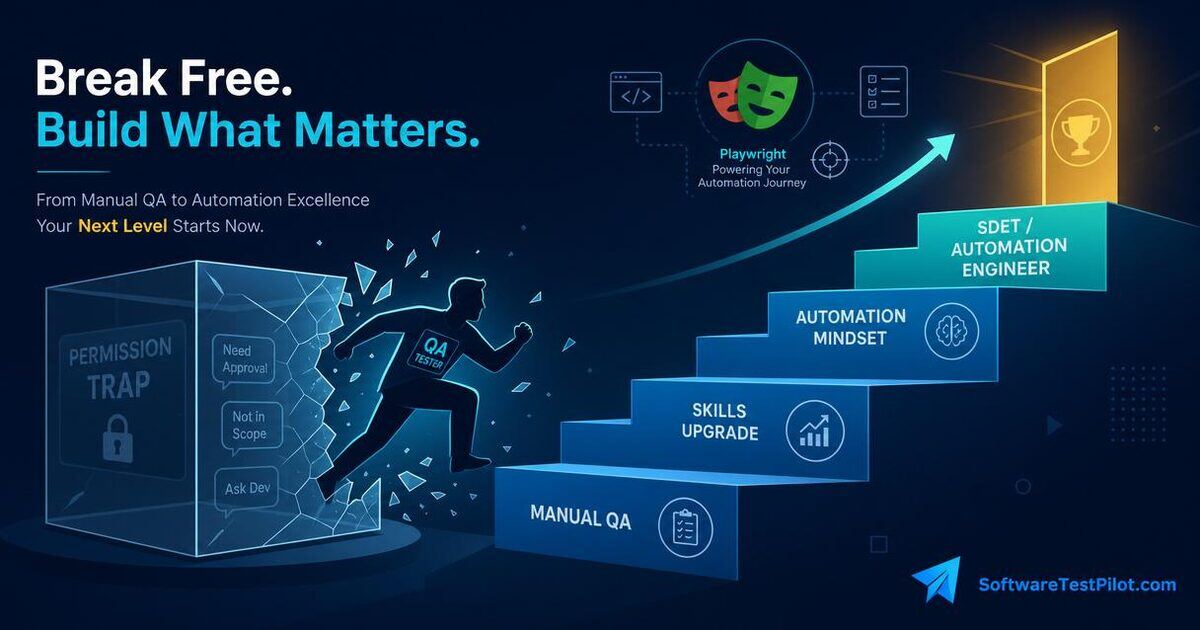
Here's the uncomfortable truth no bootcamp will tell you: your technical skill deficit is not the primary reason you're stuck. Thousands of manual QAs who have completed Python, Java and Playwright courses still spend 100% of their week clicking through checklists. They're trapped by a psychological and organizational pattern called The Permission Trap.
SoftwareTestPilot tip: Pair this with the $65k → $120k SDET 90-day plan, the Manual → SDET migration guide, the Manual to Automation hub, the ATS Resume Reviewer, and the AI Mock Interview.
1. The Permission Trap in Agile sprint planning
+-----------------------------------------------------------------------------------+
|                        THE SPRINT PLANNING PERMISSION TRAP                        |
+-----------------------------------------------------------------------------------+
| QA:  "Can we allocate 8 story points to build a Playwright regression suite for   |
|       our user registration flow this sprint?"                                    |
| PM:  "Love the idea, but we have a customer commitment Friday. If you spend 3     |
|       days writing code, who runs the 150 manual test cases? Let's revisit next   |
|       quarter when things slow down."                                             |
+-----------------------------------------------------------------------------------+
Engineering managers are measured on feature delivery velocity. Product Owners view QA through one lens: risk containment against the release deadline. If you wait for someone to file a Jira ticket labelled “Task: Write Automation Scripts” and hand it to you during planning, you will wait forever.
Sprints never slow down. There's always another escalation, another hotfix, another commitment. As long as you position yourself as a passive subordinate who needs permission to write code, leadership will keep assigning the manual execution that unblocks the release.
A backend developer doesn't ask the Scrum Master for permission to write unit tests — automated verification is intrinsic to professional software craftsmanship. Adopt the same posture.
2. Rebrand yourself: from "bug finder" to "product risk advisor"
+-----------------------------------------------------------------------------------+
|                        THE ENGINEERING VALUE HIERARCHY                            |
+-----------------------------------------------------------------------------------+
| LEVEL 3: PRODUCT RISK & VELOCITY ADVISOR   (High Value / High Pay)                |
|   Identifies architectural flaws in design reviews before code is written.        |
|   Builds automated infrastructure so developers self-test pull requests.          |
+-----------------------------------------------------------------------------------+
| LEVEL 2: AUTOMATION SCRIPT WRITER          (Medium Value)                         |
|   Translates existing manual checklists into UI automation post-merge.            |
+-----------------------------------------------------------------------------------+
| LEVEL 1: MANUAL EXPLORATORY EXECUTIONER    (Low Leverage / Capped Pay)            |
|   Manually clicks through UI screens after deploy to log cosmetic Jira bugs.      |
+-----------------------------------------------------------------------------------+
To break out of Level 1, change your vocabulary in Agile meetings. Stop talking about “running test cases” and start talking about system risk coverage and execution speed.
When a dev proposes a feature during refinement, don't ask “When will the UI be ready for me to test?” Ask like a senior quality engineer:
“What are our primary API failure boundaries for this service, and how can we seed deterministic test data into staging so we can automate regression at the pull-request layer?”
That single reframing forces developers and managers to treat you as a technical peer. See the exact framing in our deterministic test data engineering deep dive.
3. The 60-day stealth automation blueprint
+-----------------------------------------------------------------------------------+
|                  THE 60-DAY STEALTH AUTOMATION TRANSFORMATION                     |
+-----------------------------------------------------------------------------------+
| DAYS  1 - 20: AUTOMATE TEST DATA SETUP (LOW-HANGING FRUIT)                        |
|   Stop manually registering test accounts. Seed data over internal REST APIs.     |
+-----------------------------------------------------------------------------------+
| DAYS 21 - 40: BUILD LOCAL SMOKE HARNESSES IN PLAYWRIGHT                           |
|   Init a local Playwright project. Automate your 5 most tedious smoke flows.     |
+-----------------------------------------------------------------------------------+
| DAYS 41 - 60: INTEGRATE WITH PR REVIEWS & PRESENT ROI                             |
|   Attach execution logs to Jira. Show directors your scripts cut testing 70%.     |
+-----------------------------------------------------------------------------------+
Days 1–20: eradicate manual test data setup
Think about how much time you burn every sprint manually preparing data. If you test an e-commerce app, how many times have you filled a registration form, confirmed email, added a card — just to test order cancellation?
Write short standalone Node.js or TypeScript scripts that seed the same state over network APIs in under two seconds:
// scripts/stealthDataSeeder.ts
// Run locally: npx ts-node scripts/stealthDataSeeder.ts
import axios from 'axios';

async function seedTestEnvironment() {
  const timestamp = Date.now();
  const targetEmail = `qa_stealth_${timestamp}@softwaretestpilot.com`;

  const createRes = await axios.post('https://api.example.com/v1/users', {
    email: targetEmail,
    password: 'SecureStealthPassword2026!',
    tier: 'ENTERPRISE',
  });

  const { id: userId, accessToken: token } = createRes.data;

  await axios.post('https://api.example.com/v1/orders', {
    userId,
    sku: 'ANNUAL-PREMIUM-PLAN',
    status: 'PAID',
  }, { headers: { Authorization: `Bearer ${token}` } });

  console.log(`[Stealth QA] Prereqs seeded — log in and test /invoices directly.`);
}

seedTestEnvironment();
Your manual productivity doubles overnight because UI prerequisite clicking disappears.
Days 21–40: automate tedious smoke tests locally
Once data setup is scripted, init a local Playwright repo (npm init playwright@latest). Don't announce an enterprise framework — just write five clean scripts covering critical journeys: Login, Search, Checkout, Profile Update, Logout. When staging deploys, run npx playwright test instead of two hours of manual regression. Cross-reference the Playwright locators guide and the Playwright interview questions to sharpen selectors.
4. Shift left: shadow developers and comment on pull requests
+-----------------------------------------------------------------------------------+
|                        HOW QA PARTICIPATES IN PR REVIEWS                          |
+-----------------------------------------------------------------------------------+
| 1. EVALUATE TEST COVERAGE IMPACT                                                  |
|    "Does this PR include unit/integration tests for the new boundary conditions?" |
+-----------------------------------------------------------------------------------+
| 2. ENFORCE LOCATOR CONTRACT HYGIENE                                               |
|    "Can we add data-testid attributes to these modal buttons for the smoke suite?"|
+-----------------------------------------------------------------------------------+
| 3. IDENTIFY EDGE CASE GAPS EARLY                                                  |
|    "How does this endpoint handle null or missing authorization headers?"         |
+-----------------------------------------------------------------------------------+
Many manual testers feel intimidated by GitHub / GitLab code reviews — as if PRs belong exclusively to developers. That's a misconception. Developers welcome proactive quality feedback before code merges. When you leave constructive, quality-focused comments on developer PRs, three things happen:
- Devs start treating you as a technical collaborator who catches bugs before they embarrass anyone in production.
- Your engineering director notices your name in code discussions.
- You build deep architectural familiarity with the codebase.
Cross-reference the CI expectations in the GitHub Actions + Selenium CI guide and the shift-left testing playbook. For platform norms, see the official GitHub PR review docs.
5. Pitch your promotion or pivot to the open market
By Day 60 you have undeniable technical leverage: automated data setup, a local Playwright smoke harness cutting regression 70%, and a reputation in PR reviews. Now formalise the career pivot.
Internal reclassification
Book a 1:1 with your VP of Engineering or QA Director. Don't ask for a favour — present quantitative ROI proving you already operate as an SDET:
“Over the last two sprints, I built a Playwright smoke suite and a programmatic API data seeder that reduced our regression verification cycle from 16 hours to 45 minutes. I'd like to officially reclassify to SDET so I can dedicate 80% of my time to expanding this automation across all pods.”
Working code that already saves the company time and money makes the title change and salary bump an easy business decision.
External market jump
If your employer refuses to recognise the upskilling, take the leverage to the open market. Run your resume through the SoftwareTestPilot ATS Resume Reviewer, drill technical rounds on the AI Mock Interview, and target vetted six-figure listings on the QA Jobs Radar — cross-referenced with our $100k+ remote QA employers list.
6. Conclusion & your 24-hour action step
Being stuck in manual testing is painful but not permanent. You don't need formal permission, a CS degree, or a dedicated automation sprint ticket to change your trajectory. Break out of the Permission Trap today. Stop acting as a downstream gatekeeper and start operating as a software engineer: automate test data over REST, build local Playwright regression, and participate in developer PRs.
Your 24-hour action step
Pick the single most repetitive manual data setup task you do every week — creating a test account, populating a profile. Open a terminal, write a 15-line Node.js or Python script that performs that setup over network APIs, and use it during your workday tomorrow. Once it runs green, audit your evolving resume on the ATS Resume Reviewer and see what your new skillset commands on the QA Jobs Radar.