
Manual vs Automation Testing: Which QA Career Path is Better in 2026?
Honest comparison of manual QA and automation testing career paths in 2026 — salaries, demand, learning curve, and how to transition without starting over.

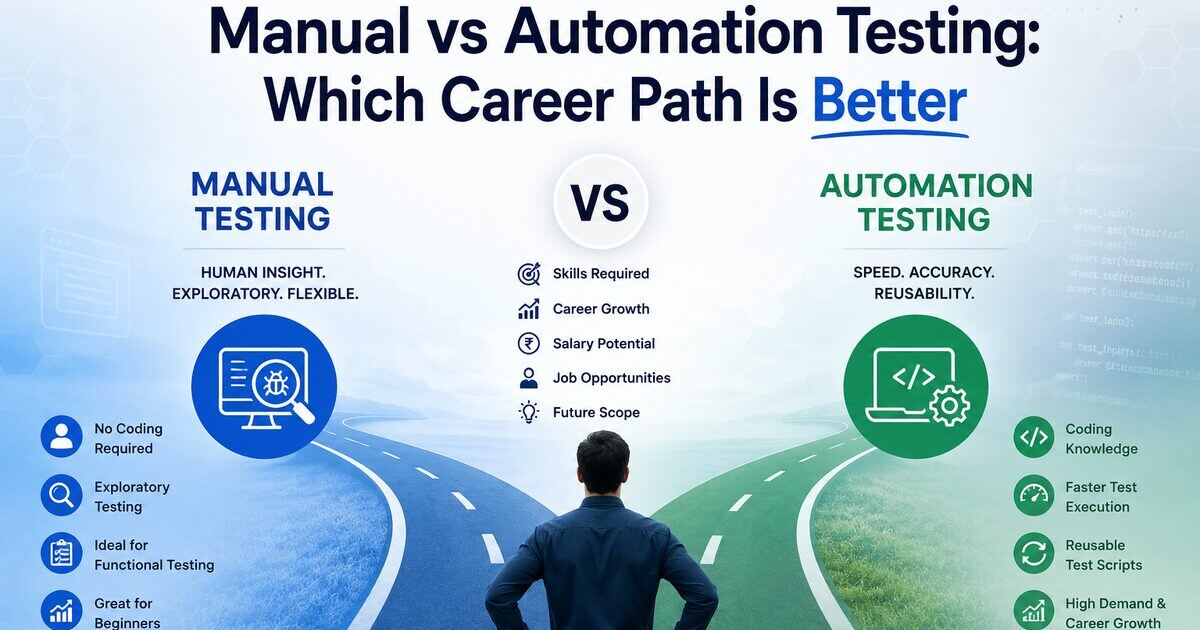
Every QA engineer asks it: should I stay manual, or learn automation? The honest answer in 2026 is that the line has blurred — but the salary gap hasn't. Here's a no-fluff, data-backed breakdown to help you choose, complete with a salary comparison table and a decision flowchart.
TL;DR — which one wins in 2026?
If you want the highest ceiling, fastest salary growth and the broadest job market, automation (SDET) wins. If you love product, UX and exploratory thinking, specialised manual QA (accessibility, security, domain experts) still pays well. The single most hireable profile is the hybrid QA engineer who can do both.
Demand & job market in 2026
LinkedIn data shows SDET and QA Automation Engineer postings grew 32% year-over-year while pure manual-only postings shrank 11%. Roughly 7 out of 10 QA job descriptions in 2026 list Selenium, Playwright or Cypress as a hard requirement, and 4 out of 10 require CI/CD and API automation.
Hiring is strongest in: fintech, SaaS, healthcare-tech, e-commerce platforms and AI/ML tooling companies.
Manual vs Automation: 2026 salary comparison
Average annual salaries from Glassdoor, Levels.fyi, LinkedIn Salary and Naukri (May 2026). Figures are total cash compensation rounded to the nearest thousand.
| Experience | Manual QA — India | Automation/SDET — India | Manual QA — US | Automation/SDET — US |
|---|---|---|---|---|
| 0–2 yrs | ₹3.5–5.5 L | ₹6–10 L | $58k–72k | $78k–105k |
| 2–5 yrs | ₹6–9 L | ₹12–22 L | $72k–95k | $110k–145k |
| 5–8 yrs | ₹10–14 L | ₹22–35 L | $95k–120k | $145k–185k |
| 8–12 yrs | ₹14–20 L | ₹35–55 L | $115k–140k | $180k–230k |
| 12+ yrs (Lead/Architect) | ₹18–28 L | ₹50–90 L | $130k–160k | $210k–290k+ |
Average salary gap: 40–80% in favour of automation at every experience level. The gap widens with seniority — senior SDETs in product companies often out-earn senior backend engineers.
What pure manual testing still owns
Manual is not dying — it is getting more specialised. Roles that still pay manual-first:
- Exploratory testers in product-led SaaS companies
- Accessibility specialists (WCAG 2.2, ADA, Section 508)
- Domain experts in banking, insurance, healthcare
- UX bug hunters for design-driven companies
- Security / penetration testers who chain manual recon with tools
Why automation wins for most QA careers
- Higher salary ceiling at every level
- Larger job market — 7 in 10 listings demand it
- Path to SDET, DevOps and Platform Engineering roles
- Better remote-work opportunities
- Skills compound (locators, frameworks, CI/CD, cloud, AI tools)
Decision flowchart — which path fits you?
Use this quick decision tree:
Do you enjoy writing code (even a little)?
│
├── YES ──► Are you 0–3 yrs experience?
│           │
│           ├── YES ──► Go Automation/SDET. Learn Playwright + TypeScript + CI/CD.
│           │           Fastest 40–80% salary jump.
│           │
│           └── NO  ──► Already 3+ yrs manual?
│                       └──► Transition to Hybrid QA in 4–6 months.
│                            Automate your existing test cases first.
│
└── NO  ──► Do you love UX / product / domain depth?
            │
            ├── YES ──► Specialise: Accessibility, Security,
            │           Exploratory, or Domain QA (fintech/health).
            │
            └── NO  ──► Try a Playwright tutorial for 1 week.
                        If still painful → consider Product/BA roles.
                        If you enjoyed it → start the automation path.
The realistic transition path (4–6 months)
- Pick one language — JavaScript/TypeScript or Python (we recommend TypeScript in 2026).
- Learn one framework — Playwright has the fastest ROI. Start with our Playwright installation guide, then dive into the complete Playwright tutorial. Skip Cypress unless your team already uses it.
- Automate your own manual test cases — pick 20 from your current project and convert them.
- Add API automation — Postman + Newman, then REST Assured or Playwright's request fixture. See our API Testing Guide.
- Add CI/CD — wire your tests into GitHub Actions or Jenkins, run on every PR.
- Practice interviews — use our AI Mock Interview to rehearse Selenium, Playwright and SQL rounds.
Most testers complete this in 4–6 months part-time (~8 hours/week).
Why hybrid is the sweet spot
The most hireable profile today is a QA engineer who can:
- Run exploratory and accessibility testing
- Write Playwright/Selenium automation
- Debug REST APIs with Postman
- Read SQL queries to validate data
- Read CI/CD logs and basic Docker commands
That's the role companies are actively hiring for at 30–50% higher salaries than pure manual.
Common mistakes when switching to automation
- Learning 3 frameworks instead of mastering 1
- Skipping API automation (it's where the bugs live)
- Writing UI tests for everything — ignore the test pyramid at your peril
- Never running tests in CI — locally-only suites die fast
- Not updating your resume — recruiters cannot see hidden skills. Use our ATS-friendly QA resume guide.
Final verdict — 2026
If you are starting your QA career today, go automation / SDET. If you have 3+ years of manual experience, become hybrid in 4–6 months. If you love product/UX/domain depth, specialise in accessibility, security or domain-heavy manual QA. Whatever you pick, validate it with real interview practice — book a free AI Mock Interview today.
If the automation track is the one you want, our Automation QA Engineer role guide lays out the day-to-day responsibilities, required stack, and salary bands you should be targeting.