Freelance QA Tester Rates in 2026: How Much to Charge (Per Hour & Project)
Real freelance QA tester rates for 2026 — hourly and per-project pricing for manual, automation, SDET, performance and AI testing, by experience and region.

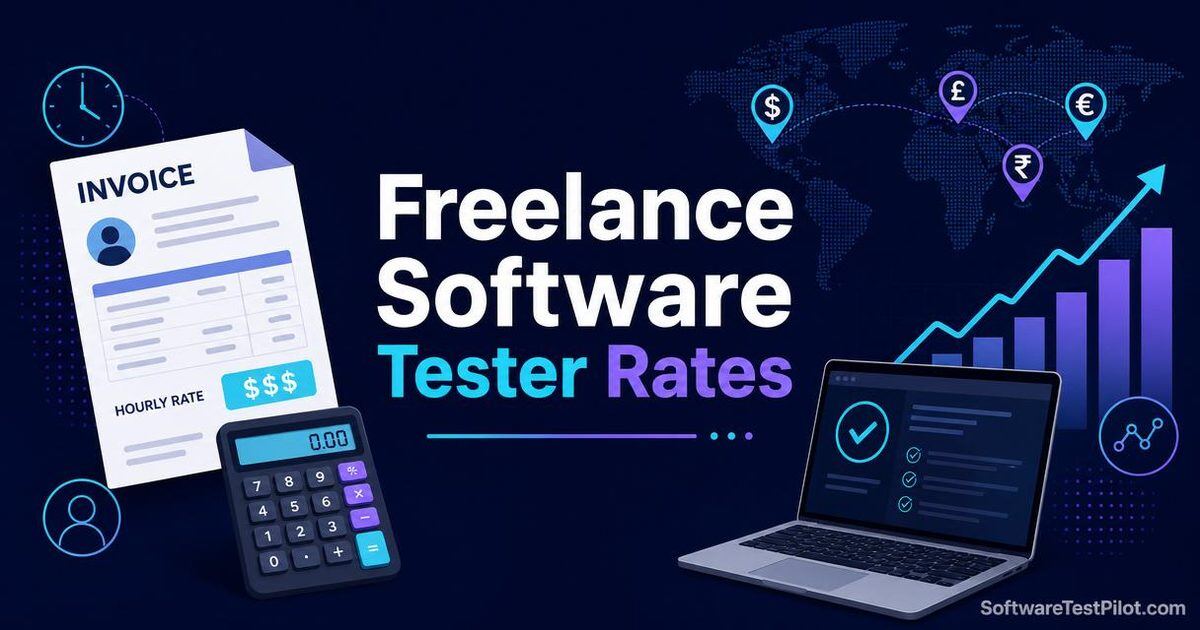
Freelance software tester rates range from $20 to $250+ per hour in 2026. This guide gives you the complete pricing data, negotiation strategies, and platforms to find high-paying clients. For the broader playbook, pair this with our Freelancing for QA Engineers guide and QA Engineer Salary Guide.
2026 Hourly Rates by Region
United States
| Level | Hourly rate |
|---|---|
| Junior QA | $50–$80 |
| Mid QA / SDET | $80–$130 |
| Senior SDET | $130–$180 |
| Principal / AI specialist | $180–$300+ |
Western Europe
| Country | Junior | Mid | Senior |
|---|---|---|---|
| UK | £40–£70 | £70–£120 | £120–£180 |
| Germany | €45–€80 | €80–€130 | €130–€200 |
| France | €40–€75 | €75–€120 | €120–€180 |
| Netherlands | €50–€85 | €85–€140 | €140–€220 |
India
| Level | Hourly rate (INR) |
|---|---|
| Junior | ₹1,500–₹3,500 |
| Mid | ₹3,500–₹6,500 |
| Senior | ₹6,500–₹12,000 |
| Principal / AI | ₹12,000–₹25,000 |
Eastern Europe
| Country | Mid | Senior |
|---|---|---|
| Poland | $40–$70 | $70–$110 |
| Ukraine | $30–$60 | $60–$100 |
| Romania | $35–$65 | $65–$105 |
Latin America
| Country | Mid | Senior |
|---|---|---|
| Brazil | $40–$70 | $70–$110 |
| Argentina | $35–$65 | $65–$100 |
| Mexico | $40–$70 | $70–$110 |
| Colombia | $30–$55 | $55–$90 |
Rate-Setting Formula
Floor rate = (Target annual income) / (Billable hours per year)

Billable hours per year = 52 weeks × 40 hours × 0.5 (50% utilization) = 1,040 hours
If you want $150k/year and can bill 1,040 hours: floor rate = $144/hour. Charge 20% above floor: $175/hour.
How to Find Freelance Clients
Top platforms
| Platform | Best for | Commission |
|---|---|---|
| Toptal | Senior engineers, premium rates | 0% |
| Upwork | First clients, broad range | 10–20% |
| Arc.dev | Senior engineers | 0% |
| Testlio | QA-only platform | N/A |
| uTest | Crowdsourced testing | N/A |
Direct outreach
The highest-converting channel in 2026. Identify 50 target companies (Crunchbase, ProductHunt), find the QA hiring manager on LinkedIn, send a personalized cold email, and follow up 3 times — 80% of deals close on touch 2 or 3.
Referrals
Lowest-friction channel. Tell your network you're freelancing, add "Available for QA consulting" to LinkedIn, and ask every client for 3 referrals.
Content marketing
Build a public portfolio: GitHub repos with test frameworks, blog posts on QA topics, conference talks, LinkedIn posts sharing insights. Live roles are a good prospect list — see our QA Jobs Radar.
How to Raise Your Rate
- Raise rates every 6–12 months — 5–15% for existing clients, 15–30% for new.
- Specialize in premium skills — AI, performance, security command 30–60% premiums.
- Build a portfolio — public GitHub projects, blog posts, and talks justify premium rates.
- Move from hourly to project-based — project rates feel like a "package"; clients don't compare hourly.
- Move from project to retainer — retainers give predictable income and unlock senior rates.
Sample Rate Sheet
QA CONSULTING RATE SHEET — [Your Name]
Effective: June 2026

Services                                          Rate
----------------------------------------          --------
Senior SDET consulting (hourly)                   $175/hr
Playwright framework build (project)              $25,000
JMeter load test setup + report (project)          $8,000
AI test case generation POC (project)             $12,000
Monthly retainer (10 hrs/week)                    $7,000/month

Payment terms: Net 15
Late payment: 1.5% monthly interest
How to Negotiate Rate
- Research market rates — use this guide and Upwork to understand the going rate for your level and region.
- Anchor high — when asked for expectations, give the top of the range. Don't lowball.
- Get the project in writing — never negotiate on a verbal agreement.
- Counter professionally — express enthusiasm, state your case, ask for a specific number.
- Negotiate total, not just rate — for longer engagements, a higher total fee feels like a package, not an expense.
For the full negotiation playbook, see our Freelancing for QA Engineers guide.
What Clients Pay For in 2026
- Speed — done faster than internally.
- Expertise — someone who has done it before.
- Fresh perspective — internal teams are too close to the problem.
- Risk reduction — a known outcome.
- Capacity — surge support.
How to Land Your First Client
- Pick a niche — "QA consultant" is too broad; "Playwright migration consultant" is specific.
- Build one project — pick a public open-source app, ship a full test suite, write a blog post.
- Get your first testimonial — even a discounted project can yield one.
- Reach out to 50 companies — cold email with a specific value proposition.
- Convert ~5% to paid — 50 emails × 5% = ~2–3 clients. Charge premium rates for the first 2–3.
How to Set Your Freelance Rate (Step by Step)
- Calculate your floor rate. Floor = target income / billable hours (1,040/year at 50% utilization). Want $150k? Floor ≈ $144/hr — charge $175 with buffer.
- Adjust for specialization — AI +30–60%, performance +15–25%, security +15–25%, mobile +10–20%.
- Adjust for region — US $50–$300/hr, UK £40–£220, EE $30–$110, India ₹1,500–₹25,000.
- Benchmark against market — Upwork, Toptal, Glassdoor, QA communities.
- Test your rate. After 6 months, evaluate booking rate, acceptance, income vs target. Adjust up 10–20% if demand is strong.
- Negotiate higher rates — anchor higher for new clients; raise annually for existing.
- Move to project or retainer pricing.
- Track and optimize — billable hours, effective rate (income/hours), and replace low-rate work with higher-rate clients.
Common Freelance Rate Mistakes
- Lowballing your rates — hurts you and the market.
- Not raising rates regularly — 2+ years flat means you're undercharging.
- Charging hourly for high-value work — projects feel like a package, hours feel like expense.
- No minimum project size — set $2,000+ to cover admin.
- Ignoring non-billable hours — budget 50% utilization.
- Competing on price — compete on quality, specialization, reliability.
- No specialization — generalists earn 30–60% less than specialists in 2026.
- Avoiding scope discussions — document changes upfront.
- No portfolio — public GitHub, blog, talks justify premium pricing.
- Ignoring taxes / business setup — factor self-employment tax, insurance, retirement into your rate.
- Working without contracts — always written.
- Burning out — set working hours and stick to them.
Keep Learning
Continue your freelance journey with the Freelancing for QA Engineers guide, the QA Engineer Salary Guide, the QA Outsourcing Services breakdown, and the SDET Career Roadmap. Hunting clients? Browse live roles on the QA Jobs Radar and sharpen your pitch with the AI mock interview.
Frequently asked questions
1.How much do freelance software testers charge in 2026?
2.What's the average freelance rate for a senior SDET?
3.How do freelance testers find clients?
4.Should I charge hourly or per project?
5.What's the highest-paying freelance QA specialization?
6.How long does it take to build a freelance practice?
Practice these questions
Run a live QA mock interview tailored to this topic and get per-skill scoring in minutes.
Was this article helpful?
More from Freelance QA
Upwork, Fiverr, rates, proposals for freelance testers.
- Automation TestingTest Automation Framework Consulting: When to Hire (2026)
- Automation TestingSoftware Testing Consulting Firm: How to Choose (2026)
- Career & Interview PrepFreelancing for QA Engineers: Complete Guide (2026)
Keep building your QA edge
Pillar guides- SDET Career RoadmapQA to SDET career pathYear-by-year plan from QA to senior SDET — skills + projects.
- QA Jobs Radarbrowse live QA job listingsLive QA / SDET / automation job feed, refreshed daily.
- All QA Jobs Hubbrowse QA jobs by role, tool and cityEvery QA jobs landing — by role, tool, city, work mode & experience.
- Company QA Interview GuidesQA interview questions by companyReal interview loops from Google, Amazon, Meta, Apple, Microsoft, Adobe, and 40+ other tech employers.
Practice these questions live
Rehearse with an AI QA interviewer that scores your answers in real time.
Continue reading

The Complete QA & SDET Career Roadmap Nobody Showed Me ($50k → $250k+)
14 min read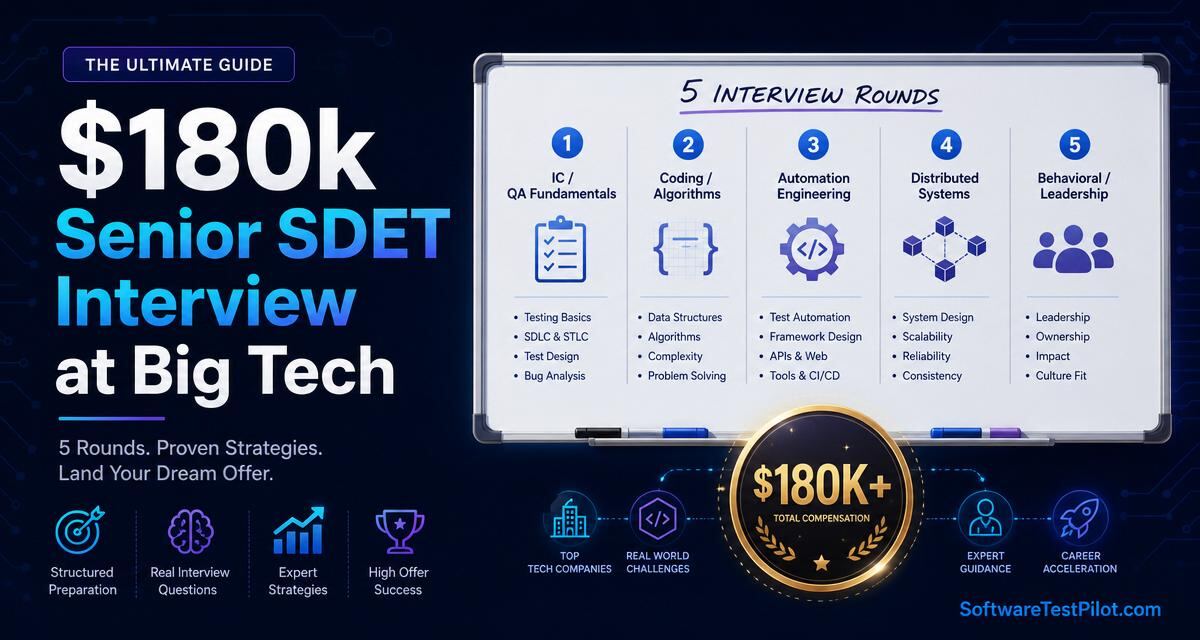
What a $180k+ Senior SDET Interview Looks Like at Big Tech (2026)
13 min read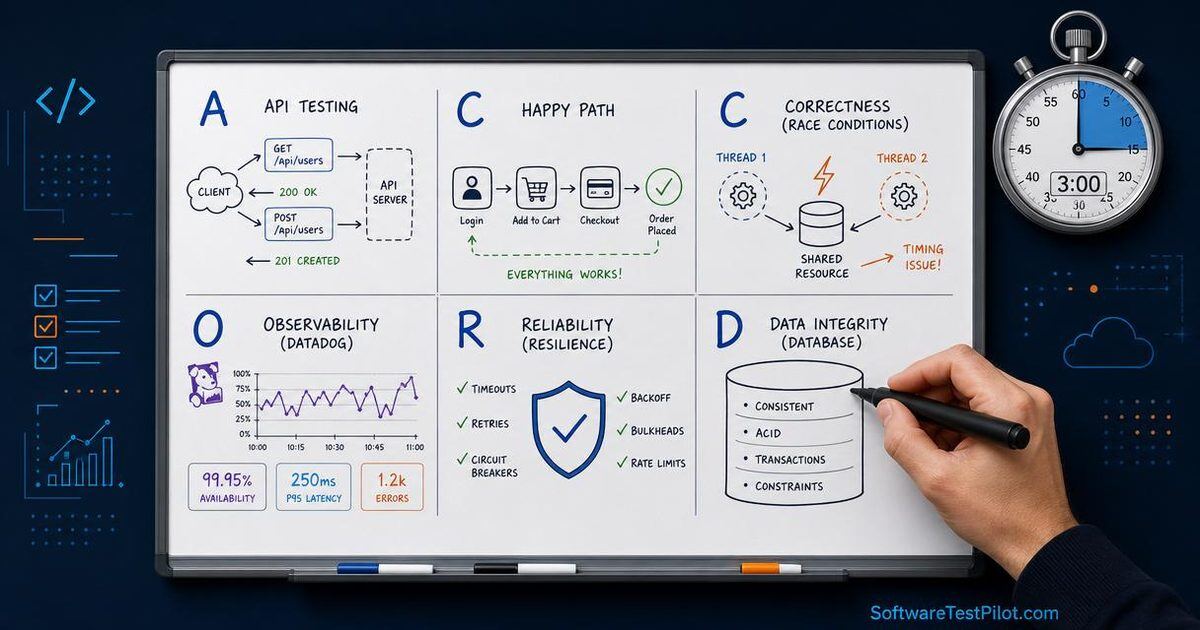
The 3-Minute Whiteboard Testing Trick That Impresses Interviewers (ACCORD Framework)
11 min readRelated concepts, tools & standards around Career & Interview Prep
A quick reference of the people, companies, frameworks and technologies most often mentioned alongside Career & Interview Prep in real QA teams — useful when you're mapping a learning path, preparing for interviews, or scoping a new project.
Join the QA Community
Connect with fellow testers, share job leads, and get career advice.
Discussion
Ask a question, share your experience, or correct us. Be kind — real people are reading.