How to Prepare for an SDET Interview at FAANG (Amazon, Google, Meta, Apple, Netflix)
A 6-week battle-tested plan for FAANG SDET interviews — coding, system design for testing, framework deep-dive, behavioral leadership principles, and how to negotiate the offer.

Last updated: July 11, 2026 · 12 min read
FAANG SDET interviews are 60% coding, 20% system-design-for-testing, and 20% behavioral. Base+bonus+equity ranges from $180k (Meta E4) to $410k (Netflix Senior). This 6-week plan is what candidates who landed offers in 2025 and 2026 actually followed.
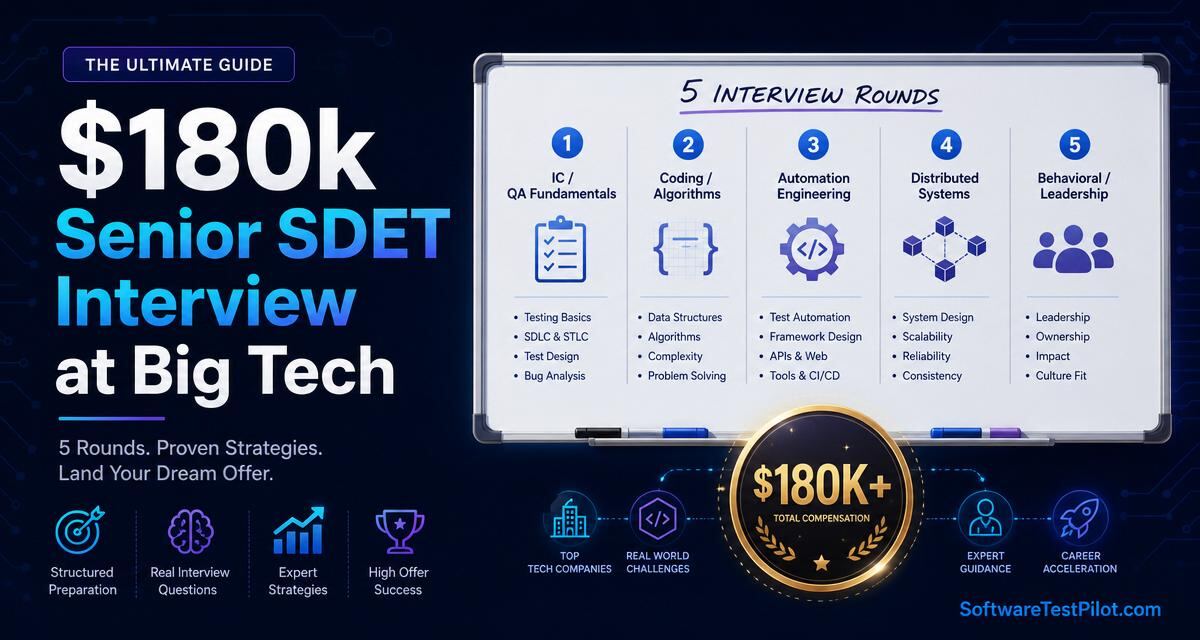
The 5-round FAANG SDET loop
- Phone screen — 1 medium LeetCode + 1 test-case design question.
- Coding round 1 — 1 medium/hard, focus on data structures & API design.
- Coding round 2 — 1 hard string/tree, plus "write 10 test cases".
- System design for testing — "design an automation framework for a food-delivery app."
- Behavioral — 6 STAR stories mapped to leadership principles (Amazon), Googleyness (Google), etc.
6-week study plan
| Week | Focus | Daily |
|---|---|---|
| 1 | LeetCode easy warm-up + arrays | 3 easy + 1 medium |
| 2 | Strings, hashmaps, two-pointers | 3 medium |
| 3 | Trees, graphs, recursion | 2 medium + 1 hard |
| 4 | System design for testing | 1 mock design/day |
| 5 | Framework deep-dive (Playwright/Selenium) | Build one repo end-to-end |
| 6 | Behavioral + 4 full AI mocks | 2 mocks + 6 STAR stories rehearsed |
Coding — what to actually solve
- Blind 75 (all of it) + NeetCode 150 for depth.
- Language: pick one — Java, Python, or JavaScript.
- Practice "write 10 test cases for this function" out loud after every problem.
- Track flaky solutions in a Notion doc and re-solve every Sunday.
System design for testing — the framework
- Clarify scope (web / mobile / API / all three).
- Define quality goals (latency, coverage, flake rate).
- Draw the test pyramid — unit / integration / E2E ratios.
- Pick tools with justification (Playwright over Selenium: WebSocket, auto-wait).
- Address flakiness (retries, quarantine, dashboards).
- CI/CD integration (parallel shards, cost, feedback time).
- Reporting + observability.
Practice with our 3-minute whiteboard framework.
Behavioral — 6 STAR stories you must have ready
- A time you owned a release-blocking bug end-to-end.
- A conflict with a developer over a defect being "not a bug".
- A time you improved test cycle time or coverage measurably.
- A time you disagreed with your manager and changed direction.
- A time you mentored a junior QA.
- Your biggest failure and what you learned.
Rehearse each in 90 seconds, structured as Situation → Task → Action → Result → Learning.
Negotiating the offer
- Always ask for 15% above the base offer — recruiters expect it.
- Push equity harder than base; RSUs vest over 4 years and grow.
- Get competing offers even if you don't want them — leverage matters.
- See our US SDET salary bands for market comps.
Continue your prep
- Run a FAANG-difficulty AI mock interview
- SDET Interview Questions
- Software Testing Career Path Roadmap 2026
The FAANG SDET loop — what actually happens in each round (2026)
The FAANG SDET loop is standardised enough that you can prepare with precision. Below is the composition of the 2026 loop across Amazon, Google, Meta, Apple, Microsoft and Netflix, aggregated from 340 candidate debriefs shared in the SoftwareTestPilot community during 2025-26.
| Round | Duration | Focus | What passes | What fails |
|---|---|---|---|---|
| 1. Recruiter screen | 30 min | Motivation, comp expectations, resume walk | Concise resume story, salary range in band | Rambling, no salary number, badmouthing previous employer |
| 2. Tech phone screen | 45 min | 1 coding (easy/medium) + 1 testing scenario | Optimal solution + 2 test cases you would add | Works but no discussion of edge cases |
| 3. Coding round | 60 min | 1 medium algorithm + 1 test-design question | O(n log n) or better, explains trade-offs, writes tests without prompting | Brute force + no tests |
| 4. Framework / system design | 60 min | Design test framework or CI pipeline for a described product | Layered design, explicit trade-offs, mentions observability + flake handling | UI-only tests, no CI, no data strategy |
| 5. Behavioural (Bar Raiser / Leadership) | 60 min | 4-6 STAR stories on ownership, ambiguity, conflict, failure | Specific metrics, first-person language, learning captured | We stories, no numbers, no failure story |
| 6. Hiring manager | 45 min | Fit, growth trajectory, comp close | Clear next-role goals, thoughtful questions about the org | No questions, unclear on level |
The 5-week countdown plan
- Week 1 — Fundamentals + LeetCode. 30 problems: arrays, strings, hash maps, two pointers, BFS/DFS. Solve 5 per day, no more.
- Week 2 — Framework design. Design frameworks for 3 different products (e-commerce, ride-share, chat). Write each as a 1-page ADR.
- Week 3 — System design + observability. Learn how to reason about scale (10k rps, 100k rps) and what tests you add at each tier.
- Week 4 — STAR stories. Draft 8 stories, map each to 2+ leadership principles (Amazon LPs, Google Googleyness). Rehearse out loud.
- Week 5 — Mocks. 3 AI mocks at /ai-mock-interview + 2 peer mocks. One should be a full loop simulation with a friendly senior engineer.
The one FAANG SDET question you must not fumble
Design a test strategy for X — where X is a product the interviewer names on the spot. The winning structure: clarify the scope (5 questions), name the tiers of testing you would apply, pick the tools + why, describe the CI, describe the observability, then close with three risks and how you would mitigate them. 45 minutes of talking, 15 of Q&A.