
Test Strategy vs Test Plan: Differences, Template, and Examples (2026)
Test strategy vs test plan explained with template, examples, and interview answers. Understand who writes each, when, and how they fit into modern agile QA.

Last updated: July 17, 2026 · 11 min read · By SoftwareTestPilot
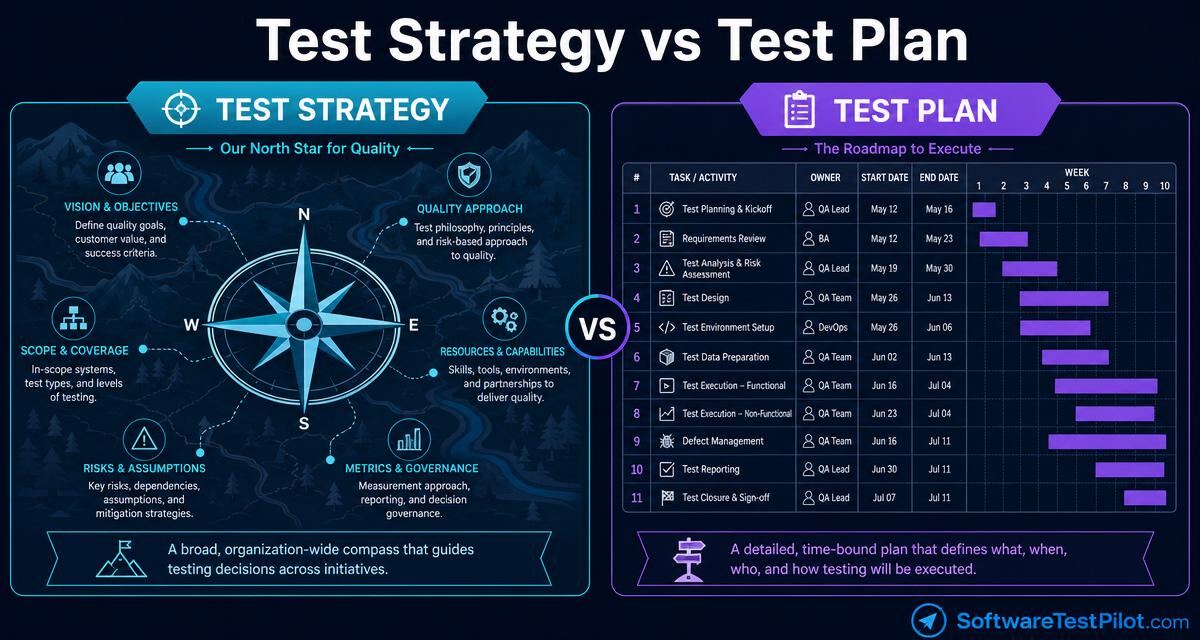
A Test Strategy is the organisation's long-lived philosophy of how it tests — types, tools, environments, entry / exit criteria, quality gates. A Test Plan is the project-specific instantiation — this release, this scope, this team, this schedule. Confusing the two is one of the most common QA mistakes and a near-guaranteed interview question. This guide fixes it with definitions, a side-by-side table, a template, and a worked example.
Pair with the test plan template and the SDLC phases guide.
Key takeaways
- Strategy = organisation-wide, long-lived philosophy. Plan = project-specific, time-bound execution.
- One strategy governs many test plans.
- Test manager / QA lead owns strategy; test lead owns the plan.
- Both are IEEE 829 / ISTQB standard artefacts and appear in almost every mid-to-senior QA interview.
1. What is a Test Strategy?
A test strategy is a high-level, long-lived document that defines how an organisation tests software. It codifies test types (unit, integration, system, acceptance, performance, security, accessibility), tooling standards, environment tiers, entry / exit criteria, defect severity taxonomy, automation strategy, risk management, and roles. One test strategy typically governs many projects for years.
2. What is a Test Plan?
A test plan is a project-specific, time-bound document derived from the strategy. It defines: scope, in-scope and out-of-scope features, test approach for this release, resources, schedule, environments allocated, entry and exit criteria for the release, risks specific to the project, and deliverables. One test plan governs one release or one project.
3. Test strategy vs test plan: side-by-side
| Aspect | Test Strategy | Test Plan |
|---|---|---|
| Scope | Organisation-wide | Project / release specific |
| Lifespan | Years | Weeks to months |
| Owner | Head of QA / test manager | Test lead for the project |
| Level | Strategic (how we test) | Tactical (how we test this) |
| Approvals | CTO, VP Eng, QA head | Project sponsor, dev lead |
| Change frequency | Rare (annual review) | Every release |
| Answers | What are our testing principles? | What are we testing this sprint / release? |
4. What goes in a Test Strategy
- Objectives and scope of testing across the org.
- Test levels adopted (unit / integration / system / acceptance).
- Test types (functional, regression, performance, security, accessibility).
- Tools per level (JUnit, Playwright, JMeter, ZAP, axe).
- Environments tiering (dev, QA, staging, pre-prod, prod-monitoring).
- Entry / exit criteria templates.
- Defect severity and priority taxonomy.
- Automation strategy (pyramid target, coverage target).
- Metrics and reporting (DORA, escape rate, MTTR).
- Roles and responsibilities.
5. What goes in a Test Plan
- Introduction and reference to the parent strategy.
- In-scope and out-of-scope features for this release.
- Test approach and levels for this project.
- Test deliverables (cases, scripts, reports).
- Environments and test data allocated.
- Entry criteria (build ready, unit tests green).
- Exit criteria (0 open Sev-1 defects, 95% of P1 cases passed).
- Schedule and milestones.
- Resources and responsibilities.
- Risks and mitigations specific to this release.
Ready-to-use version in the test plan template guide.
6. Worked example
Strategy (excerpt): “Every product team runs a test pyramid with ≥70% unit, ≤10% E2E. All E2E is Playwright + TypeScript. Production has synthetic monitoring on top-5 flows. Escape rate target ≤2 defects / 1000 story points / quarter.”
Plan (excerpt for Payments v2 release): “Scope: Apple Pay + Google Pay checkout. Approach: contract tests against Stripe sandbox + 12 Playwright E2E flows + a 200-user k6 load test. Entry: dev unit tests green. Exit: 0 Sev-1, all P1 flows pass, load test under 300ms p95. Timeline: 3 sprints. Risks: sandbox rate limits, tokenisation edge cases.”
The strategy is inherited; the plan spells out what this release does inside those rails.
7. In modern agile / CI-CD teams
Agile teams still need both, but the artefacts are lighter. The strategy might be a 5-page wiki page. The plan might be a section of the release ticket or a one-pager per epic. Continuous delivery teams often replace release-level plans with per-epic test approaches plus a persistent quality dashboard. Read the shift-left with AI copilots guide for how AI is compressing this further in 2026.
8. Common pitfalls
- Writing a test plan without a strategy — every project reinvents the wheel.
- Copy-pasting the strategy into every plan — no project-specific detail.
- Skipping exit criteria — nobody knows when testing is “done”.
- Treating the strategy as a one-time document — it needs annual review to reflect tool and org changes.
9. Interview prep
Very common at 3+ years and near-guaranteed for lead / manager roles. Prompts: “Difference between test strategy and test plan?”, “Walk me through a test plan you've written”. Rehearse on the AI Mock Interview. Full pillar prep on the 5-year Q&A and QA lead roadmap.
10. Your 24-hour action step
Skim your team's current test plan for the next release. Does it reference a parent strategy? If yes, is it consistent? If no, draft the strategy in one page and link it. That's a lead-level artefact that pays off release after release. Benchmark comp on the QA Salary Guide and audit your resume on the ATS Resume Reviewer.
9. 2026 strategy-plan-execution stack — who writes what, and how often
The three artefacts get confused because their names sound similar, but they operate on different clocks and have different owners. Below is the model elite QA orgs actually use in 2026.
| Artefact | Scope | Owner | Cadence | Lifespan |
|---|---|---|---|---|
| Test Strategy | Org / product line | Head of QA / Principal SDET | Reviewed quarterly | 12–18 months |
| Test Plan | Release / epic | QA Lead | Per release or major epic | 2–8 weeks |
| Test Cases / Charters | Story / feature | QA Engineer | Every sprint | Until the feature is retired |
The 3 questions each artefact must answer
- Strategy: What kinds of quality risk do we care about across the whole product? Which testing types (unit, contract, E2E, perf, security, a11y) do we invest in, at what ratio?
- Plan: For this release, what specifically will we test, in which environments, with which entry/exit criteria? See the 2026 test plan template.
- Cases/charters: For this story, what are the exact steps + expected results, and which exploratory charters will surface the unknown unknowns?
Common failure modes
- Strategy but no plan → team knows the philosophy but forgets it under release pressure. Fix: enforce a 1-page plan per epic.
- Plan but no strategy → every plan reinvents wheels (env choice, tooling, coverage bar). Fix: publish a strategy that plans inherit from.
- Cases but no plan → the classic “ticket-taker QA” anti-pattern. Fix: refuse to start execution before the plan's entry criteria are met.
Sample 2026 test strategy skeleton
1. Quality vision (2 lines)
2. In-scope product areas + risk tiers
3. Test-pyramid target ratios per service
4. Non-functional bars (perf p95, a11y WCAG level, security SAST)
5. Environment topology + data strategy
6. Tooling: framework, CI, reporting, observability
7. Metrics: escape rate, flake rate, coverage, lead time
8. Review cadence + owners
Keep the strategy to 2–3 pages. Anything longer becomes shelfware.
Interview follow-ups
- How often should the strategy change? Reviewed quarterly, rewritten only on major platform shifts (e.g. adopting mobile, or moving to microservices).
- Who signs off the strategy? Head of Engineering + Head of Product. The strategy is a cross-functional agreement, not a QA-only document.
- What is the “master test plan”? A legacy IEEE 829 concept — today's org-level document is the strategy; the master plan folds into the strategy.