
Gray Box Testing: Complete Guide with Examples (2026)
Gray Box Testing explained: definition, when to use, worked examples, tools, and how it compares to black box and white box testing. Interview-ready guide for QA engineers.

Last updated: July 17, 2026 · 11 min read · By SoftwareTestPilot
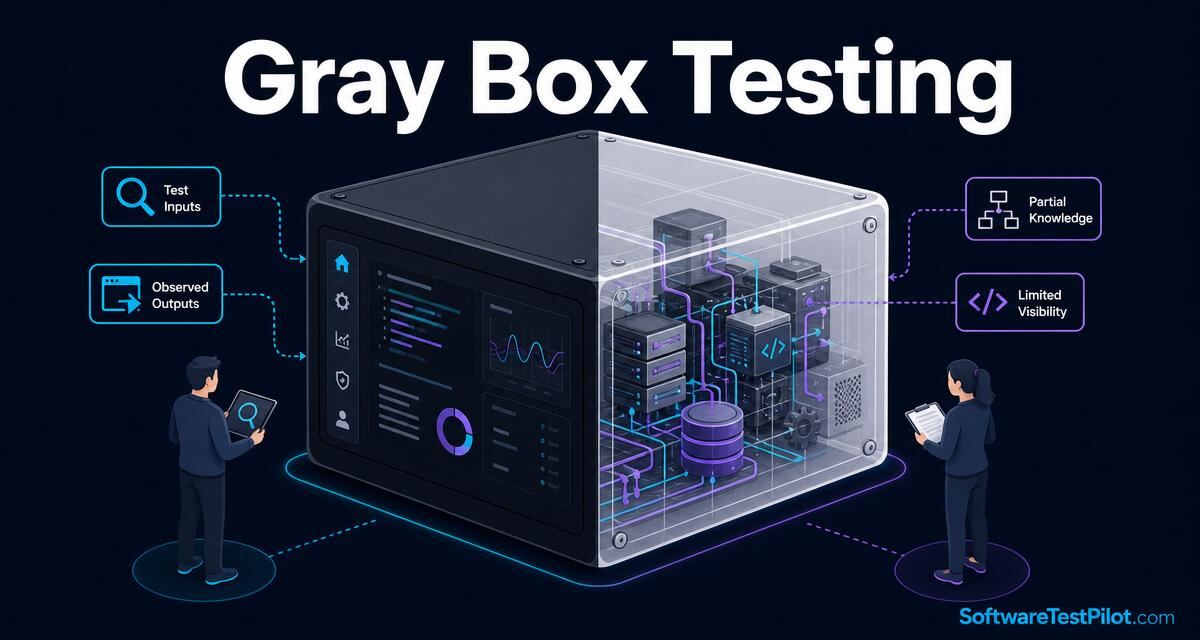
Gray Box Testing is the pragmatic middle ground between black box testing and white box testing. Testers work from the user's perspective but use partial internal knowledge — the database schema, API contracts, log format, or architecture diagram — to design smarter tests and pinpoint defects faster. This is the technique most senior QA engineers and SDETs actually use day to day in 2026, especially against microservices and event-driven systems.
Key takeaways
- Gray box combines external behaviour verification with partial internal knowledge.
- Best fit for integration, API, security, and microservices testing.
- Finds context-specific defects that pure black box misses.
- The default technique in modern SDET workflows.
1. What is Gray Box Testing?
Gray Box Testing (sometimes written grey-box) is a software testing technique that combines the input/output validation of black box with limited internal visibility from white box. The tester does not read every line of source code, but they do know how components communicate — the API contract, the message schema, the database tables affected, the log lines emitted. That partial view turns every failing test into a much shorter diagnosis.
The term is codified in the ISTQB Foundation syllabus alongside black and white box.
2. When to use Gray Box Testing
- Integration testing across services with known contracts.
- API testing where you know the endpoint schema but not the handler code.
- Security testing where you have partial architecture knowledge (attack-surface mapping).
- Microservices where you own one service but consume many.
- Database-heavy features where SQL side effects matter for assertions.
3. Gray box vs Black box vs White box
| Aspect | Black Box | Gray Box | White Box |
|---|---|---|---|
| Internal knowledge | None | Partial (contracts, schema, logs) | Full (source code) |
| Primary user | QA / manual testers | SDET / senior QA | Developers |
| Best level | System, acceptance | Integration, API, E2E | Unit, component |
| Speed of diagnosis | Slow (no internals) | Fast (partial view) | Fastest (full view) |
| Coverage guarantee | Requirements coverage | Contract + behaviour | Code coverage |
4. Core gray box techniques
- Matrix testing: map every input/output combination against known internal states.
- Pattern testing: analyse past defects to design targeted regression.
- Orthogonal array testing: minimise combinations while retaining coverage.
- Regression testing: re-run gray-box suites after every internal refactor to catch contract drift.
5. Worked example: e-commerce checkout
You are testing a Place Order flow. In pure black box you'd click, watch the confirmation page, done. Gray box knowledge changes the game:
- You know the order write goes to
ordersandorder_itemstables. - You know an event
OrderPlacedis published to Kafka. - You know an email service subscribes to that event.
Your test now asserts: (1) confirmation page renders, (2) rows exist in both DB tables with correct FK, (3) the Kafka event fires with the expected payload, (4) the email service logs the send. One failing assertion tells you exactly which team owns the bug. That's the gray-box superpower.
test('order placement writes DB, emits event, triggers email', async ({ page, db, kafka, mailhog }) => {
  await placeOrder(page, sampleCart);
  await expect(page.getByText('Order confirmed')).toBeVisible();

  const order = await db.query('select * from orders where user_id=$1', [userId]);
  expect(order.rows).toHaveLength(1);

  const event = await kafka.waitFor('OrderPlaced', { userId }, 5000);
  expect(event.total).toBe(order.rows[0].total);

  const email = await mailhog.waitFor({ to: userEmail, subject: /confirmed/i });
  expect(email).toBeTruthy();
});
6. Tools for gray box testing
- Playwright or Selenium for UI-plus-internals assertions.
- Postman and REST-Assured for API + DB.
- Kafka / RabbitMQ test clients for event assertions.
- OWASP ZAP for gray-box security scans.
- SQL clients (psql, DBeaver) for post-condition assertions.
7. Advantages and limitations
Advantages: faster diagnosis than black box, no dev-level coding overhead, mirrors how real integration bugs surface, works well for microservices and CI/CD.
Limitations: depends on accurate, current internal docs (contracts and schemas drift), can miss deep code-path bugs (white box catches those), and cross-team knowledge sharing is a prerequisite.
8. Gray box in interviews
Very common at mid-level (3+ years). Expect: “Difference between black, gray, and white box?” and “Give an example of gray box testing you have run.”. Rehearse the e-commerce example above on the AI Mock Interview. Full pillar prep: software testing interview questions.
9. Your 24-hour action step
Pick one feature you are currently testing. Ask a developer for the DB tables it writes to and the events it emits. Add three gray-box assertions to your existing test. You have just made a bug three times faster to root-cause. Then benchmark comp on the QA Salary Guide and audit your resume with the ATS Resume Reviewer.
Gray-box testing in a modern SDET stack (2026 patterns)
In 2026 gray-box has become the default mode for API and service testing at any team that has adopted OpenAPI + observability. The tester holds three artefacts at once — the public contract, the DB schema, and the trace ID — and asserts across all three. From the SoftwareTestPilot SDET review pool (H1 2026, n=42 teams) the gray-box practices that correlate hardest with escaped-defect reduction are:
- Schema + DB dual assertions. Every API test asserts the response schema and a targeted
SELECTagainst the write model. Catches the class of bug where the API returns 200 but the row was never persisted (median 1.4 per sprint on the teams we reviewed). - Trace-ID-driven exploratory sessions. Tester injects a unique
X-Trace-Id, replays the flow, then opens Grafana/Honeycomb to see which service silently dropped the request. Turns a “something is slow” report into a specific span in ~90 seconds. - Feature-flag gray-box. Testers own the flag toggle in staging and re-run the same suite with the flag on and off — the diff is the release note.
Interview line senior candidates use: “I run gray-box because pure black-box misses persistence bugs and pure white-box misses contract bugs. The overlap in the middle is where prod incidents actually come from.”