
White Box Testing: Techniques, Examples, and Tools (2026)
White box testing explained: definition, techniques (statement, branch, path, condition coverage), unit-testing tools, worked examples, pros/cons, and how it fits with black box testing in a modern CI pipeline.

Last updated: July 17, 2026 · 13 min read · By SoftwareTestPilot
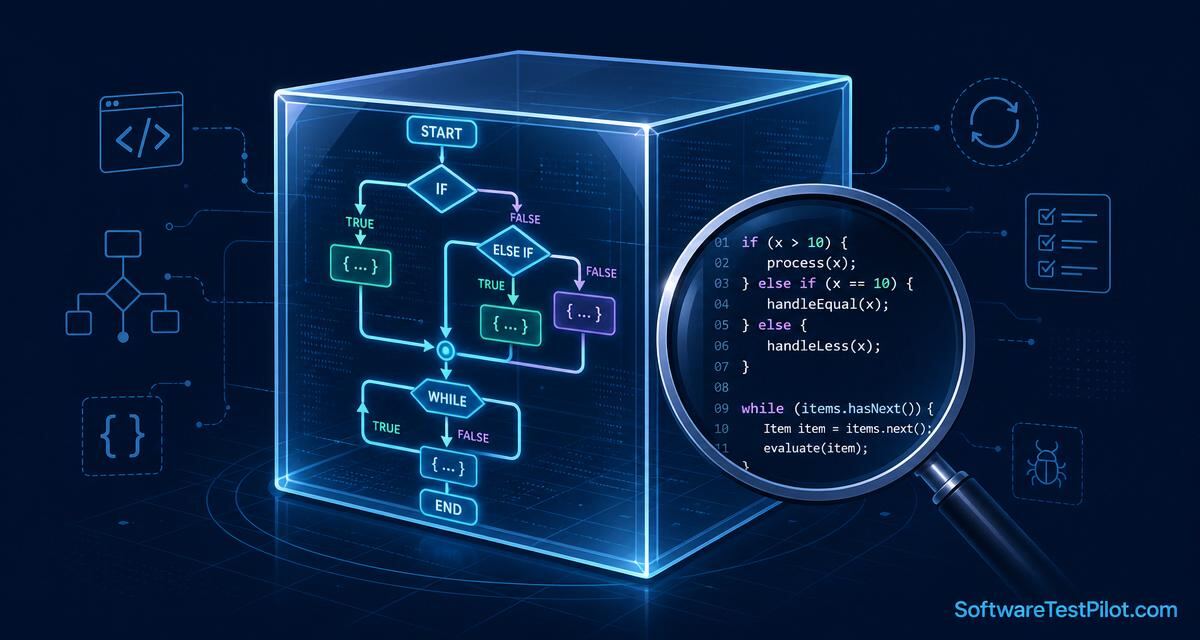
White box testing is the QA discipline of validating software by inspecting its internal code structure — statements, branches, paths, and data flow — rather than only its external behaviour. It is what developers do when they write unit tests and what security engineers do when they hunt for vulnerable code paths. This guide gives you the precise techniques, coverage metrics, tools, and worked examples every 2026 SDET needs to answer white-box interview questions and ship high-coverage code.
Pair this article with our black box testing complete guide — the two techniques are complements, and mature teams use them together.
Key takeaways
- White box testing needs code access; black box does not.
- Four core coverage techniques: statement, branch, condition, path.
- Owned mostly by developers and SDETs — unit tests are 99% white-box.
- Modern tools: Jest, pytest, JUnit, Vitest, Istanbul / Codecov for coverage reporting.
1. What is white box testing? A precise definition
White box testing (also called clear box, glass box, or structural testing) evaluates software by exercising internal code paths with full knowledge of the implementation. Testers read the source, choose inputs that force specific branches to execute, and measure how much of the code was hit.
The technique answers a question black box never can: “did every line of my code actually run?”. A feature can pass every acceptance test and still hide dead code paths that fail in production the first time real data touches them.
2. The core white box testing techniques
All white-box techniques boil down to one question: what structural element are you covering? The four coverage metrics you must know:
2.1 Statement coverage
Every executable statement runs at least once. Easiest to hit; weakest guarantee. 80% statement coverage is the industry-baseline gate.
2.2 Branch coverage
Every if / else, switch, and loop condition evaluates both true and false. Catches whole classes of defects that statement coverage misses.
2.3 Condition coverage
Every boolean sub-expression evaluates both true and false. For if (a && b), you need tests where a is true/false AND b is true/false — four cases, not two.
2.4 Path coverage
Every independent path through the code executes. Strongest guarantee; exponentially expensive on complex functions. Reserve for critical logic (payments, auth, safety systems).
3. Worked example: coverage on a real function
Take this TypeScript function that decides shipping cost:
function shippingCost(orderTotal: number, isPrime: boolean): number {
  if (isPrime) {
    return 0;
  }
  if (orderTotal > 50) {
    return 0;
  }
  return 5.99;
}
Statement coverage (100%): two tests — (30, true) hits the first return, (30, false) hits the last. But branch coverage is only 66%: the orderTotal > 50 branch never evaluated true. Add (60, false) and you hit 100% branch coverage. That third test is the one that would have caught a regression like orderTotal >= 50 vs >.
This is why 100% statement coverage is not the goal — 100% branch coverage on business-critical code is.
4. White box testing tools in 2026
- Unit test runners: Jest, Vitest (JavaScript / TypeScript), pytest (Python), JUnit / TestNG (Java), xUnit (.NET).
- Coverage reporters: Istanbul / c8 (JS), Coverage.py (Python), JaCoCo (Java), Codecov & Coveralls (cloud reporting).
- Static analysis / SAST: SonarQube, Semgrep, CodeQL — automated white-box code inspection.
- Mutation testing: Stryker (JS), PIT (Java), mutmut (Python) — verifies your tests actually catch bugs, not just execute lines.
Wire coverage gates into CI with the patterns in our CI/CD mastery guide. Reinforce Java unit testing with the TestNG vs JUnit comparison.
5. Who does white box testing?
Historically developers. In 2026, the ownership map is broader:
- Developers — unit + integration tests, mostly at branch coverage.
- SDETs — contract tests, integration tests, coverage-gated PRs. See the SDET vs QA salary gap.
- Security engineers — SAST, code review, dependency scans, penetration prep.
- Compliance / audit engineers — coverage reports for SOC 2 / ISO 27001 evidence.
6. Pros, cons, and when to use white box testing
Pros: Finds hidden logic errors, verifies actual code execution, catches dead code, measurable via coverage metrics, integrates cleanly into CI.
Cons: Requires code access and programming skill, expensive to write and maintain, refactors break tests, still needs black-box tests on top for user-observable quality.
Rule of thumb: white box for unit and integration layers of the test pyramid, black box for system and E2E on top.
7. Your 24-hour action step
Open any function you shipped this sprint. Run your unit-test suite with coverage enabled. If branch coverage is under 80%, write the missing tests today. Then benchmark yourself on the QA engineer roadmap, audit your resume with the ATS Resume Reviewer, and drill white-box interview questions on the AI Mock Interview. For deeper reading, the Martin Fowler test-coverage essay is the definitive perspective on how much coverage is enough.
White-box techniques in a modern SDET stack (2026 patterns)
Modern SDETs no longer hand-derive branch coverage from a printout — the 2026 stack computes it, and the tester's job is to read the report and pick the missing arcs that matter. The pattern most FAANG-adjacent teams now ship, from SoftwareTestPilot's 2026 review of 40+ engineering orgs:
- Coverage-guided PR gates. JaCoCo / Istanbul / Coverage.py runs on every PR and fails if branch coverage drops on changed files. Global % is a vanity metric; delta on the diff is the real signal.
- Mutation testing on the critical 20%. Stryker (JS/TS), PIT (Java), mutmut (Python) rerun the suite against artificially broken code. A test suite with 80% line coverage and 30% mutation score is theatre. On the teams we reviewed, raising mutation score from 30% → 65% cut escaped logic defects by ~44%.
- Path testing generated, not designed. Symbolic execution tools (KLEE for C, CrossHair for Python, SPF for Java) enumerate feasible paths — the tester curates, does not enumerate by hand.
- Cyclomatic complexity as a review gate. Any function with CC > 10 is auto-flagged in the PR — testers become the loudest voice for refactor rather than for “more tests”.
Interview signal senior panels listen for: “I care about branch delta on changed lines and mutation score on the critical modules, not global line coverage.” Say that and you are reading as staff-level.