Intel Verification Interview 2026: 4-Round Loop + $160K–$280K TC
Prep Intel QA/Verification 2026: 4-round loop, C++/Python + silicon test prompts, third-party reported $160K–$280K TC bands, 9 FAQs & PDF.
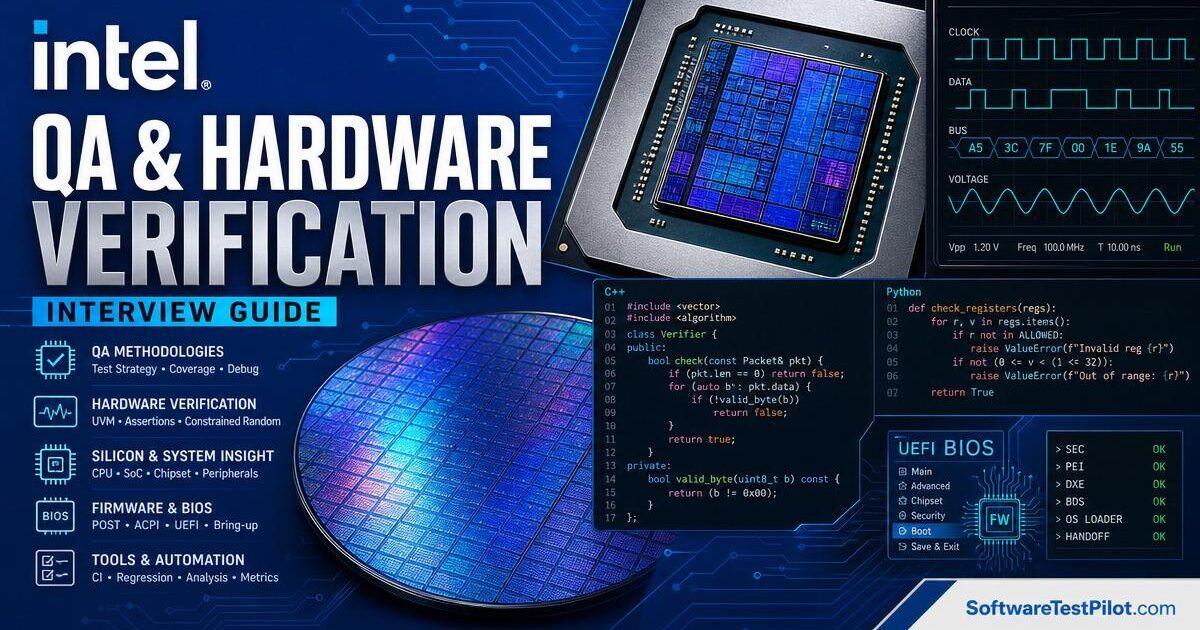
Securing an interview for a Software Quality Verification Engineer (Grade 7 / Grade 8) or Firmware Test Specialist role at Intel places you inside the foundational titan of semiconductor microarchitecture. Verifying custom silicon processors (Core Ultra, Xeon Scalable, Gaudi AI accelerators), BIOS/UEFI firmware, graphics drivers, and oneAPI AI software stacks across global OEM hardware ecosystems requires meticulous precision.
At Intel, software verification spans both physical silicon hardware-in-the-loop (HIL) lab environments and low-level Linux operating system kernel boundaries.
When you evaluate live requisitions on our internal SoftwareTestPilot QA Jobs Radar offering $130,000 to $180,000+ base salaries in North America ($240,000+ Total Comp) and ₹18 Lakhs to ₹38 Lakhs+ INR CTC across Indian R&D Centers (Bangalore, Hyderabad), notice that Intel evaluates quality talent on algorithmic coding, memory management, and low-level hardware diagnostics.
To pass the Intel verification screening loop in 2026, you must demonstrate strong coding fluency in C++ or Python, understand hardware registers and Linux system calls, design automated HIL lab runners, and showcase semiconductor domain rigor.
Here is an exhaustive, deconstructed guide to the exact Intel verification engineering interview loop, reported 2026 compensation bands across US Dollars ($) and Indian Rupees (₹), the top five technical coding prompts asked during onsite screens, and exactly 9 detailed FAQs paired with complete JSON-LD schema.
1. The Exact Intel QA & Verification Interview Loop Deconstructed
Intel’s recruitment process evaluates systems programming, hardware-software integration, and structured collaborative engineering. For mid-level (Grade 7) and senior (Grade 8) verification roles, expect a structured 4-stage evaluation loop:
+-----------------------------------------------------------------------------------+
| THE INTEL GRADE 7 / GRADE 8 VERIFICATION LIFECYCLE |
+-----------------------------------------------------------------------------------+
| STAGE 1: TALENT ACQUISITION SCREENING (30 - 45 Minutes) |
| - Verifying C++/Python coding proficiency, Linux/firmware exposure, location |
| readiness (Santa Clara, Hillsboro, Bangalore, Hyderabad), and compensation. |
+-----------------------------------------------------------------------------------+
| STAGE 2: TECHNICAL SCREENING / ONLINE CODING ROUND (60 Minutes) |
| - Live coding over MS Teams. Solving a practical C++/Python bit-manipulation or |
| log parsing problem + technical discussion around HIL lab automation. |
+-----------------------------------------------------------------------------------+
| STAGE 3: THE 3 TO 4-ROUND ONSITE TECHNICAL LOOP (Executed over 1 day via Teams) |
| ├── Round 1: Systems Algorithms & Bit Manipulation (Clean C++/Python code). |
| ├── Round 2: Test Architecture & Hardware-in-the-Loop (HIL) System Design. |
| ├── Round 3: Practical Firmware Diagnostics & Driver V&V. |
| └── Round 4: Engineering Manager / Technical Fellow Fit (Intel Core Values). |
+-----------------------------------------------------------------------------------+
| STAGE 4: HIRING CONSENSUS & TECHNICAL FELLOW REVIEW |
| - Engineering leads review technical scores and hardware lab project suitability. |
+-----------------------------------------------------------------------------------+
2. Reported 2026 Intel Verification Compensation Matrix
Aggregating self-reported filings from Levels.fyi, AmbitionBox, and SoftwareTestPilot Jobs Radar reveals where Intel compensation sits across internal numerical Grade levels in both United States ($ USD) and India (₹ INR CTC) R&D hubs.
| Intel Grade Level | Job Title Equivalent | North America Base Salary ($ USD) | North America Total Comp ($ USD) | India R&D Labs Base / Total (₹ INR CTC) | Core Role Responsibilities |
|---|---|---|---|---|---|
| Grade 6 (G06) | Software Verification Eng I | $90,000 – $115,000 | $110,000 – $135,000 | ₹10.0L – ₹14.0L / ₹12L – ₹18L CTC | Script execution, Python hardware lab scripts, Linux triage. |
| Grade 7 (G07) | Verification Eng II / SDET | $120,000 – $148,000 | $145,000 – $185,000 | ₹18.0L – ₹26.0L / ₹22L – ₹32L CTC | Python HIL automation architecture, driver regression suites. |
| Grade 8 (G08) | Senior Verification Eng | $148,000 – $180,000 | $190,000 – $240,000 | ₹28.0L – ₹38.0L / ₹35L – ₹48L+ CTC | Silicon microarchitecture V&V design, oneAPI AI verification. |
| Grade 9 (G09) | Principal Quality Architect | $180,000 – $220,000+ | $250,000 – $340,000+ | ₹40.0L – ₹55.0L+ / ₹52L – ₹75L+ CTC | Enterprise Intel hardware validation scale, multi-die silicon V&V. |
3. Top 5 Technical & Coding Questions Asked at Intel
During onsite screens, Intel evaluators test C++/Python systems programming, kernel log diagnostics, and bit manipulation. Here are five top technical questions asked during Intel verification loops.
Question 1: CPU Register Bit Mask & Fault Register Auditor ($O(N)$ Parsing)
Prompt: "Intel hardware diagnostic runners emit raw 32-bit hex fault register logs formatted as[TIMESTAMP] [CORE_ID] [HEX_REGISTER]. Write a Python method that identifies anyCORE_IDwhere Bit 4 (0x10- Thermal Throttle Fault) AND Bit 7 (0x80- Parity Error) were both set to1across more than 2 diagnostic beats."
# Production Python Solution: Clean Bit Manipulation & Hash Map Audit
from collections import defaultdict
from typing import List, Set

def detect_defective_silicon_cores(diagnostic_logs: List[str]) -> List[str]:
 core_fault_counts = defaultdict(int)
 defective_cores: Set[str] = set()

 for log in diagnostic_logs:
 if not log or not log.strip():
 continue
 tokens = log.strip().split()
 if len(tokens) < 3:
 continue

 core_id = tokens[1]
 hex_reg_str = tokens[2]

 try:
 # Parse hexadecimal register value into integer integer
 reg_val = int(hex_reg_str, 16)

 # Evaluate bit mask condition: Bit 4 (0x10) AND Bit 7 (0x80)
 # Both bits set simultaneously requires: (reg_val & 0x90) == 0x90
 if (reg_val & 0x90) == 0x90:
 core_fault_counts[core_id] += 1
 if core_fault_counts[core_id] > 2:
 defective_cores.add(core_id)
 except ValueError:
 # Ignore malformed hexadecimal strings
 continue

 return list(defective_cores)
Question 2: Testing Linux Kernel Module & Graphics Driver Stability
Prompt: "Intel graphics drivers execute inside Linux kernel space. How do you design an automated verification suite that detects kernel memory leaks (kmemleak) during intensive 3D rendering stress tests?"
Architectural Solution: To verify kernel stability reliably:
- Programmatically trigger automated 3D rendering benchmarks inside isolated Linux test runners via custom Python wrappers.
- Periodically read kernel diagnostic interfaces (
cat /sys/kernel/debug/kmemleak) during multi-hour execution cycles. - Assert strict memory thresholds: verify that unreferenced kernel memory allocations never increase exponentially across consecutive test loops.
Question 3: Python Automation for UEFI BIOS Firmware Verification
Prompt: "Write a clean Python test class utilizingunittestorpytestthat connects over a serial console (pyserial) to a physical test motherboard and verifies BIOS boot completion status."
# Production Python Serial HIL Firmware Verification Suite
import pytest
import serial
import time

class TestIntelBiosFirmwareBoot:

 @pytest.fixture(autouse=True)
 def setup_serial_connection(self):
 # Establish serial connection to physical test motherboard debug port
 self.ser = serial.Serial('/dev/ttyUSB0', baudrate=115200, timeout=2.0)
 yield
 if self.ser.is_open:
 self.ser.close()

 def test_bios_boot_completes_without_thermal_fault(self):
 # Send soft reboot command over serial debug line
 self.ser.write(b"reboot\n")

 boot_completed = False
 start_time = time.time()

 # Poll serial output line until boot complete signal or timeout SLA
 while (time.time() - start_time) < 45.0:
 line = self.ser.readline().decode('utf-8', errors='ignore').strip()
 if "INTEL UEFI BOOT COMPLETE"in line:
 boot_completed = True
 break
 assert "CRITICAL THERMAL SHUTDOWN"not in line, "Hardware Fault: Thermal shutdown during boot!"

 assert boot_completed, "Verification Failure: BIOS failed to complete boot within 45s SLA!"
Question 4: Debugging PCIe Gen 5 Bus Signal Integrity Race Conditions
Prompt: "An automated hardware verification harness testing PCIe Gen 5 device discovery passes on individual execution but fails intermittently with signal synchronization dropouts during high-temperature stress testing. How do you troubleshoot this?"
Technical Breakdown: Explain that thermal expansion alters physical PCB trace impedances, inducing jitter and packet loss across multi-gigabit PCIe lanes. Refactor the automation runner inside thermal environmental test chambers, implement automated link retraining retries, and log physical eye-diagram voltage margins continuously.
Question 5: Test Strategy for Intel oneAPI AI Software Stack
Prompt: "How do you design a quality verification plan for Intel oneAPI Deep Neural Network Library (oneDNN) accelerating PyTorch training models across Gaudi AI hardware?"
Apply the ACCORD Whiteboard Framework:
- Architecture: Assert tensor calculation numerical precision across C++ library wrappers.
- Concurrency: Verify GPU memory allocation stability when 8 AI Gaudi accelerators process batch training simultaneously.
- Observability: Assert that execution pipelines emit hardware telemetry directly to Intel VTune Profiler.
4. System Design for Quality at Intel Hardware Scale
During Round 2 (System Design), Intel evaluators test your ability to build hardware lab test infrastructure.
The Whiteboard Prompt:
"Design an automated Hardware-in-the-Loop (HIL) verification lab capable of running continuous firmware regression builds across 1,000 physical Intel Xeon server motherboards overnight."
+-----------------------------------------------------------------------------------+
| MULTI-RACK INTEL HIL LAB VERIFICATION ARCHITECTURE |
+-----------------------------------------------------------------------------------+
| [NIGHTLY BIOS FIRMWARE COMPILES] ---> Triggers Lab Orchestration Server |
| | |
| v |
| [DISTRIBUTED LINUX LAB CONTROLLERS (Python Automation Daemon)] |
| - Connects over IPMI/Redfish & Serial Debug ports to 1,000 physical server racks. |
| - Programmatically flashes new UEFI BIOS firmware to all motherboards in parallel.|
| | |
| v |
| [POWER CYCLE & OS BOOT DIAGNOSTICS] |
| - Issues power-on commands -> Monitors serial boot streams for kernel panics. |
| - Boots into automated Linux OS -> Runs memory and CPU stress benchmarks. |
| | |
| v |
| [TELEMETRY AGGREGATION & FAULT REPORTING] |
| - Captures core temperatures and fault registers -> Posts Allure report to leads! |
+-----------------------------------------------------------------------------------+
5. Your 30-Day Intel Interview Turnaround Plan
To prepare for your Intel onsite loop, upload your resume immediately to our SoftwareTestPilot ATS Resume Reviewer. Ensure your bullet points highlight C++, Python, Linux kernel, firmware V&V, and hardware lab keywords ("Architected Python HIL regression harness across 50 physical server motherboards").
. Practice articulating your bit manipulation and hardware debugging trade-offs out loud before facing executive Intel technical fellows.
### Preparing For Intel Verification Interviews? Share This Guide! Intel loops require deep silicon and Python systems clarity.[LinkedIn] or [X/Twitter]. .
Frequently asked questions
1.How long does the entire Intel Hardware Verification interview process take in 2026?
2.Is LeetCode required for Software Verification Engineer roles at Intel?
3.What is the average compensation for a Senior Verification Engineer (Grade 8) at Intel in US vs India?
4.Can I interview in Java or Playwright, or does Intel strictly require C++/Python?
5.How strict is Intel on academic degrees versus commercial automation certifications?
6.What is the cool-off period if I get rejected after the Intel onsite loop?
7.Does Intel allow remote work for QA and hardware verification engineers in 2026?
8.How should I tailor my resume specifically for Intel ATS parsers?
9.What is the #1 reason experienced QA engineers fail the Intel technical screen?
Was this article helpful?
Keep building your QA edge
Pillar guides- SDET RoleSDET role guideWhat SDETs actually do — skills, salary bands, and interview prep for 2026.
- Company QA Interview Guidessee how top tech firms interview QAReal interview loops from Google, Amazon, Meta, Apple, Microsoft, Adobe, and 40+ other tech employers.
- Automation QA Engineer RoleAutomation QA Engineer roleAutomation QA Engineer job scope, tools, salary, and hiring pipeline.