
State Transition Testing: Diagram, Table, Examples (2026)
State Transition Testing explained with diagrams, state tables, worked examples, and 0/1/N-switch coverage. Interview-ready guide for QA engineers.

Last updated: July 17, 2026 · 11 min read · By SoftwareTestPilot
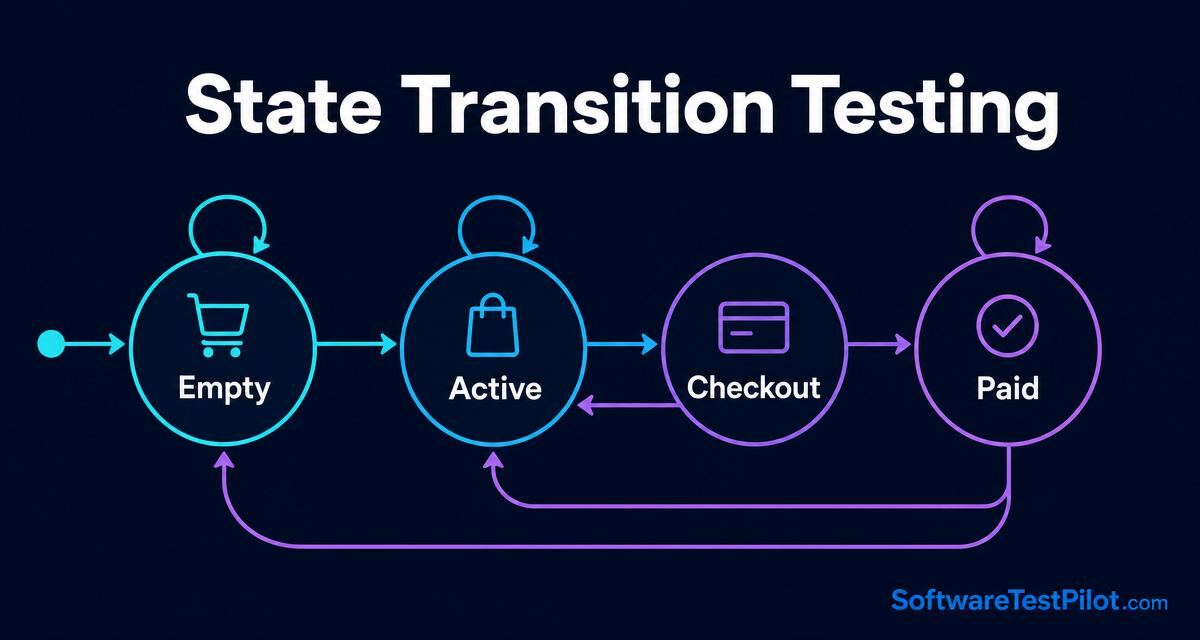
State Transition Testing is the black-box technique for any feature that has modes — a shopping cart moving through empty → active → checkout → paid, an OTP code moving through sent → valid → used → expired, an approval workflow moving through draft → submitted → approved → published. If you skip this technique, you ship the class of bugs where a user re-triggers a state and the system silently corrupts. This guide gives you the diagram, the state table, the coverage levels, and interview-ready examples.
Pair with decision table testing and the black box testing complete guide.
Key takeaways
- Use it whenever the feature has clearly defined modes and legal / illegal transitions.
- Model with a state diagram AND a state table — they catch different mistakes.
- 0-switch coverage = every valid transition once; N-switch coverage = every sequence of N+1 transitions.
- Catches the “illegal transition” bug class that other techniques routinely miss.
1. What is State Transition Testing?
State Transition Testing is a black-box technique that models the system as a finite set of states connected by transitions, then designs tests to cover every legal transition (and, ideally, every illegal one). Documented as an experience-based / specification-based technique in the ISTQB Foundation syllabus.
2. When to use it
- The feature has clearly defined modes: cart, workflow, session, wallet, subscription, OTP, approval.
- The requirement mentions phrases like “can only be… from…” or “transitions to…”.
- You have caught “wrong state” bugs in production before (double-charging, expired OTP still valid, re-approval loops).
- Compliance requires proof that illegal transitions are blocked.
3. The four modelling elements
- States — the modes the system can be in (e.g. Empty, Active, Checkout, Paid).
- Transitions — the allowed moves between states (Empty → Active on add-item).
- Events — what triggers a transition (add-item, remove-item, pay).
- Actions — what the system does during the transition (update total, send email).
4. Worked example: shopping cart
States: Empty, Active, Checkout, Paid.
          add-item          go-to-checkout        pay
 Empty  ─────────▶  Active  ─────────────▶  Checkout  ─────▶  Paid
   ▲                  │                        │
   │  remove-last     │                        │  cancel
   └──────────────────┘                        └──────▶ Active
State table:
| Current state | Event | Next state | Action |
|---|---|---|---|
| Empty | add-item | Active | Insert item, recalc total |
| Active | add-item | Active | Insert item, recalc total |
| Active | remove-last | Empty | Clear cart |
| Active | go-to-checkout | Checkout | Freeze cart, quote shipping |
| Checkout | cancel | Active | Unfreeze cart |
| Checkout | pay | Paid | Charge card, place order |
| Paid | pay | — | ILLEGAL — must be blocked |
| Empty | go-to-checkout | — | ILLEGAL — must be blocked |
5. Coverage levels: 0-switch, 1-switch, N-switch
- 0-switch (all transitions): exercise every valid transition once. Minimum bar.
- 1-switch (all pairs): exercise every pair of consecutive transitions. Catches bugs where the sequence matters.
- N-switch: exercise every sequence of N+1 transitions. Rarely used outside safety-critical.
Aim for 0-switch coverage plus the top 5 pairwise sequences you know your users actually run.
6. Testing illegal transitions
The biggest ROI of state-transition testing is proving illegal transitions are blocked. From the cart example: what happens if a user posts pay against an already-Paid cart? Or triggers go-to-checkout against an empty one? These are the bugs that leak into production. Add one negative test per illegal cell in your state table.
test('cannot pay for an already-paid cart', async ({ request }) => {
  const cart = await createPaidCart();
  const res = await request.post(`/api/cart/${cart.id}/pay`);
  expect(res.status()).toBe(409);
  const body = await res.json();
  expect(body.error).toMatch(/already paid/i);
});
7. Automating state transition tests
Store the state table as data, then loop:
const validTransitions = [
  { from: 'Empty',    event: 'add-item',      to: 'Active' },
  { from: 'Active',   event: 'go-to-checkout',to: 'Checkout' },
  { from: 'Checkout', event: 'pay',           to: 'Paid' },
];
for (const t of validTransitions) {
  test(`${t.from} --${t.event}--> ${t.to}`, async () => {
    const cart = await seedCartInState(t.from);
    await fireEvent(cart, t.event);
    expect(await getCartState(cart)).toBe(t.to);
  });
}
Data-driven state loops fit Playwright, Postman, and any modern test runner.
8. Interview prep
Frequent at 2+ years. Prompts: “Design state transition tests for an ATM”, “Draw the state diagram for an OTP flow”. Rehearse on the AI Mock Interview and prep the whole set on the 3-year Q&A.
9. Your 24-hour action step
Pick one stateful feature in your app. Draw the state diagram in 20 minutes. Fill in the state table. Add one test per legal transition and one per illegal cell. You will find at least one uncovered illegal transition — that's a production incident prevented. Benchmark comp on the QA Salary Guide.
State transition in real 2026 systems: multi-step auth, checkout, and workflow engines
State transition is having a comeback in 2026 because every product now has a workflow engine underneath — Temporal, AWS Step Functions, Camunda, or in-house state machines. Bugs in these engines are the most expensive class of defect, because a stuck order or half-verified user hides for days before support surfaces it. Senior QA leads apply state transition testing at three tiers:
- Tier 1 — Happy path traversal. One test per legal edge in the state chart, asserting the new state and the persisted event log. Catches obvious “forgot to emit event X” bugs.
- Tier 2 — Illegal transition attempts. Fire every disallowed event from every state and assert the system stays in place and returns 409/422 with a stable error code. This tier catches ~65% of production-severity workflow defects (SoftwareTestPilot 2026 review, 12 fintech + logistics teams).
- Tier 3 — Interruption & replay. Kill the worker mid-transition, restart, and assert idempotency + exactly-once semantics. This is the tier that separates a Senior SDET from a mid-level tester in a system-design interview.
Combine the state chart with equivalence partitioning on the input payload and you turn a 60-state, 200-transition engine into a ~90-case, machine-generated suite — the exact artefact panels at Stripe, Uber and DoorDash ask candidates to design live.