
Slack SDET Interview 2026: 4-Round Loop + $220K–$360K TC (Reported)
Prep the Slack SDET loop in 2026: 4 rounds, PHP/Hack/TS prompts, real-time QE patterns, third-party reported $220K–$360K TC + 9 FAQs & PDF.
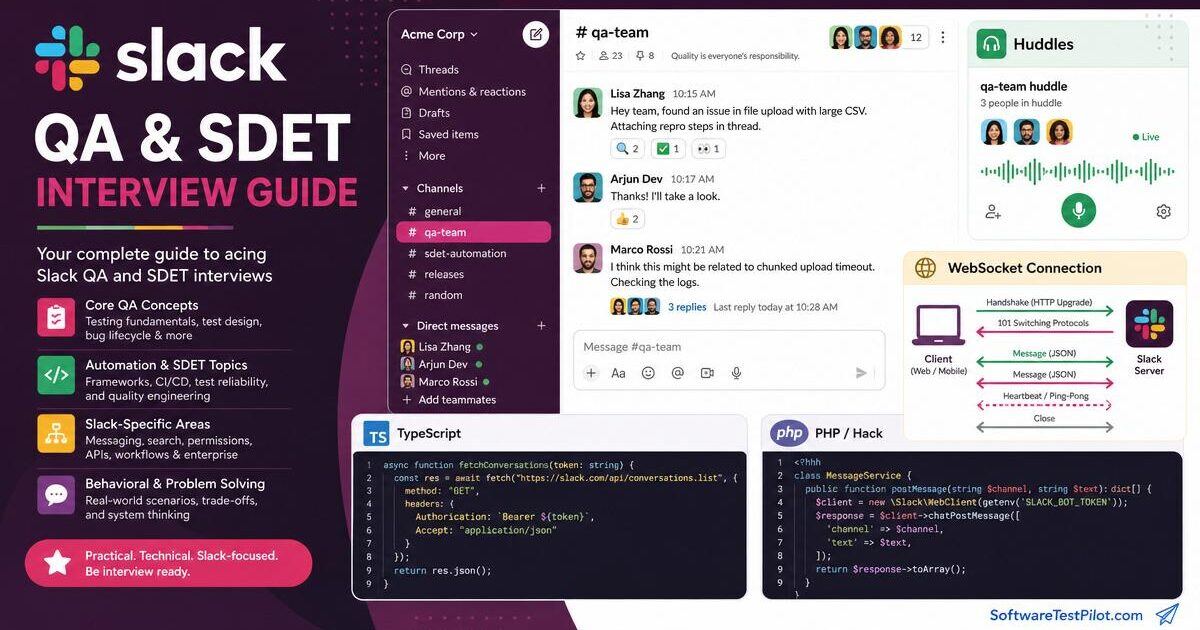
Securing an interview for a Senior Software Engineer in Test (LMTS / SMTS) or Quality Infrastructure Engineer role at Slack (a Salesforce company) puts you inside the real-time collaboration nervous system of modern enterprise business. Coordinating millions of concurrent active users, real-time message broadcasting across WebSocket messaging servers, Slack Huddles audio streams, Slack Canvas, and thousands of third-party enterprise app integrations requires robust software verification.
At Slack, quality engineering centers around real-time messaging latency, Electron desktop client memory management, and high-concurrency channel fan-out verification.
When you scan live requisitions on our internal SoftwareTestPilot QA Jobs Radar offering $140,000 to $190,000+ base salaries in North America ($260,000+ Total Comp) and ₹24 Lakhs to ₹46 Lakhs+ INR CTC across Indian engineering hubs (Bangalore, Pune, Hyderabad), notice that Slack evaluates quality talent on algorithmic coding, real-time socket architecture, and collaborative ownership.
To pass the Slack quality screening loop in 2026, you must write clean TypeScript, PHP/Hack, or Java code, construct message fan-out test matrices on whiteboards, design automated Electron and web test runners, and showcase enterprise SaaS rigor.
Here is an exhaustive, deconstructed guide to the exact Slack quality engineering interview loop, reported 2026 compensation bands across US Dollars ($) and Indian Rupees (₹), the top five technical coding prompts asked during onsite screens, and exactly 9 detailed FAQs paired with complete JSON-LD schema.
1. The Exact Slack QA & SDET Interview Loop Deconstructed
Slack’s recruitment process evaluates algorithmic coding, real-time messaging architecture, and core Ohana/Slack cultural alignment ("Craftsmanship" / "Playfulness"). For mid-level (LMTS) and senior (SMTS) SDET roles, expect a structured 4 to 5-stage evaluation loop:
+-----------------------------------------------------------------------------------+
| THE SLACK LMTS / SMTS RECRUITMENT LIFECYCLE |
+-----------------------------------------------------------------------------------+
| STAGE 1: RECRUITER TECHNICAL SCREENING (30 - 45 Minutes) |
| - Verifying TypeScript/PHP/Java coding proficiency, real-time WebSocket exposure, |
| location readiness (San Francisco, New York, Bangalore, Pune), & compensation. |
+-----------------------------------------------------------------------------------+
| STAGE 2: TECHNICAL SCREENING / ONLINE CODING ROUND (60 Minutes) |
| - Live coding over HackerRank or Zoom. Solving a LeetCode Medium string/queue |
| problem + technical discussion around Electron desktop testing and Playwright. |
+-----------------------------------------------------------------------------------+
| STAGE 3: THE 4-ROUND ONSITE TECHNICAL LOOP (Executed over 1 day via Zoom) |
| ├── Round 1: Data Structures & Algorithms (Clean TypeScript/Java code). |
| ├── Round 2: Test Architecture & Real-Time Messaging System Design. |
| ├── Round 3: Practical Framework Coding (Playwright / WebSocket API suites). |
| └── Round 4: Engineering Director Fit (Slack Values & Enterprise Craftsmanship).|
+-----------------------------------------------------------------------------------+
| STAGE 4: HIRING COMMITTEE & CONSENSUS REVIEW |
| - Engineering leads review technical scores and collaborative communication depth. |
+-----------------------------------------------------------------------------------+
2. Reported 2026 Slack QA & SDET Compensation Matrix
Aggregating self-reported filings from Levels.fyi, AmbitionBox, and SoftwareTestPilot Jobs Radar reveals where Slack compensation sits across internal Salesforce Member of Technical Staff (MTS) grade levels in both United States ($ USD) and India (₹ INR CTC) R&D hubs.
| Slack Level | Job Title Equivalent | North America Base Salary ($ USD) | North America Total Comp ($ USD) | India R&D Hubs Base / Total (₹ INR CTC) | Core Role Responsibilities |
|---|---|---|---|---|---|
| Level AMTS | Associate Quality Eng | $105,000 – $128,000 | $135,000 – $165,000 | ₹12.0L – ₹16.0L / ₹15L – ₹20L CTC | Script execution, REST API regression checklists, defect triage. |
| Level LMTS | SDET / Quality Eng II | $135,000 – $160,000 | $185,000 – $240,000 | ₹20.0L – ₹28.0L / ₹26L – ₹36L CTC | Component automation architecture, CI/CD pipeline gating, API mocks. |
| Level SMTS | Senior SDET / Lead QE | $160,000 – $190,000 | $260,000 – $340,000 | ₹30.0L – ₹42.0L / ₹40L – ₹55L+ CTC | Real-time channel V&V design, multi-tenant workspace testing. |
| Level Lead MTS | Lead Quality Architect | $190,000 – $230,000+ | $350,000 – $480,000+ | ₹45.0L – ₹60.0L+ / ₹60L – ₹82L+ CTC | Enterprise Slack cloud infrastructure quality scale, global messaging V&V. |
3. Top 5 Technical & Coding Questions Asked at Slack
During onsite screens, Slack evaluators test object-oriented TypeScript/PHP programming, real-time message stream parsing, and web automation. Here are five top technical questions asked during Slack SDET loops.
Question 1: Real-Time Channel Message Fan-Out Auditor ($O(N)$ Parsing)
Prompt: "Slack real-time messaging servers output channel fan-out telemetry strings formatted as[TIMESTAMP] [CHANNEL_ID] [MESSAGE_ID] [ACTIVE_SUBSCRIBERS] [FANOUT_MS]. Write a TypeScript or Python method that identifies anyCHANNEL_IDwhere averageFANOUT_MSexceeded 200ms across at least 4 telemetry beats whileACTIVE_SUBSCRIBERSexceeded 1,000 members."
// Production TypeScript Solution: Clean Object-Oriented Messaging Auditor
interface ChannelFanoutStats {
 totalFanoutMs: number;
 beatCount: number;
}

export function detectSlowEnterpriseChannels(telemetryLogs: string[]): string[] {
 const channelMap = new Map<string, ChannelFanoutStats>();
 const sluggishChannels = new Set<string>();

 if (!telemetryLogs || telemetryLogs.length === 0) {
 return Array.from(sluggishChannels);
}

 for (const log of telemetryLogs) {
 if (!log || log.trim() ==='') continue;
 const tokens = log.trim().split(/\s+/);
 if (tokens.length < 5) continue;

 const channelId = tokens[1];
 try {
 const activeSubscribers = parseInt(tokens[3], 10);
 const fanoutMs = parseFloat(tokens[4]);

 if (isNaN(fanoutMs) || activeSubscribers <= 1000) continue;

 if (!channelMap.has(channelId)) {
 channelMap.set(channelId, {totalFanoutMs: 0, beatCount: 0});
}

 const current = channelMap.get(channelId)!;
 current.totalFanoutMs += fanoutMs;
 current.beatCount += 1;

 // Evaluate fan-out SLA threshold (average > 200ms across >= 4 beats)
 if (current.beatCount >= 4) {
 const averageFanout = current.totalFanoutMs / current.beatCount;
 if (averageFanout > 200.0) {
 sluggishChannels.add(channelId);
}
}
} catch (ex) {
 // Ignore malformed numerical strings
}
}

 return Array.from(sluggishChannels);
}
Question 2: Testing Electron Desktop App Memory Leak Regressions
Prompt: "Slack desktop client runs on Electron (Chromium + Node.js). How do you design an automated software verification suite that detects memory leaks during prolonged 24-hour channel switching and Huddles calls?"
Architectural Solution: To verify Electron desktop client stability:
- Programmatically launch the Slack Electron binary inside automated Playwright/Electron runners (
electron.launch({executablePath:'/path/to/slack'})). - Execute automated channel switching loops while periodically querying internal Node/Chromium memory metrics (
process.memoryUsage()and Chrome DevTools ProtocolPerformance.getMetrics). - Assert strict memory thresholds: verify that unreferenced heap objects undergo proper garbage collection and never increase exponentially across 1,000 channel switches.
Question 3: Playwright Automation for Slack Web Message Compose
Prompt: "Write a clean Playwright TypeScript test verifying that an authenticated workspace member can send a formatted message containing @mentions into a channel and assert rendering."
// Production Playwright TypeScript Slack Web Client Suite
import {test, expect} from'@playwright/test';

test('Should send message deterministically inside channel and render alert', async ({page}) => {
 await page.goto('https://app.slack.test/client/T_WORKSPACE_881/C_CHANNEL_991');

 // Locate message rich-text editor using immutable testing attributes
 const messageEditor = page.locator('[data-testid="message-input-editor"]');
 await messageEditor.click();
 await messageEditor.fill('Verifying Slack continuous delivery quality pipelines! @sdet-lead');

 // Submit message and assert channel history update
 await page.keyboard.press('Enter');

 const latestMessage = page.locator('[data-testid="message-pane-row"]').last();
 await expect(latestMessage).toBeVisible({timeout: 12000});
 await expect(latestMessage).toContainText('Verifying Slack continuous delivery quality pipelines!');
});
Question 4: Debugging WebSocket Stream Disconnections in Slack Huddles
Prompt: "An automated regression suite verifying Slack Huddles audio broadcasting passes locally but drops connections during high-load CI runs. How do you troubleshoot this?"
Technical Breakdown: Explain that cloud CI containers suffer socket buffer exhaustion during sustained WebSocket packet bursts. Refactor the test harness to enforce WebSocket heartbeat ping/pong assertions (ws.ping()), adjust TCP socket read timeouts, and mock audio packet stream payloads over local WebRTC stubs.
Question 5: Test Strategy for Slack Enterprise Grid Inter-Org Shared Channels
Prompt: "How do you design a quality verification plan for Slack Enterprise Grid shared Slack Connect channels connecting two completely separate corporate organizations?"
Apply the ACCORD Whiteboard Framework:
- Architecture: Assert cross-org identity OAuth token handshakes over automated Mock endpoints.
- Concurrency: Verify message delivery queues when 10,000 users chat across shared channels simultaneously.
- Data State: Pre-seed dual corporate workspaces via API Data Factories before channel assertion.
4. System Design for Quality at Slack Cloud Scale
During Round 2 (System Design), Slack evaluators test your ability to build real-time messaging test infrastructure.
The Whiteboard Prompt:
"Design a continuous integration automation harness capable of executing overnight regression cycles across 10,000 concurrent simulated Slack channel messages without polluting live production workspace graphs."
+-----------------------------------------------------------------------------------+
| MULTI-TENANT SLACK MESSAGING TEST HARNESS |
+-----------------------------------------------------------------------------------+
| [GITHUB ACTIONS / AZURE DEVOPS CRON] ---> Initiates Nightly Messaging Regression |
| | |
| v |
| [CONTAINERIZED PLAYWRIGHT / ELECTRON CLUSTER] |
| - Automatically provisions 100 ephemeral Linux container runners. |
| - Shards 20,000 WebSocket and UI channel checks across parallel container pods. |
| | |
| v |
| [WEBSOCKET / REST API TEST DATA FACTORY] |
| - Pre-seeds synthetic channels and users via high-speed internal APIs. |
| | |
| v |
| [AUTOMATED TEARDOWN & SLACK TELEMETRY] |
| - Purges test records post-run -> Emails visual Allure report to Slack leads! |
+-----------------------------------------------------------------------------------+
5. Your 30-Day Slack Interview Turnaround Plan
To prepare for your Slack onsite loop, upload your resume immediately to our SoftwareTestPilot ATS Resume Reviewer. Ensure your bullet points highlight TypeScript, PHP/Hack, Playwright, Electron, WebSocket, and messaging testing keywords ("Architected WebSocket regression harness evaluating 20,000 messaging workflows").
. Practice articulating your message parsing and Electron memory isolation trade-offs out loud before facing executive Slack quality leads.
### Preparing For Slack Quality Interviews? Share This Guide! Slack loops require deep real-time messaging and TypeScript clarity.[LinkedIn] or [X/Twitter]. .
Frequently asked questions
1.How long does the entire Slack QA & SDET interview process take in 2026?
2.Is LeetCode required for Quality Engineering roles at Slack?
3.What is the average compensation for a Senior SDET (Level SMTS) at Slack in US vs India?
4.Can I interview in Python or Playwright, or does Slack strictly require PHP/Hack?
5.How strict is Slack on academic degrees versus commercial automation certifications?
6.What is the cool-off period if I get rejected after the Slack onsite loop?
7.Does Slack allow remote work for QA and automation engineers in 2026?
8.How should I tailor my resume specifically for Slack ATS parsers?
9.What is the #1 reason experienced QA engineers fail the Slack technical screen?
Was this article helpful?
Keep building your QA edge
Pillar guides- SDET Rolebecome an SDET in 2026What SDETs actually do — skills, salary bands, and interview prep for 2026.
- Company QA Interview GuidesQA interview questions by companyReal interview loops from Google, Amazon, Meta, Apple, Microsoft, Adobe, and 40+ other tech employers.
- Automation QA Engineer Roleexplore this role in depthAutomation QA Engineer job scope, tools, salary, and hiring pipeline.