
Lyft SDET Interview 2026: T2–T5 Loop + $230K–$380K TC (Reported)
Crack Lyft's SDET T2–T5 loop in 2026: Envoy mesh + Prime Time prompts, Python/Go rounds, third-party reported $230K–$380K TC, 9 FAQs & PDF.
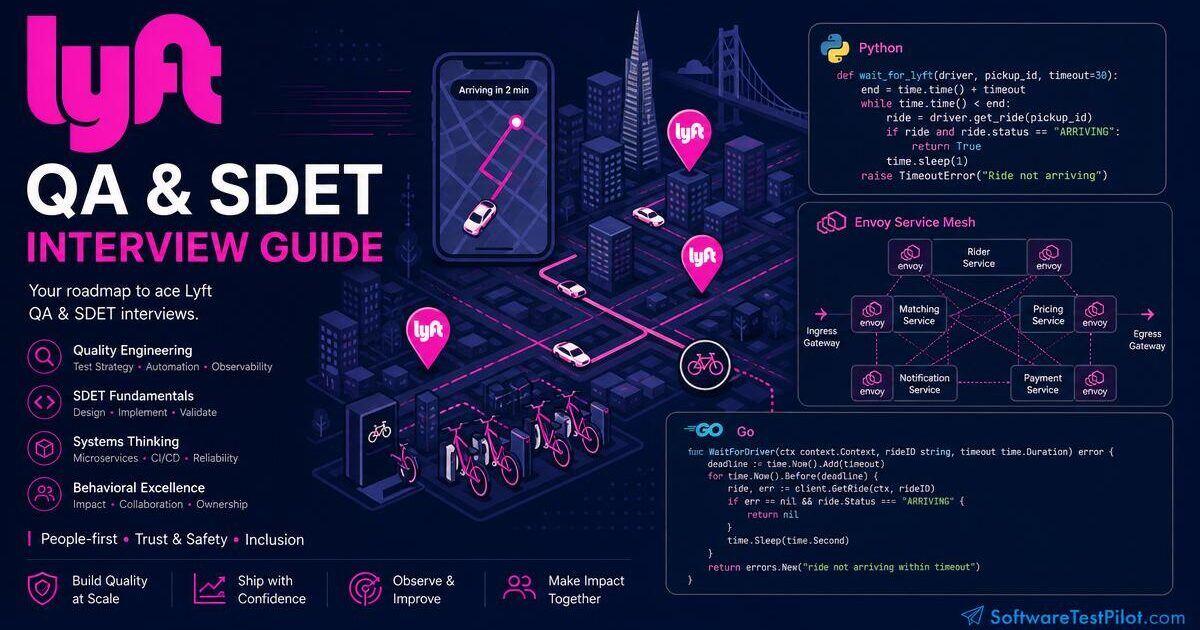
Securing an interview for a Software Engineer in Test (T3 / T4) or Staff Quality Architect (T5) role at Lyft puts you inside the agile, developer-centric transportation network challenging urban mobility. Coordinating rides, bike-share grids, and autonomous vehicle telemetry across North American metropolitan hubs requires software verification capable of handling geospatial pricing, Envoy service mesh networking, and mobile reliability.
At Lyft, quality engineering centers around Python/Go microservices, real-time dispatch verification, and continuous mobile automation across iOS and Android.
When you scan live requisitions on our internal SoftwareTestPilot QA Jobs Radar offering $145,000 to $195,000+ base salaries in North America ($280,000+ Total Comp) and ₹22 Lakhs to ₹45 Lakhs+ INR CTC across Indian engineering hubs (Bangalore, Hyderabad), notice that Lyft evaluates quality talent on algorithmic coding, microservice network observability, and mobile automation rigor.
To pass the Lyft quality screening loop in 2026, you must write clean Python or Go code, construct geospatial test matrices on whiteboards, design automated mobile and Envoy API test runners, and showcase deep ride-sharing systems intuition.
Here is an exhaustive, deconstructed guide to the exact Lyft quality engineering interview loop, reported 2026 compensation bands across US Dollars ($) and Indian Rupees (₹), the top five technical coding prompts asked during onsite screens, and exactly 9 detailed FAQs paired with complete JSON-LD schema.
1. The Exact Lyft QA & SDET Interview Loop Deconstructed
Lyft’s recruitment process evaluates algorithmic coding, real-time microservice architecture, and cultural ownership. For mid-level (T3) and senior (T4) SDET roles, expect a structured 4 to 5-stage evaluation loop:
+-----------------------------------------------------------------------------------+
| THE LYFT T3 / T4 SDET RECRUITMENT LIFECYCLE |
+-----------------------------------------------------------------------------------+
| STAGE 1: RECRUITER TECHNICAL SCREENING (30 - 45 Minutes) |
| - Verifying Python/Go/TypeScript coding proficiency, mobile/backend exposure, |
| location readiness (San Francisco, Seattle, New York, Bangalore), & compensation.|
+-----------------------------------------------------------------------------------+
| STAGE 2: TECHNICAL SCREENING / ONLINE CODING ROUND (60 Minutes) |
| - Live coding over CodeSignal or Zoom. Solving a LeetCode Medium array/string |
| problem + technical discussion around Envoy service mesh and mobile automation. |
+-----------------------------------------------------------------------------------+
| STAGE 3: THE 4-ROUND ONSITE TECHNICAL LOOP (Executed over 1 day via Zoom) |
| ├── Round 1: Data Structures & Algorithms (Clean Python/Go code, optimization). |
| ├── Round 2: Real-Time Dispatch & Mobile Quality System Design. |
| ├── Round 3: Practical Framework Coding (Playwright / Appium / API testing). |
| └── Round 4: Engineering Director Fit (Lyft Cultural Values & Ownership). |
+-----------------------------------------------------------------------------------+
| STAGE 4: HIRING COMMITTEE & CONSENSUS REVIEW |
| - Engineering leads review technical scores and real-time verification depth. |
+-----------------------------------------------------------------------------------+
2. Reported 2026 Lyft QA & SDET Compensation Matrix
Aggregating self-reported filings from Levels.fyi, AmbitionBox, and SoftwareTestPilot Jobs Radar reveals where Lyft compensation sits across internal T (Technical) engineering grades in both United States ($ USD) and India (₹ INR CTC) R&D hubs.
| Lyft Level | Job Title Equivalent | North America Base Salary ($ USD) | North America Total Comp ($ USD) | India R&D Hubs Base / Total (₹ INR CTC) | Core Role Responsibilities |
|---|---|---|---|---|---|
| Level T2 | Software Eng I in Test | $105,000 – $130,000 | $135,000 – $170,000 | ₹12.0L – ₹16.0L / ₹15L – ₹22L CTC | Script execution, REST/gRPC API regression, Appium mobile suites. |
| Level T3 | Software Eng II / SDET | $135,000 – $165,000 | $190,000 – $250,000 | ₹20.0L – ₹28.0L / ₹26L – ₹36L CTC | Component automation architecture, Envoy pipeline gating, API mocks. |
| Level T4 | Senior SDET / Lead QE | $165,000 – $195,000 | $270,000 – $360,000 | ₹30.0L – ₹42.0L / ₹40L – ₹58L+ CTC | Real-time dispatch V&V design, prime pricing ledger architecture. |
| Level T5 | Staff Quality Architect | $195,000 – $235,000+ | $380,000 – $500,000+ | ₹45.0L – ₹60.0L+ / ₹62L – ₹85L+ CTC | Enterprise Lyft infrastructure quality scale, multi-region V&V. |
3. Top 5 Technical & Coding Questions Asked at Lyft
During onsite screens, Lyft evaluators test object-oriented Python/Go programming, geospatial data parsing, and mobile platform automation. Here are five top technical questions asked during Lyft SDET loops.
Question 1: Prime Time Fare Pricing Ledger Auditor ($O(N)$ Parsing)
Prompt: "Lyft Prime Time pricing engines emit real-time geospatial grid telemetry formatted as[TIMESTAMP] [GEO_ZONE_ID] [ACTIVE_DRIVERS] [RIDE_REQUESTS] [PRIME_MULTIPLIER]. Write a Python or TypeScript method that identifies anyGEO_ZONE_IDwherePRIME_MULTIPLIERremained above2.0whileACTIVE_DRIVERSexceededRIDE_REQUESTSacross at least 3 telemetry beats."
# Production Python Solution: Clean Object-Oriented Geospatial Auditor
from collections import defaultdict
from typing import List, Set

class GeoZonePrimeStats:
 def __init__(self):
 self.consecutive_anomalous_beats = 0

def detect_faulty_prime_zones(telemetry_logs: List[str]) -> List[str]:
 zone_map = defaultdict(GeoZonePrimeStats)
 faulty_zones: Set[str] = set()

 for log in telemetry_logs:
 if not log or not log.strip():
 continue
 tokens = log.strip().split()
 if len(tokens) < 5:
 continue

 zone_id = tokens[1]
 try:
 active_drivers = int(tokens[2])
 ride_requests = int(tokens[3])
 prime_multiplier = float(tokens[4])

 stats = zone_map[zone_id]

 # Evaluate anomaly condition: prime > 2.0 when drivers > requests
 if prime_multiplier > 2.0 and active_drivers > ride_requests:
 stats.consecutive_anomalous_beats += 1
 if stats.consecutive_anomalous_beats >= 3:
 faulty_zones.add(zone_id)
 else:
 stats.consecutive_anomalous_beats = 0
 except ValueError:
 # Ignore malformed numerical strings
 continue

 return list(faulty_zones)
Question 2: Testing Envoy Service Mesh Asynchronous Dispatch Pipelines
Prompt: "When a rider requests a trip, Lyft backend services publish matching events across Envoy service mesh routing layers. How do you design an automated test harness that verifies deterministic driver assignment without network flakiness?"
Architectural Solution: To verify Envoy service mesh routing:
- Programmatically trigger the ride dispatch API endpoint via Axios or Playwright API requests.
- Implement an automated Python or Go test fixture subscribing to Envoy shadow traffic taps or internal mock endpoints, asserting exact JSON/Protobuf message schema formatting.
- Assert strict SLA timing: verify that driver matching events publish across the mesh within a 1,200ms latency budget.
Question 3: Playwright Automation for Lyft Operations Web Dispatch Console
Prompt: "Write a clean Playwright TypeScript test verifying that a Lyft operations administrator can search for a driver ID and assert their active online status."
// Production Playwright TypeScript Lyft Dispatch Console Suite
import {test, expect} from'@playwright/test';

test('Should locate active driver deterministically within operations console', async ({page}) => {
 await page.goto('https://operations.lyft.test/dispatch/drivers');

 // Filter driver list using immutable testing attributes
 const searchBar = page.locator('[data-testid="driver-search-input"]');
 await searchBar.fill('DRV_9918221');

 // Assert driver row renders and online status badge reads active
 const driverRow = page.locator('[data-testid="driver-row-DRV_9918221"]');
 await expect(driverRow).toBeVisible();

 const statusBadge = driverRow.locator('[data-testid="driver-status-badge"]');
 await expect(statusBadge).toHaveText('ONLINE_AVAILABLE', {timeout: 12000});
});
Question 4: Debugging Appium Native Mobile GPS Location Spoofing
Prompt: "An automated Appium regression suite verifying Lyft mobile driver trip tracking passes locally on emulators but fails during real-device cloud runs due to inaccurate GPS mock updates. How do you troubleshoot this?"
Technical Breakdown: Explain that cloud real-device farms suffer polling delays when injecting mock NMEA GPS coordinates. Refactor the mobile harness to utilize direct device daemon bridges (adb shell mock_location on Android or XCUITest simulated location matrices on iOS), ensuring sub-50ms coordinate synchronization before asserting trip fare calculations.
Question 5: Test Strategy for Lyft Bikes & Scooters Fleet Balancing
Prompt: "How do you design a quality verification plan for Lyft Bikes & Scooters dockless fleet balancing telematics and user unlocking flows?"
Apply the ACCORD Whiteboard Framework:
- Architecture: Assert cellular IoT telematics unlocking payloads over MQTT/REST endpoints.
- Concurrency: Verify station dock lock release queues when 5,000 commuters unlock bikes simultaneously.
- Data State: Pre-seed virtual bike GPS locations via API Data Factories before unlocking verification.
4. System Design for Quality at Lyft Cloud Scale
During Round 2 (System Design), Lyft evaluators test your ability to build real-time dispatch test infrastructure.
The Whiteboard Prompt:
"Design a continuous integration automation harness capable of executing overnight regression cycles across 10,000 concurrent simulated ride requests without polluting live production driver pools."
+-----------------------------------------------------------------------------------+
| MULTI-TENANT LYFT DISPATCH TEST HARNESS |
+-----------------------------------------------------------------------------------+
| [GITHUB ACTIONS / TEKTON CRON] ---> Initiates Nightly Dispatch Regression Cycle |
| | |
| v |
| [KUBERNETES CONTAINER SHARDING CLUSTER] |
| - Automatically provisions 100 ephemeral Python / Playwright Linux runners. |
| - Shards 20,000 API and mobile simulation checks across parallel container workers.|
| | |
| v |
| [ENVOY / GRPC TEST DATA FACTORY] |
| - Pre-seeds synthetic driver and rider accounts via high-speed internal APIs. |
| | |
| v |
| [AUTOMATED TEARDOWN & ENVOY TELEMETRY] |
| - Purges test records post-run -> Emails visual Allure report to Lyft leads! |
+-----------------------------------------------------------------------------------+
5. Your 30-Day Lyft Interview Turnaround Plan
To prepare for your Lyft onsite loop, upload your resume immediately to our SoftwareTestPilot ATS Resume Reviewer. Ensure your bullet points highlight Python, Go, Playwright, Appium, Envoy, and logistics testing keywords ("Architected Envoy regression harness evaluating 20,000 logistics workflows").
. Practice articulating your geospatial parsing and mobile device isolation trade-offs out loud before facing executive Lyft quality leads.
### Preparing For Lyft Quality Interviews? Share This Guide! Lyft loops require deep real-time backend and mobile clarity.[LinkedIn] or [X/Twitter]. .
6. Lyft vs Uber SDET Loop — What Actually Changes
Candidates cross-apply to Lyft and Uber constantly, but the two loops are not interchangeable. Miss the delta and you will answer the wrong question in the room.
| Signal | Lyft (T3–T5) | Uber (L4–L6) |
|---|---|---|
| Leveling | T2 → T5 (single ladder, no bar raiser) | L3 → L6 with a dedicated Bar Raiser vote |
| Backend language emphasis | Python-first, Go for infra pods | Go-first, Java for legacy dispatch |
| Async pipeline focus | Envoy service mesh — shadow traffic taps, latency budgets, mTLS | Apache Kafka + gRPC — topic partitions, exactly-once semantics, consumer lag SLOs |
| Geospatial primitive | Prime Time zones + bike/scooter dockless fleets | H3 hexagonal indexing + Freight lanes + Eats delivery polygons |
| Cultural framing | "Fully Flexible" remote-friendly, ownership + iteration speed | Hybrid RTO 3-day, bar-raiser rubric weighted on scale & ambiguity |
| Mobile automation | Playwright + Appium, driver + rider parity suites | Appium + XCUITest, plus native fixtures for Eats/Freight/Rides |
| Cool-off if rejected | 6 months across product lines | 6 months, but team-specific re-applies allowed |
The three prompts Lyft asks that Uber does not
- Envoy shadow-traffic verification — how do you validate a canary release without polluting live dispatch telemetry? Expect to reason about traffic taps, header propagation, and Envoy filter chains.
- Bike & scooter fleet balancing — MQTT unlock payloads, dock lock queues, and station rebalancing test matrices. Uber does not run micromobility at Lyft's scale, so this prompt is genuinely Lyft-only.
- Prime Time pricing fairness audits — Lyft evaluators frequently ask about regulatory pricing verification (NYC TLC caps, CPUC filings) rather than pure surge math.
If you are debating which loop to prep first, sanity-check with a Lyft-tuned mock via the SoftwareTestPilot AI Mock Interview and pull live Lyft-tagged requisitions from QA Jobs Radar before rewriting your resume.
Frequently asked questions
1.How long does the entire Lyft QA & SDET interview process take in 2026?
2.Is LeetCode required for Quality Engineering roles at Lyft?
3.What is the average compensation for a Senior SDET (Level T4) at Lyft in US vs India?
4.Can I interview in Python or Playwright, or does Lyft strictly require Go/Java?
5.How strict is Lyft on academic degrees versus commercial automation certifications?
6.What is the cool-off period if I get rejected after the Lyft onsite loop?
7.Does Lyft allow remote work for QA and automation engineers in 2026?
8.How should I tailor my resume specifically for Lyft ATS parsers?
9.What is the #1 reason experienced QA engineers fail the Lyft technical screen?
Was this article helpful?
Keep building your QA edge
Pillar guides- SDET RoleSDET role guideWhat SDETs actually do — skills, salary bands, and interview prep for 2026.
- Company QA Interview GuidesQA interview questions by companyReal interview loops from Google, Amazon, Meta, Apple, Microsoft, Adobe, and 40+ other tech employers.
- Automation QA Engineer Roleexplore this role in depthAutomation QA Engineer job scope, tools, salary, and hiring pipeline.