
Apple QA & Verification Interview 2026: 5-Round Loop + $210K–$380K TC
Prep the Apple Verification interview in 2026: 5-round loop, Swift/Python prompts, third-party reported $210K–$380K TC bands, 9 FAQs & free PDF.
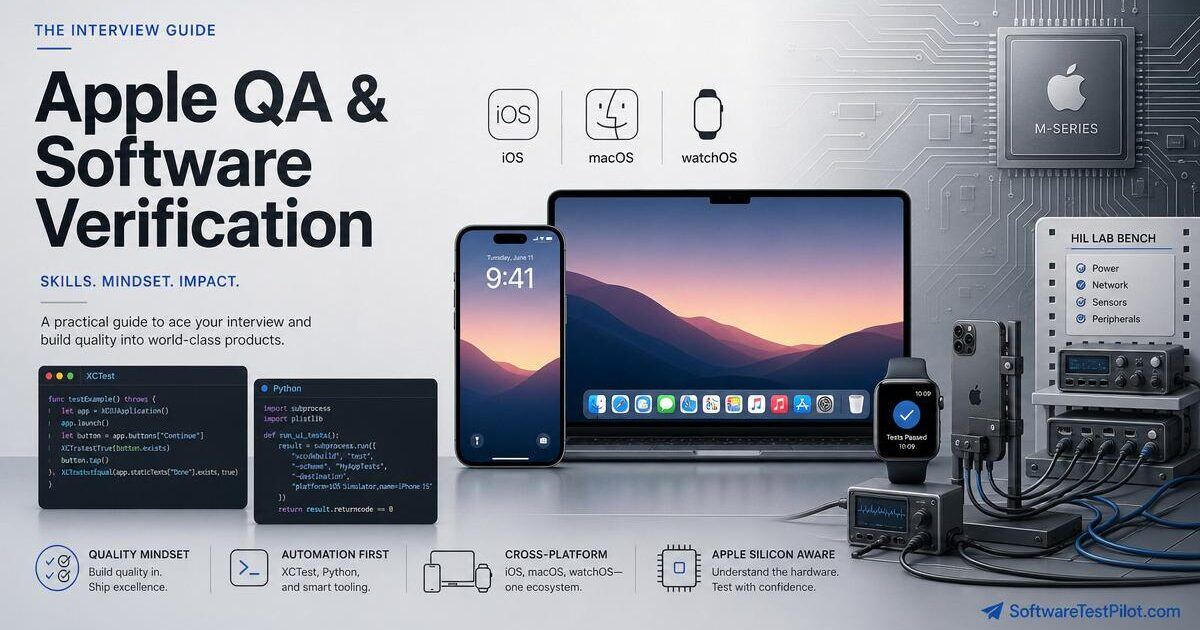
Securing an interview for a Software Verification Engineer, QA Automation Engineer, or System Quality Architect role at Apple places you inside one of the most secretive, perfection-driven engineering cultures on earth. Operating the consumer operating systems (iOS, macOS, watchOS, visionOS) and custom silicon hardware (Apple Silicon M-series and A-series chips) that power over two billion active devices globally requires meticulous verification.
At Apple, quality engineering is inseparable from hardware-software integration. Unlike pure web SaaS companies where testing lives entirely inside browser containers or AWS clouds, Apple quality engineers verify how software interacts with physical sensors, battery thermal limits, Bluetooth protocols, and custom silicon neural engines.
When you scan live requisitions on our internal SoftwareTestPilot QA Jobs Radar offering $155,000 to $215,000+ base salaries (paired with Apple's reliable RSU equity grants bringing total compensation past $280,000 to $400,000+), notice that Apple evaluates quality candidates with intense domain specificity.
To pass the Apple quality screening loop in 2026, you must demonstrate strong algorithmic coding in Python or Swift, understand low-level operating system memory mechanics, write robust automated suites in XCTest or custom Python harnesses, and exhibit obsessive attention to user privacy and device battery life.
Here is an exhaustive, deconstructed guide to the exact Apple quality engineering interview loop, reported 2026 compensation bands across internal ICT tiers, the top five technical coding prompts asked during onsite screens, and exactly 9 detailed FAQs paired with complete JSON-LD schema.
1. The Exact Apple QA & Software Verification Loop Deconstructed
Apple’s interview process is famously autonomous, team-driven, and highly specialized. For mid-level (ICT3) and senior (ICT4) verification roles, expect a structured 5-stage evaluation loop:
+-----------------------------------------------------------------------------------+
| THE APPLE ICT3 / ICT4 QA RECRUITMENT LIFECYCLE |
+-----------------------------------------------------------------------------------+
| STAGE 1: RECRUITER & HIRING MANAGER SCREEN (30 - 45 Minutes) |
| - Verifying Python/Swift coding depth, hardware/OS integration exposure, |
| on-site Cupertino/Austin readiness, and passion for Apple products. |
+-----------------------------------------------------------------------------------+
| STAGE 2: TECHNICAL SCREENING ROUND (45 - 60 Minutes) |
| - Live coding screen over Webex/CoderPad. Solving a practical Python string/array |
| parsing problem + deep dive into OS debugging (crash logs, memory leaks). |
+-----------------------------------------------------------------------------------+
| STAGE 3: THE 5 TO 6-ROUND ONSITE LOOP (Executed over 1 day via Webex or Onsite) |
| ├── Round 1: Coding & Algorithms (Python/Swift optimization & clean logic). |
| ├── Round 2: System Architecture & Hardware Verification (Whiteboarding V&V). |
| ├── Round 3: Practical OS Automation & Test Frameworks (XCTest / Python). |
| ├── Round 4: Cross-Functional Team Fit & Domain Deep Dive (Privacy/Security). |
| └── Round 5: Hiring Manager Loop (Project ownership, attention to detail). |
+-----------------------------------------------------------------------------------+
| STAGE 4: HIRING MANAGER & VP DEBRIEF APPROVAL |
| - Unlike centralized FAANG committees, Apple hiring managers hold strong |
| autonomous decision authority supported by executive director sign-off. |
+-----------------------------------------------------------------------------------+
2. Reported 2026 Apple Software Verification Compensation Matrix
Aggregating publicly self-reported compensation filings from Levels.fyi and SoftwareTestPilot Jobs Radar reveals where Apple compensation sits across internal ICT (Individual Contributor Tech) leveling bands.
| Apple Level | Job Title Equivalent | Base Salary Band | Annual Stock (RSU Equivalent) | Target Bonus (10–15%) | Total Compensation (TC) |
|---|---|---|---|---|---|
| Level ICT2 | Software Verification Eng I | $115,000 – $138,000 | $30,000 – $50,000 | $12,000 | $157,000 – $200,000 |
| Level ICT3 | Verification Eng II / SDET | $145,000 – $175,000 | $60,000 – $95,000 | $18,000 | $223,000 – $288,000 |
| Level ICT4 | Senior Verification Eng | $170,000 – $215,000 | $110,000 – $165,000 | $25,000 | $305,000 – $405,000 |
| Level ICT5 | Staff Quality Architect | $210,000 – $260,000+ | $180,000 – $280,000+ | $35,000 | $425,000 – $575,000+ |
3. Top 5 Practical Coding & Verification Prompts Asked at Apple
During onsite screens, Apple evaluators test pragmatic data parsing, operating system diagnostics, and hardware integration logic. Here are five top prompts asked during Apple QA loops.
Question 1: OS Kernel Crash Log Parser ($O(N)$ Parsing)
Prompt: "Apple iOS diagnostic daemons generate raw crash logs formatted as[TIMESTAMP] [PROCESS_NAME] [PID] [FAULT_CODE] [MEMORY_ADDRESS]. Write a Python method that parses an array of raw crash logs, identifies all distinct processes that experienced aEXC_BAD_ACCESSmemory fault more than twice, and sorts them by crash frequency."
# Production Python Solution: Clean Hash Map Parsing & Sorting
from collections import defaultdict
from typing import List, Tuple

def analyze_ios_memory_faults(raw_logs: List[str]) -> List[Tuple[str, int]]:
 fault_counts = defaultdict(int)

 for entry in raw_logs:
 if not entry or not entry.strip():
 continue

 tokens = entry.strip().split()
 if len(tokens) < 5:
 continue

 process_name = tokens[1]
 fault_code = tokens[3]

 # Filter strictly for invalid memory access crashes
 if fault_code == "EXC_BAD_ACCESS":
 fault_counts[process_name] += 1

 # Filter processes crashing more than twice
 frequent_crashers = [
 (process, count) for process, count in fault_counts.items() if count > 2
]

 # Sort descending by crash frequency ($O(K \log K)$ where K is unique processes)
 frequent_crashers.sort(key=lambda x: x[1], reverse=True)

 return frequent_crashers
Question 2: Testing Battery Thermal Throttling & Hardware Drain
Prompt: "How do you design an automated software verification suite that measures iOS background app battery drain and thermal CPU throttling during prolonged 4K video playback?"
Architectural Solution: To verify hardware thermal metrics:
- Programmatically control physical iOS test devices over USB/Lightning via custom Python automation harnesses interacting with Apple's internal diagnostic daemons (
sysdiagnose/ Instruments). - Execute automated UI playback scripts via XCTest/XCUITest while logging continuous battery current draw (
mA) and CPU junction temperature sensors. - Assert that CPU thermal throttling does not trigger frame drops below 60 FPS within a 30-minute operational window.
Question 3: Native iOS UI Automation Using Swift XCTest
Prompt: "Write a clean Swift XCTest automation script verifying that Safari on iOS correctly displays a privacy warning banner when navigating to an unencrypted HTTP URL."
// Production Swift XCUITest Verification Suite
import XCTest

class SafariPrivacyVerificationTests: XCTestCase {

 override func setUpWithError() throws {
 continueAfterFailure = false
}

 func testUnencryptedHttpTriggersPrivacyWarningBanner() throws {
 let safariApp = XCUIApplication(bundleIdentifier: "com.apple.mobilesafari")
 safariApp.launch()

 // Locate address URL bar and type insecure HTTP test address
 let urlBar = safariApp.otherElements["URLBar"]
 XCTAssertTrue(urlBar.waitForExistence(timeout: 5.0))
 urlBar.tap()

 let textField = safariApp.textFields["URLTextField"]
 textField.typeText("http://insecure.apple.test\r")

 // Assert iOS Safari privacy protection banner renders deterministically
 let privacyWarning = safariApp.staticTexts["Not Secure"]
 XCTAssertTrue(privacyWarning.waitForExistence(timeout: 8.0), "Security Defect: Safari failed to display insecure HTTP privacy banner!")
}
}
Question 4: Debugging Bluetooth LE Connection Race Conditions
Prompt: "An automated hardware verification harness testing AirPods pairing passes on single devices but fails intermittently with timeout errors when multiple Bluetooth Low Energy (BLE) devices broadcast simultaneously nearby. How do you troubleshoot this?"
Technical Breakdown: Explain that 2.4GHz RF radio congestion and advertisement packet collisions delay BLE discovery handshakes. Refactor the automation harness inside RF-shielded Faraday isolation enclosures, implement strict UUID device filtering (advertisementData[CBAdvertisementDataServiceUUIDsKey]), and replace fixed timeouts with retry-backed BLE handshake event listeners.
Question 5: Test Strategy for Apple visionOS Spatial Audio
Prompt: "How do you design an end-to-end quality verification strategy for dynamic head-tracking spatial audio latency on Apple Vision Pro headsets?"
Apply the ACCORD Whiteboard Framework:
- Architecture: Assert spatial audio render pipelines over CoreAudio hardware buffers.
- Concurrency: Verify low-latency audio sync during concurrent 4K dual-eye rendering.
- Observability: Assert that audio-to-motion latency never exceeds 12 milliseconds via automated oscilloscope hardware triggers.
4. System Design for Quality at Apple Hardware Scale
During Round 2 (System Design), Apple evaluators test your ability to build automation across hardware and OS boundaries.
The Whiteboard Prompt:
"Design an automated hardware-in-the-loop (HIL) verification lab capable of running continuous iOS nightly regression builds across 2,000 physical iPhone and iPad test devices."
+-----------------------------------------------------------------------------------+
| 2,000-DEVICE APPLE HIL LAB ARCHITECTURE |
+-----------------------------------------------------------------------------------+
| [NIGHTLY iOS BUILD COMPILES] ---> Triggers Apple Internal Orchestration Server |
| | |
| v |
| [DISTRIBUTED HARDWARE LAB CONTROLLERS (Mac Studio Racks)] |
| - Manages USB/Thunderbolt hubs connected to 2,000 physical iPhones inside racks. |
| - Flashes new iOS build image to devices simultaneously via programmatic DFU tools.|
| | |
| v |
| [PARALLEL XCTEST & PYTHON HARNESS EXECUTION] |
| - Shards 100,000 system regression tests across all 2,000 hardware devices. |
| - Captures real-time battery thermal logs, kernel crash dumps, and UI frame rates.|
| | |
| v |
| [RADAR DEFECT LOGGING & TRIAGE DASHBOARD] |
| - Automatically parses crash logs -> Opens high-priority tickets in Apple Radar! |
+-----------------------------------------------------------------------------------+
5. Your 30-Day Apple Interview Turnaround Plan
To prepare for your Apple onsite loop, upload your resume immediately to our SoftwareTestPilot ATS Resume Reviewer. Ensure your bullet points highlight Swift, Python, XCTest, OS debugging, and hardware verification keywords ("Architected automated hardware-in-the-loop verification harness across 50 devices").
. Practice articulating your Python file parsing and OS debugging trade-offs out loud before facing executive Apple verification leaders.
### Preparing For Apple Verification Interviews? Share This Guide! Apple loops require intense hardware and OS integration depth. Share this deconstructed interview guide with your QA peers on [LinkedIn] or [X/Twitter]. .
Frequently asked questions
1.How long does the entire Apple Software Verification interview process take in 2026?
2.Is LeetCode required for Software Verification Engineer roles at Apple?
3.What is the average total compensation for a Senior Verification Engineer (ICT4) at Apple?
4.Can I interview in Python or Java, or does Apple strictly require Swift?
5.How strict is Apple on academic engineering degrees versus practical experience?
6.What is the cool-off period if I get rejected after the Apple onsite loop?
7.Does Apple allow remote work for QA and software verification engineers in 2026?
8.How should I tailor my resume specifically for Apple ATS parsers?
9.What is the #1 reason experienced QA engineers fail the Apple technical screen?
Was this article helpful?
Keep building your QA edge
Pillar guides- SDET Rolesee what this role really looks likeWhat SDETs actually do — skills, salary bands, and interview prep for 2026.
- Company QA Interview GuidesSoftwareTestPilot's company interview libraryReal interview loops from Google, Amazon, Meta, Apple, Microsoft, Adobe, and 40+ other tech employers.
- Automation QA Engineer RoleAutomation QA Engineer roleAutomation QA Engineer job scope, tools, salary, and hiring pipeline.