Stripe SDET & Quality Engineering Interview Questions & Process (2026 Guide)
Crack the Stripe SDET/QE loop in 2026: 5 rounds, Ruby/TS prompts, payments QE at scale, third-party reported $290K–$470K TC + 9 FAQs & PDF.
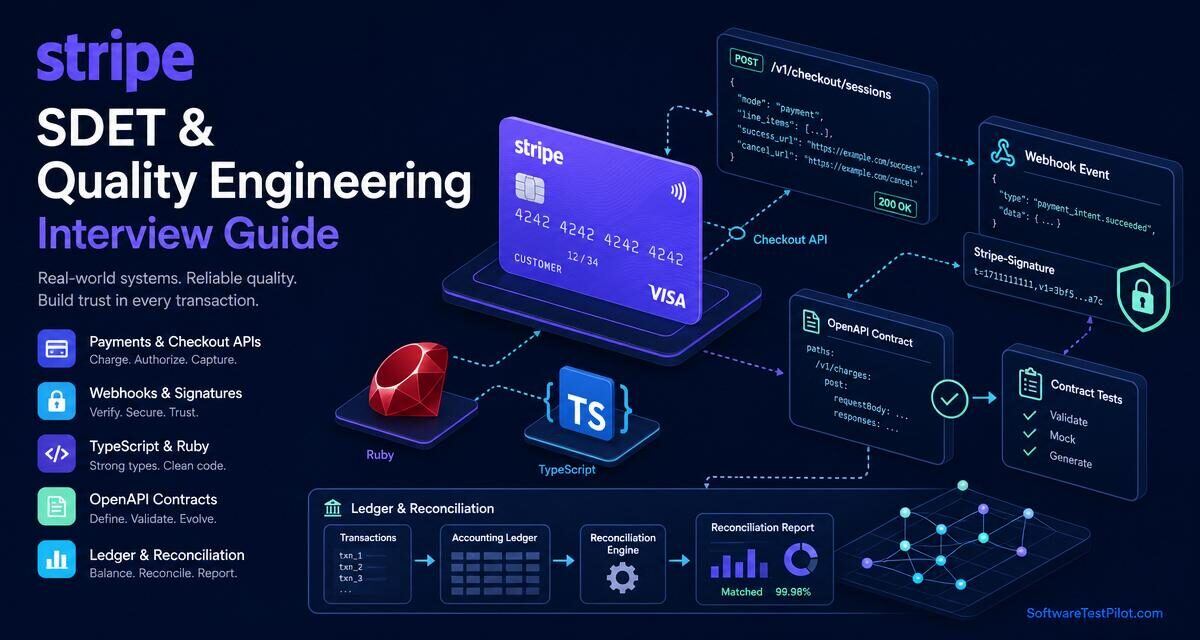
Securing an interview for a Software Development Engineer in Test (SDET) or Quality Infrastructure Engineer position at Stripe puts you inside the world's most revered developer-first engineering culture. Stripe processes over a trillion dollars in annual payment volume across 195 countries, powering checkout infrastructure for Amazon, Shopify, Airbnb, and millions of global SaaS businesses.
At Stripe, quality engineering is high-stakes financial engineering. If an API contract mutation introduces a fractional percentage bug into Stripe's core billing engine or credit card settlement webhook, the financial loss and regulatory liability under PCI-DSS and SOC2 standards are immediate and catastrophic.
When you scan live requisitions on our internal SoftwareTestPilot QA Jobs Radar offering $155,000 to $215,000+ base salaries (paired with top-tier equity packages pushing total compensation past $280,000 to $380,000+), notice that Stripe evaluates quality candidates differently from almost any other tech giant.
Stripe does not ask esoteric LeetCode graph puzzles on dry whiteboards. Instead, Stripe evaluates SDETs on Pragmatic Production Code Execution — pair-programming inside real, messy repositories in Ruby or TypeScript, building idempotent API contract verification suites, simulating asynchronous banking webhooks, and designing deterministic CI/CD pipelines.
Key takeaways
- 5-stage loop — recruiter, pair-programming screen, 4-round onsite (integration/API, quality systems, bug hunt, manager).
- Senior SDET (L3) total comp reaches $340k–$445k+.
- Stripe rejects LeetCode puzzles; expect real repos, real bugs, real diffs.
1. The Exact Stripe SDET & Quality Engineering Loop Deconstructed
Stripe's interview process famously mirrors daily engineering workflows. For mid-level (L2) and senior (L3/L4) SDET roles, expect a structured 5-stage evaluation loop:
+-----------------------------------------------------------------------------------+
|                  THE STRIPE L3 / L4 SDET RECRUITMENT LIFECYCLE                    |
+-----------------------------------------------------------------------------------+
| STAGE 1: RECRUITER & TECHNICAL ALIGNMENT SCREEN (30 - 45 Minutes)                 |
| - Ruby/TypeScript proficiency, API contract depth, payment familiarity, comp.     |
+-----------------------------------------------------------------------------------+
| STAGE 2: PRACTICAL PAIR PROGRAMMING PHONE SCREEN (60 Minutes)                     |
| - Live interactive coding in your preferred language. Debugging a broken ledger   |
|   class or writing an API test fixture from scratch.                              |
+-----------------------------------------------------------------------------------+
| STAGE 3: THE 4-ROUND ONSITE LOOP (Executed over 1 day via Zoom)                   |
|   |-- Round 1: Integration & API Testing (Writing contract tests against mocks). |
|   |-- Round 2: Quality Systems & CI/CD Design (Payment test harnesses).          |
|   |-- Round 3: Bug Hunt / Legacy Code Refactoring (Messy Ruby/TS suites).        |
|   +-- Round 4: Manager / Behavioral & Culture Fit ("Operating with Rigor").     |
+-----------------------------------------------------------------------------------+
| STAGE 4: HIRING COMMITTEE & WORK SAMPLE REVIEW                                    |
| - Committee evaluates actual code diffs and test architecture from the loop.      |
+-----------------------------------------------------------------------------------+

| - Matching with Core Payments, Billing, Connect, or Infrastructure quality pods.  |
+-----------------------------------------------------------------------------------+
2. Reported 2026 Stripe SDET Compensation Matrix
Aggregating self-reported filings from Levels.fyi and SoftwareTestPilot Jobs Radar reveals where Stripe compensation sits across internal levels. Stripe offers high base salaries combined with highly-valued private/public equity packages.
| Stripe Level | Job Title Equivalent | Base Salary Band | Annual Equity (RSU Equivalent) | Target Bonus | Total Compensation (TC) |
|---|---|---|---|---|---|
| Level 1 (L1) | Quality Engineer I | $120k – $145k | $40k – $60k | 10% | $170k – $220k |
| Level 2 (L2) | SDET / Quality Eng II | $150k – $180k | $80k – $120k | 10–15% | $245k – $320k |
| Level 3 (L3) | Senior SDET / QA Lead | $175k – $215k | $140k – $200k+ | 15% | $340k – $445k+ |
| Level 4 (L4) | Staff Quality Architect | $210k – $260k+ | $220k – $350k+ | 15–20% | $470k – $660k+ |
3. Top 5 Practical Coding & Testing Prompts Asked at Stripe
During onsite pair-programming rounds, Stripe evaluators test how cleanly you write code, structure assertions, and handle edge cases.
Question 1: Idempotent Payment Settlement Reconciliation (O(N))
Prompt: Stripe settlement batches emit transaction arrays formatted as[TX_ID, CHARGE_ID, AMOUNT_CENTS, CURRENCY, STATUS]. Write a TypeScript or Ruby function that processes an array of settlement records, aggregates total successful charges per currency, and ensures idempotent handling by discarding duplicateCHARGE_IDentries.
interface CurrencyLedgerSummary {
  totalAmountCents: number;
  processedChargeIds: Set<string>;
}

export function reconcileSettlementLedger(records: string[][]): Record<string, number> {
  const ledgerMap = new Map<string, CurrencyLedgerSummary>();

  for (const row of records) {
    if (!row || row.length < 5) continue;
    const [txId, chargeId, amountStr, currency, status] = row;
    if (status !== 'SUCCEEDED') continue;

    const amountCents = parseInt(amountStr, 10);
    if (isNaN(amountCents) || amountCents < 0) continue;

    const cleanCurrency = currency.toUpperCase();
    if (!ledgerMap.has(cleanCurrency)) {
      ledgerMap.set(cleanCurrency, { totalAmountCents: 0, processedChargeIds: new Set() });
    }
    const summary = ledgerMap.get(cleanCurrency)!;

    // Idempotency Guard: discard duplicate charge processing
    if (!summary.processedChargeIds.has(chargeId)) {
      summary.processedChargeIds.add(chargeId);
      summary.totalAmountCents += amountCents;
    }
  }

  const finalSummary: Record<string, number> = {};
  ledgerMap.forEach((val, key) => { finalSummary[key] = val.totalAmountCents; });
  return finalSummary;
}
Question 2: Testing Stripe Webhook Signatures (Stripe-Signature)
Prompt: How do you write an automated integration test verifying that a merchant's server correctly validates cryptographic webhook signatures sent by Stripe before updating an order status?
- Programmatically compute an HMAC-SHA256 signature using the test secret (
whsec_test_secret) and synthetic JSON payload timestamp (t=1719820800,v1=...). - Inject the synthetic header
Stripe-Signatureinto an automatedrequest.postcall against the target webhook receiver endpoint. - Assert that valid signatures return
200 OKwhile tampered timestamps return400 Bad RequestwithSignatureVerificationError.
Question 3: Playwright API Contract Backward Compatibility Verification
Prompt: Write a Playwright TypeScript suite verifying that Stripe'sPOST /v1/payment_intentsendpoint strictly maintains schema backward compatibility across API version headers (Stripe-Version: 2026-06-01).
import { test, expect } from '@playwright/test';

test('Should strictly enforce payment intent schema contract under pinned API version', async ({ request }) => {
  const response = await request.post('https://api.stripe.test/v1/payment_intents', {
    headers: {
      'Authorization': `Bearer ${process.env.STRIPE_TEST_SECRET_KEY}`,
      'Stripe-Version': '2026-06-01'
    },
    form: {
      amount: '2000',
      currency: 'usd',
      'payment_method_types[]': 'card'
    }
  });

  expect(response.status()).toBe(200);
  const payload = await response.json();

  expect(payload.object).toBe('payment_intent');
  expect(payload.amount).toBe(2000);
  expect(payload.currency).toBe('usd');
  expect(payload.status).toBe('requires_payment_method');
  expect(typeof payload.client_secret).toBe('string');
});
More contract patterns in our API testing interview questions hub.
Question 4: Debugging Race Conditions in Billing Subscriptions
Prompt: An automated integration suite testing recurring monthly subscription upgrades passes 95% of the time but fails intermittently with double-charge errors. How do you troubleshoot this in Ruby/TypeScript?
Database transaction locking delays cause webhooks to arrive before local database mutations finish committing. Implement explicit database transaction boundary assertions or use Stripe test clocks (test_helpers.test_clocks) to advance virtual billing time deterministically.
Question 5: Test Strategy for Stripe Connect Multi-Party Split Payments
Prompt: How do you design a quality verification plan for Stripe Connect destination charges splitting a $100 checkout between a platform fee ($10) and connected merchant transfer ($90) across multiple currencies?
- Architecture: Assert ledger balance transfers over Stripe API balances endpoints.
- Concurrency: Verify payout settlement timing under concurrent platform fee updates.
- Data state: Seed connected Express merchant accounts programmatically using Stripe account creation APIs.
4. System Design for Quality at Stripe Scale
During Round 2 (System Design), Stripe evaluators test your ability to build financial quality infrastructure.
Whiteboard prompt: Design a continuous integration test harness capable of evaluating Stripe's core billing engine against 100,000 synthetic merchant API versions overnight without polluting production financial ledgers.
+-----------------------------------------------------------------------------------+
|                  STRIPE DISTRIBUTED FINANCIAL TEST HARNESS                        |
+-----------------------------------------------------------------------------------+
| [GITHUB ACTIONS PR / NIGHTLY CRON] ---> Triggers Sharded Execution                |
|                                       |                                           |
|                                       v                                           |
| [EPHEMERAL DOCKER / KUBERNETES SHARDED WORKERS]                                   |
| - Provisions 100 isolated test runner pods.                                       |
| - Injects distinct Stripe API version headers (Stripe-Version: 2025-XX to 2026).  |
|                                       |                                           |
|                                       v                                           |
| [STRIPE TEST CLOCKS & API DATA FACTORIES]                                         |
| - Advances virtual billing time via /v1/test_helpers/test_clocks.                 |
| - Asserts automated invoice generation and subscription renewal ledgers.          |
|                                       |                                           |
|                                       v                                           |
| [ZERO-POLLUTION ISOLATED TEST LEDGERS]                                            |
| - All test mutations write to isolated test-mode schemas (sk_test_*).             |
| - Automated teardown scripts purge synthetic merchant accounts post-run!          |
+-----------------------------------------------------------------------------------+
5. Your 30-Day Stripe Interview Turnaround Plan
Upload your resume to our ATS Resume Reviewer. Ensure bullets highlight API contract backward compatibility, Ruby/TypeScript fluency, Playwright, and financial quality metrics ("Architected idempotent API contract suite preventing payment ledger regression").
Run daily simulated pair-programming screens using the SoftwareTestPilot AI Interview Coach. Practice articulating code architecture out loud before facing executive Stripe quality leaders.
Complement your prep with:
- API testing interview questions — contract depth
- Playwright interview questions — automation surface
- Senior SDET interview questions — L3-level rigor
- SQL interview questions for testers — ledger validation
- SDET career roadmap — levelling plan
- Amazon QA interview guide — compare loops
- Microsoft QA interview guide — enterprise cloud angle
Pro tip: Stripe reviewers read your actual diffs post-loop. Write real production-grade code: null-safe, idempotent, edge-case-aware — even in pair programming.
Frequently asked questions
1.How long does the entire Stripe SDET & Quality Engineering interview process take in 2026?
2.Is LeetCode required for Quality Engineering roles at Stripe?
3.What is the average total compensation for a Senior SDET (Level 3) at Stripe?
4.Can I interview in Python or Playwright, or does Stripe strictly require Ruby?
5.How strict is Stripe on academic engineering degrees versus practical portfolios?
6.What is the cool-off period if I get rejected after the Stripe onsite loop?
7.Does Stripe allow remote work for QA and automation engineers in 2026?
8.How should I tailor my resume specifically for Stripe ATS parsers?
9.What is the #1 reason experienced QA engineers fail the Stripe technical screen?
Was this article helpful?
Keep building your QA edge
Pillar guides- Selenium PillarSelenium WebDriver guide300 Selenium WebDriver Q&A — locators, waits, frameworks.
- Playwright Installation Guidehow to install Playwright step by stepInstall Playwright the right way — Node, browsers, VS Code, first test.
- XPath & CSS Selector Generatorgenerate robust Playwright and Selenium locatorsInteractive locator generator for Playwright, Selenium and Cypress — with Page Object export.
- SDET Rolesee what this role really looks likeWhat SDETs actually do — skills, salary bands, and interview prep for 2026.
- Automation QA Engineer RoleAutomation QA Engineer career guideAutomation QA Engineer job scope, tools, salary, and hiring pipeline.
- Company QA Interview Guidescompany QA interview guidesReal interview loops from Google, Amazon, Meta, Apple, Microsoft, Adobe, and 40+ other tech employers.