Google QA & SDET Interview Questions & Process (2026 Complete Guide)
How the Google QA/SDET loop is commonly described in 2026: 5 rounds, LeetCode Medium/Hard prompts, third-party reported pay context and 9 FAQs.
How we calculated this, and what our own posting data shows
How we calculated this
This guide is built from the published structure of Google's engineering loop, candidate-reported round formats, and the skills our own Jobs Radar index shows the wider senior SDET market testing for. We state plainly that we index no Google requisitions directly, so nothing on this page is presented as an internal Google source.
- Sample analysed
- 459 postings
- Posting date range
- March 4, 2026 – August 11, 2026
- Postings disclosing pay
- 45 of 459 index-wide
- Data last refreshed
- August 12, 2026
What the wider SDET market tests for (market baseline, not Google reqs)
Based on 459 postings analysed from our Jobs Radar index — Every QA and SDET requisition in our index, worldwide — posted between March 4, 2026 and August 11, 2026. We index no requisitions from this employer directly; this is the wider market baseline we use to rank prep priorities.
- Selenium named183(40%)
- Manual / functional focus161(35%)
- API / service testing named124(27%)
- Playwright named122(27%)
- Cypress named41(9%)
How to prioritise prep for a Google SDET loop
Google is the clearest example of a loop where tool trivia earns you almost nothing. The market baseline above — Selenium in 183 of 459 postings, Playwright in 122, API and service testing in 124 — describes what most employers screen on, and Google is the employer least like that distribution. Its loop weights data structures, algorithmic reasoning, and the ability to design a test strategy for a system you have never seen, in that order. Knowing the Playwright API cold is table stakes, not a differentiator.
The round that eliminates most QA candidates is coding, and specifically coding under narration. You are expected to talk through complexity, restate constraints, and choose a data structure for a reason you can articulate. Testers who prepare by grinding problems silently tend to solve them and still fail, because the signal being measured is engineering communication. Practise out loud, in forty-minute blocks, on medium-difficulty problems, and force yourself to state the invariant before writing the loop.
The test-design round rewards a structure rather than a checklist. Given 'test Google Docs offline mode', a weak answer lists cases; a strong one partitions the problem — state model, conflict resolution, network transitions, storage limits, telemetry — and only then produces representative cases per partition, with an explicit statement of what would be left untested and why. Naming the risk you are choosing not to cover is one of the strongest signals available to you in that hour.
System design is where seniority is priced. Expect to design test infrastructure, not the product: how you would run a hermetic environment, keep a large suite under a flake budget, shard it for a fifteen-minute signal, and decide what gates a release. Bring numbers from your own work — suite size, run time before and after, flake rate — because that is what converts a good story into a level. Continue with our Amazon QA interview guide to see how differently a behaviour-weighted loop scores the same experience.

Securing an interview for a Quality Assurance Engineer or Software Development Engineer in Test (SDET) role at Google represents one of the pinnacle achievements in modern software testing. Operating global infrastructure that answers billions of search queries daily, streams petabytes of YouTube video, and powers mission-critical Google Cloud Platform (GCP) enterprise clusters requires an uncompromising quality philosophy.
At Google, quality is never treated as an afterthought or an isolated downstream verification step. Unlike legacy IT organizations where testers manually click through screens after developers finish coding, Google operates under the Test Engineering (TE) and Software Engineer, Tools and Infrastructure (SETI) model.
When you scan QA and SDET requisitions on our internal SoftwareTestPilot QA Jobs Radar offering $160,000 to $220,000+ base salaries (paired with significant equity GSUs bringing total compensation past $350,000+), you will see that Google evaluates quality candidates on the exact same algorithmic and distributed systems rubrics applied to core backend developers.
To pass the Google quality screening loop, you must write clean algorithms on whiteboards, architect distributed continuous integration test harnesses capable of handling millions of requests per minute, and debug complex asynchronous race conditions.
Key takeaways
- Candidate reports describe a 5-stage loop — recruiter screen, DSA coding, 5-round onsite, hiring committee, team match.
- Third-party reports (Levels.fyi) put L5 Senior SDET total compensation around $315k–$400k+; not company-confirmed.
- System design rounds test quality infrastructure at scale, not manual test-case authoring.
1. How the Google QA & SDET Interview Loop Is Commonly Described
Sourcing note: the stage-by-stage structure below reflects patterns candidates commonly describe in public interview reports. Round counts, formats and prompts vary by role, level, location and hiring team, and the company does not publish a guaranteed loop.
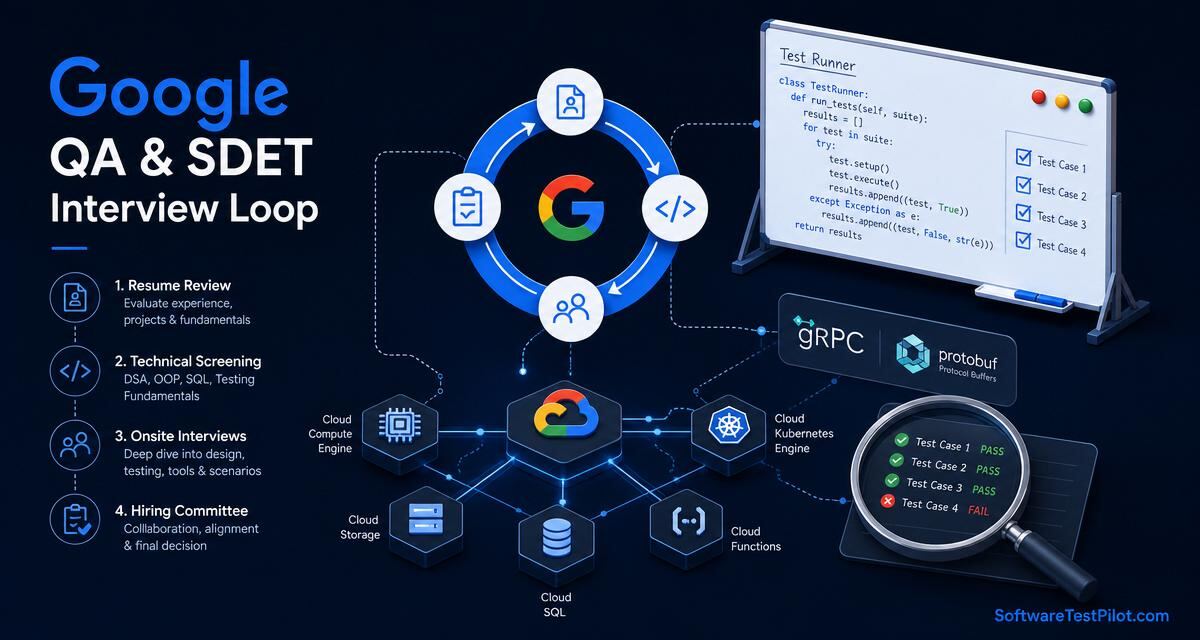
Google's recruitment process is standardized, data-driven, and evaluated by independent hiring committees. For mid-level (L4) and senior (L5) SDET roles, expect a structured 5-stage evaluation loop:
+-----------------------------------------------------------------------------------+
|                  THE GOOGLE L4 / L5 SDET RECRUITMENT LIFECYCLE                    |
+-----------------------------------------------------------------------------------+
| STAGE 1: RECRUITER SCREENING (30 - 45 Minutes)                                    |
| - Salary expectations, core language stack (Go, Python, C++, Java),               |
|   verifying automated CI/CD infrastructure familiarity.                           |
+-----------------------------------------------------------------------------------+
| STAGE 2: TECHNICAL SCREENING / DSA CODING (45 - 60 Minutes)                       |
| - Live shared Google Doc or IDE coding round. LeetCode Medium data                |
|   parsing or string manipulation tailored to quality diagnostics.                 |
+-----------------------------------------------------------------------------------+
| STAGE 3: THE 5-ROUND ONSITE LOOP (Executed over 1 or 2 days)                      |
|   Round 1: Data Structures & Algorithms                                        |
|   Round 2: Test Infrastructure & System Design                                 |
|   Round 3: Practical Framework Architecture & Debugging                        |
|   Round 4: Quality Strategy & Risk Modeling                                    |
|   Round 5: Leadership & "Googlyness"                                           |
+-----------------------------------------------------------------------------------+
| STAGE 4: HIRING COMMITTEE (HC) REVIEW                                             |
+-----------------------------------------------------------------------------------+
| STAGE 5: TEAM MATCHING & EXECUTIVE OFFER APPROVAL                              |
+-----------------------------------------------------------------------------------+
2. Reported 2026 Google QA & SDET Compensation (third-party sources)
Where these numbers come from. SoftwareTestPilot does not hold Google-confirmed pay data and cannot confirm any individual Google offer. The bands below are third-party reported figures self-submitted to public compensation sites (Levels.fyi, AmbitionBox, Glassdoor). Our own Jobs Radar index supplies general QA/SDET market benchmarks only — it contains no Google pay disclosures we can attribute to the company. Treat every range as a planning reference point, not a quote: actual pay varies by level, location, hiring team and the year the report was submitted.
| Google Level | Equivalent Title | Base Salary Band | Annual Equity (GSU) | Target Bonus (15%) | Total Comp (TC) |
|---|---|---|---|---|---|
| L3 | Junior QA / Test Engineer | $118k – $138k | $35k – $55k | $18k | $171k – $211k |
| L4 | Automation Engineer / SDET | $145k – $172k | $65k – $95k | $24k | $234k – $291k |
| L5 | Senior SDET / TE Lead | $175k – $215k | $110k – $155k | $30k | $315k – $400k+ |
| L6 | Staff Quality Architect | $210k – $255k+ | $180k – $280k+ | $40k | $430k – $575k+ |
3. Top 5 Technical & Coding Questions Asked at Google
During your onsite technical rounds, Google interviewers will evaluate your coding fluency and architectural judgment across realistic domain problems. Here are five top prompts asked during Google SDET loops.
Question 1: Distributed Log Trace Anomaly Detection (O(N) Parsing)
Prompt: Given an array of raw server log strings from a distributed Google Cloud cluster formatted as[TIMESTAMP] [TRACE_ID] [SERVICE] [STATUS] [DURATION_MS], write an optimized function to identify allTRACE_IDs where total transaction time exceeded 800ms OR where any service returned a 5xx status code.
// O(N) time / O(U) space
interface TraceDiagnostics { cumulativeTime: number; hasError: boolean; }

export function analyzeGoogleCloudTraces(logs: string[]): string[] {
  const traceMap = new Map<string, TraceDiagnostics>();
  const failedTraces = new Set<string>();

  for (const log of logs) {
    if (!log?.trim()) continue;
    const tokens = log.trim().split(/\s+/);
    if (tokens.length < 5) continue;

    const traceId = tokens[1];
    const status = parseInt(tokens[3], 10);
    const duration = parseInt(tokens[4], 10);
    if (isNaN(status) || isNaN(duration)) continue;

    if (!traceMap.has(traceId)) {
      traceMap.set(traceId, { cumulativeTime: 0, hasError: false });
    }
    const current = traceMap.get(traceId)!;
    current.cumulativeTime += duration;
    if (status >= 500 && status < 600) current.hasError = true;
    if (current.cumulativeTime > 800 || current.hasError) failedTraces.add(traceId);
  }
  return Array.from(failedTraces);
}
Question 2: Designing an API Contract Validator for Protobuf/gRPC
Prompt: Google internal microservices communicate over gRPC and Protocol Buffers rather than HTTP JSON REST. How would you design an automated test harness that verifies backward compatibility when a developer alters a .proto schema file?
Architectural Solution: Construct an Automated AST Schema Linter and Mock Server Harness:
- Parse the modified
.protoabstract syntax tree during PR creation. - Assert strict backward-compatibility rules: existing field tags (
id = 1;) must not be deleted or reassigned to different data types (int32→string). - Spin up an ephemeral Go or Python gRPC mock server using
grpcurlor Playwright API interceptors to verify serialization determinism.
Question 3: Dynamic Rate-Limiting & Idempotency Verification
Prompt: Write a test script that validates whether Google Search Ads API correctly enforces rate limits (HTTP 429) under high concurrency while guaranteeing idempotent retry handling.
import asyncio, httpx, pytest

API_ENDPOINT = "https://ads-api.google.com/v1/campaigns"

async def issue_request(client, token):
    headers = {"Authorization": f"Bearer {token}", "Idempotency-Key": "req_key_9921"}
    return await client.post(API_ENDPOINT, headers=headers, json={"budget": 500})

@pytest.mark.asyncio
async def test_google_ads_rate_limiting_concurrency():
    async with httpx.AsyncClient() as client:
        tasks = [issue_request(client, "test_jwt") for _ in range(150)]
        responses = await asyncio.gather(*tasks)
        status_codes = [r.status_code for r in responses]
        assert 429 in status_codes, "Rate limit gateway did not throttle traffic!"
        assert status_codes.count(201) <= 100, "SLA Violation: Allowed >100 requests!"
Question 4: Debugging Flaky UI Tests in Containerized Runners
Prompt: A Playwright UI test verifying Google Drive file uploads passes on a local M3 MacBook Pro but fails intermittently inside Linux CI containers with TimeoutError. How do you diagnose and fix this?
Containerized Linux runners suffer from 2 vCPU compute throttling and lack GPU acceleration. Replace static sleeps with network-response promises:
await Promise.all([
  page.waitForResponse(r => r.url().includes('/upload/drive/v3') && r.status() === 200),
  page.locator('[data-testid="drive-upload-btn"]').setInputFiles('test-payload.pdf')
]);
See our full Playwright tutorial for the wider pattern library.
Question 5: Test Strategy for Google Maps Route Calculation
Prompt: How would you structure a comprehensive quality test plan for Google Maps navigation turn-by-turn route calculation across mobile and web?
Apply the ACCORD Whiteboard Framework:
- Architecture: Verify backend routing graph algorithms over gRPC APIs rather than slow UI taps.
- Concurrency: Test traffic re-routing under massive multi-user GPS location broadcast updates.
- Data State: Seed synthetic map graph networks inside ephemeral Docker sandboxes for deterministic road-closure simulations.
4. System Design for Quality at Google Scale
During Round 3 (System Design), Google evaluators test your ability to build infrastructure for massive developer ecosystems.
Whiteboard prompt: Design a continuous integration test runner capable of executing 100,000 automated regression tests across Google monorepos in under 5 minutes.
[DEVELOPER PR COMMIT] --> Webhook to Google Bazel Build Engine
        |
        v
[AST DEPENDENCY GRAPH IMPACT ANALYSIS]
 - Evaluates Bazel build target graph -> Identifies only 4,200 impacted tests.
 - Skips 95,800 unimpacted regression scripts instantly.
        |
        v
[KUBERNETES CONTAINER SHARDING CLUSTER]
 - Spawns 300 ephemeral pods, each executing ~14 tests in parallel.
        |
        v
[REMOTE BAZEL BUILD CACHE (RBE)]
 - Reuses previously-computed test artifacts across the fleet.
        |
        v
[STRUCTURED RESULT SINK -> BIGQUERY]
 - Publishes flake scores, duration deltas, and owner routing.
Passing candidates explicitly call out test-impact analysis, remote build execution, and flake quarantine — not just "run tests in parallel".
5. Your 30-Day Google Interview Preparation Roadmap
To prepare for your Google onsite loop, upload your resume immediately to our ATS Resume Reviewer. Ensure your bullet points highlight quantitative CI/CD and distributed systems achievements ("Architected sharded Playwright suite evaluating 20k tests in 4 minutes").
Next, run simulated daily technical screening loops using the SoftwareTestPilot AI Interview Coach. Practice articulating your algorithmic time complexity and system-design trade-offs out loud before facing executive Google hiring committees.
Complement your prep with:
- Selenium interview questions — framework depth
- Playwright interview questions — modern UI automation
- API testing interview questions — REST + gRPC surface
- SQL interview questions for testers — data validation rounds
- SDET career roadmap — long-term levelling plan
Pro tip: Google's hiring bar for QA is the same as SWE. Treat every practice session as if you were solving a LeetCode Medium — no shortcuts.
Frequently asked questions
1.How long does the entire Google QA & SDET interview process take in 2026?
2.Is LeetCode required for QA Engineer versus SDET roles at Google?
3.What is the average total compensation for a Senior SDET (L5) at Google?
4.Can I interview in Python or Java, or does Google require Go/C++?
5.How strict is Google on academic Computer Science degrees versus GitHub portfolios?
6.What is the cool-off period if I get rejected after the Google onsite loop?
7.Does Google allow remote work for QA and automation engineers in 2026?
8.How should I tailor my resume specifically for Google ATS parsers?
9.What is the #1 reason experienced QA engineers fail the Google technical screen?
Was this article helpful?
Keep building your QA edge
Pillar guides- SDET Career RoadmapQA to SDET career pathYear-by-year plan from QA to senior SDET — skills + projects.
- QA Jobs RadarQA Jobs RadarLive QA / SDET / automation job feed, refreshed daily.
- All QA Jobs Hubbrowse QA jobs by role, tool and cityEvery QA jobs landing — by role, tool, city, work mode & experience.
- SDET Rolebecome an SDET in 2026What SDETs actually do — skills, salary bands, and interview prep for 2026.
- Company QA Interview GuidesQA interview questions by companyReal interview loops from Google, Amazon, Meta, Apple, Microsoft, Adobe, and 40+ other tech employers.