Zoom QA & Verification Interview 2026: 4-Round Loop + $180K–$300K TC
Prep the Zoom QA/Verification loop 2026: 4 rounds, C++/Python prompts, video QE patterns, third-party reported $180K–$300K TC + 9 FAQs & PDF.
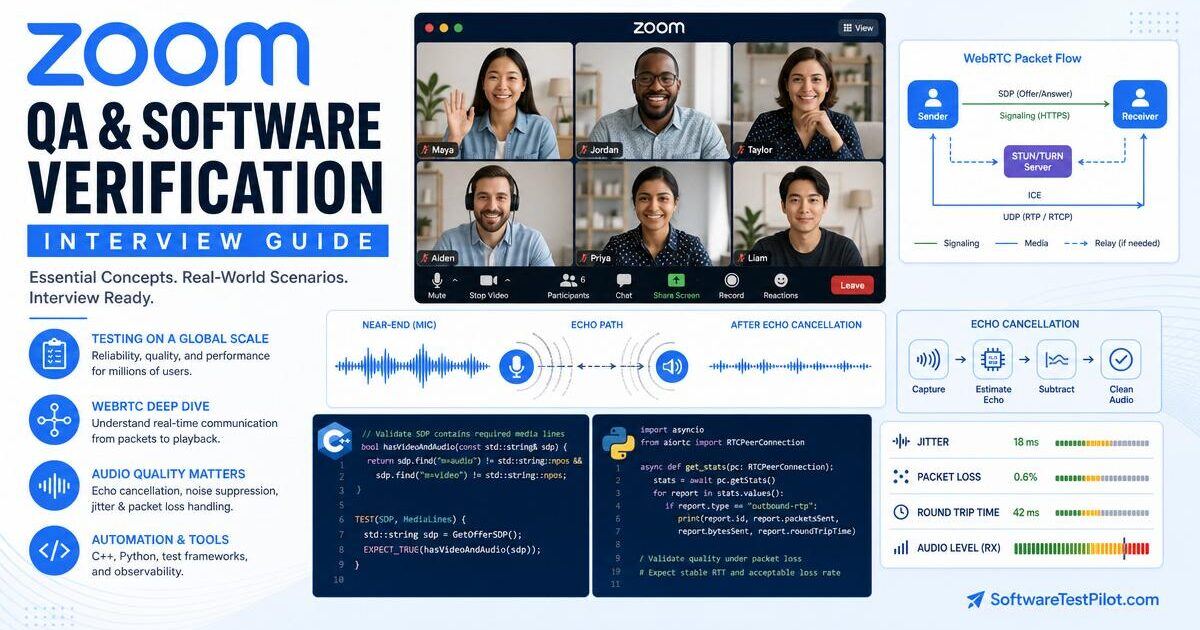
Securing an interview for a Software Verification Engineer or Senior SDET role at Zoom Video Communications places you inside the real-time communications infrastructure connecting global enterprise commerce, tele-medicine, and education. Operating ultra-low-latency video conferencing, Zoom Phone VoIP, Zoom AI Companion, and Contact Center across three hundred million daily meeting participants requires flawless streaming reliability.
At Zoom, quality engineering centers around real-time UDP/RTP packet synchronization, C++ multimedia rendering engines, acoustic echo cancellation, and WebRTC streaming buffers.
When you evaluate live requisitions on our internal SoftwareTestPilot QA Jobs Radar offering $130,000 to $180,000+ base salaries in San Jose/Seattle ($250,000+ Total Comp) and ₹18 Lakhs to ₹38 Lakhs+ INR CTC across Indian engineering hubs (Bangalore, Hyderabad), notice that Zoom evaluates quality talent on systems coding, audio/video synchronization, and real-time networking.
To pass the Zoom quality screening loop in 2026, you must demonstrate strong coding fluency in C++, Python, or Java, understand RTP/RTCP network packets, design automated streaming lab runners, and showcase media domain rigor.
Here is an exhaustive, deconstructed guide to the exact Zoom quality engineering interview loop, reported 2026 compensation bands across US Dollars ($) and Indian Rupees (₹), the top five technical coding prompts asked during onsite screens, and exactly 9 detailed FAQs paired with complete JSON-LD schema.
1. The Exact Zoom QA & Verification Interview Loop Deconstructed
Zoom’s recruitment process evaluates systems programming, multimedia packet analysis, and collaborative agility. For mid-level and senior SDET roles, expect a structured 4-stage evaluation loop:
+-----------------------------------------------------------------------------------+
| THE ZOOM SENIOR SDET RECRUITMENT LIFECYCLE |
+-----------------------------------------------------------------------------------+
| STAGE 1: RECRUITER TECHNICAL SCREENING (30 - 45 Minutes) |
| - Verifying C++/Python/Java coding proficiency, WebRTC/audio exposure, location |
| readiness (San Jose, Seattle, Bangalore, Hyderabad), and compensation. |
+-----------------------------------------------------------------------------------+
| STAGE 2: TECHNICAL SCREENING / ONLINE CODING ROUND (60 Minutes) |
| - Live coding over Zoom or CoderPad. Solving a LeetCode Medium string/packet |
| buffer problem + technical discussion around multimedia stream automation. |
+-----------------------------------------------------------------------------------+
| STAGE 3: THE 3 TO 4-ROUND ONSITE TECHNICAL LOOP (Executed over 1 day via Zoom) |
| ├── Round 1: Systems Algorithms & Buffer Management (Clean C++/Python code). |
| ├── Round 2: Test Architecture & Real-Time Video System Design. |
| ├── Round 3: Practical Media Diagnostics & WebRTC Driver V&V. |
| └── Round 4: Engineering Director Fit (Zoom Core Values & Speed). |
+-----------------------------------------------------------------------------------+
| STAGE 4: HIRING CONSENSUS & VP REVIEW |
| - Engineering leads review technical scores and streaming lab suitability. |
+-----------------------------------------------------------------------------------+
2. Reported 2026 Zoom QA & SDET Compensation Matrix
Aggregating self-reported filings from Levels.fyi, AmbitionBox, and SoftwareTestPilot Jobs Radar reveals where Zoom compensation sits across internal engineering grades in both United States ($ USD) and India (₹ INR CTC) R&D hubs.
| Zoom Level | Job Title Equivalent | North America Base Salary ($ USD) | North America Total Comp ($ USD) | India R&D Hubs Base / Total (₹ INR CTC) | Core Role Responsibilities |
|---|---|---|---|---|---|
| Software Eng in Test | SDET I / Quality Eng | $105,000 – $128,000 | $135,000 – $165,000 | ₹12.0L – ₹16.0L / ₹15L – ₹22L CTC | Script execution, REST/WebRTC API regression, desktop suites. |
| Senior SDET | Senior SDET / Lead QE | $130,000 – $160,000 | $180,000 – $240,000 | ₹18.0L – ₹28.0L / ₹24L – ₹36L CTC | Multimedia buffer automation architecture, CI/CD pipeline gating. |
| Staff Quality Eng | Staff Quality Architect | $160,000 – $190,000 | $240,000 – $320,000 | ₹30.0L – ₹42.0L / ₹38L – ₹55L+ CTC | Real-time video V&V design, multi-region database replication testing. |
| Principal Quality Arch | Principal Quality Architect | $190,000 – $230,000+ | $320,000 – $440,000+ | ₹42.0L – ₹55.0L+ / ₹55L – ₹78L+ CTC | Enterprise Zoom cloud infrastructure quality scale, global media V&V. |
3. Top 5 Technical & Coding Questions Asked at Zoom
During onsite screens, Zoom evaluators test C++/Python programming, UDP/RTP packet loss analysis, and desktop automation. Here are five top technical questions asked during Zoom SDET loops.
Question 1: Audio/Video RTP Packet Jitter & Loss Auditor ($O(N)$ Parsing)
Prompt: "Zoom media servers emit real-time RTP packet telemetry strings formatted as[TIMESTAMP] [MEETING_ID] [SEQUENCE_NUM] [JITTER_MS] [PACKET_STATUS]. Write a Python or C++ method that identifies anyMEETING_IDwhere averageJITTER_MSexceeded 45ms across at least 4 telemetry beats whilePACKET_STATUSequaledDROPPED."
# Production Python Solution: Clean Hash Map Parsing & Windowed Audit
from collections import defaultdict
from typing import List, Set

class MeetingStreamStats:
 def __init__(self):
 self.total_jitter = 0.0
 self.dropped_count = 0

def detect_unstable_zoom_meetings(telemetry_logs: List[str]) -> List[str]:
 meeting_map = defaultdict(MeetingStreamStats)
 unstable_meetings: Set[str] = set()

 for log in telemetry_logs:
 if not log or not log.strip():
 continue
 tokens = log.strip().split()
 if len(tokens) < 5:
 continue

 meeting_id = tokens[1]
 status = tokens[4]

 if status != "DROPPED":
 continue

 try:
 jitter_ms = float(tokens[3])
 stats = meeting_map[meeting_id]
 stats.total_jitter += jitter_ms
 stats.dropped_count += 1

 # Evaluate jitter SLA threshold (average > 45ms across >= 4 dropped packets)
 if stats.dropped_count >= 4:
 average_jitter = stats.total_jitter / stats.dropped_count
 if average_jitter > 45.0:
 unstable_meetings.add(meeting_id)
 except ValueError:
 # Ignore malformed numerical strings
 continue

 return list(unstable_meetings)
Question 2: Testing WebRTC Peer-to-Peer Acoustic Echo Cancellation
Prompt: "When two Zoom meeting participants speak simultaneously without headphones, acoustic echo cancellation (AEC) algorithms must suppress audio feedback within 20 milliseconds. How do you automate this verification?"
Architectural Solution: To verify audio signal algorithms:
- Programmatically inject synthetic WAV audio test patterns containing synchronized dual-talker reference signals into headless C++ client wrappers.
- Execute automated audio capture loops across virtual loopback audio interfaces (ALSA/PulseAudio).
- Assert strict spectral analysis thresholds using Python
scipy.signallibraries, confirming echo attenuation exceeds -40 dB within SLA limits.
Question 3: Playwright Automation for Zoom Web Meeting Join
Prompt: "Write a clean Playwright TypeScript test verifying that an authenticated participant can join a Zoom Web meeting via URL and assert active meeting state."
// Production Playwright TypeScript Zoom Web Client Suite
import {test, expect} from'@playwright/test';

test('Should join Zoom Web meeting deterministically and render video canvas', async ({page}) => {
 // Grant microphone and camera browser permissions automatically
 await page.context().grantPermissions(['camera','microphone']);

 await page.goto('https://app.zoom.test/wc/join/99182218921');

 // Input participant display name and submit join
 await page.locator('[data-testid="inputname"]').fill('QA Automated Participant');
 await page.locator('[data-testid="joinBtn"]').click();

 // Assert meeting room control toolbar renders deterministically
 const meetingControls = page.locator('[data-testid="meeting-control-bar"]');
 await expect(meetingControls).toBeVisible({timeout: 15000});
 await expect(page.locator('[data-testid="mute-btn"]')).toBeVisible();
});
Question 4: Debugging Desktop C++ Client CPU Starvation during 4K Video Screen Share
Prompt: "An automated desktop regression suite verifying 4K screen sharing passes on single clients but freezes with 100% CPU spikes during 50-person gallery view CI tests. How do you troubleshoot this?"
Technical Breakdown: Explain that decoding 50 concurrent H.264/AV1 video streams exhausts hardware decoding threads. Troubleshoot by verifying active GPU acceleration offloading (NVENC / VideoToolbox), asserting automatic adaptive bitrate downscaling (switching gallery tiles to 360p thumbnails), and monitoring thread deadlocks via C++ core dump analyzers.
Question 5: Test Strategy for Zoom AI Companion Meeting Summaries
Prompt: "How do you design a quality verification plan for Zoom AI Companion real-time meeting transcripts and post-meeting action item summaries?"
Apply the ACCORD Whiteboard Framework:
- Architecture: Assert real-time speech-to-text WebSocket audio frame transcription pipelines.
- Concurrency: Verify LLM summary inference queues when 10,000 meetings end at the top of the hour simultaneously.
- Observability: Assert that AI summaries embed clean SOC2 enterprise data privacy guardrails.
4. System Design for Quality at Zoom Media Scale
During Round 2 (System Design), Zoom evaluators test your ability to build real-time media test infrastructure.
The Whiteboard Prompt:
"Design a continuous integration automation harness capable of executing overnight regression cycles across 5,000 simulated meeting participants without polluting live production media routers."
+-----------------------------------------------------------------------------------+
| MULTI-TENANT ZOOM STREAMING TEST HARNESS |
+-----------------------------------------------------------------------------------+
| [GITHUB ACTIONS / AZURE DEVOPS CRON] ---> Initiates Nightly Media Regression |
| | |
| v |
| [CONTAINERIZED C++ / PLAYWRIGHT CLUSTER] |
| - Automatically provisions 100 ephemeral Linux container runners. |
| - Shards 10,000 WebRTC and UI streaming checks across parallel container pods. |
| | |
| v |
| [WEBRTC / REST API TEST DATA FACTORY] |
| - Pre-seeds synthetic meeting rooms and hosts via high-speed internal APIs. |
| | |
| v |
| [AUTOMATED TEARDOWN & MEDIA TELEMETRY] |
| - Purges test records post-run -> Emails visual Allure report to Zoom leads! |
+-----------------------------------------------------------------------------------+
5. Your 30-Day Zoom Interview Turnaround Plan
To prepare for your Zoom onsite loop, upload your resume immediately to our SoftwareTestPilot ATS Resume Reviewer. Ensure your bullet points highlight C++, Java, Python, WebRTC, RTP streaming, and multimedia testing keywords ("Architected WebRTC regression harness evaluating 10,000 media workflows").
. Practice articulating your packet jitter parsing and multimedia isolation trade-offs out loud before facing executive Zoom quality leads.
### Preparing For Zoom Quality Interviews? Share This Guide! Zoom loops require deep real-time media and systems clarity.[LinkedIn] or [X/Twitter]. .
Frequently asked questions
1.How long does the entire Zoom QA & SDET interview process take in 2026?
2.Is LeetCode required for Quality Engineering roles at Zoom?
3.What is the average compensation for a Senior SDET at Zoom in US vs India?
4.Can I interview in Python or Playwright, or does Zoom strictly require C++/Java?
5.How strict is Zoom on academic degrees versus commercial automation certifications?
6.What is the cool-off period if I get rejected after the Zoom onsite loop?
7.Does Zoom allow remote work for QA and automation engineers in 2026?
8.How should I tailor my resume specifically for Zoom ATS parsers?
9.What is the #1 reason experienced QA engineers fail the Zoom technical screen?
Was this article helpful?
Keep building your QA edge
Pillar guides- SDET Rolebecome an SDET in 2026What SDETs actually do — skills, salary bands, and interview prep for 2026.
- Company QA Interview Guidescompany QA interview guidesReal interview loops from Google, Amazon, Meta, Apple, Microsoft, Adobe, and 40+ other tech employers.
- Automation QA Engineer RoleSoftwareTestPilot's Automation QA role pageAutomation QA Engineer job scope, tools, salary, and hiring pipeline.