Twitter / X SDET Interview 2026: 4-Round Loop + $210K–$360K TC
Crack the Twitter/X SDET loop in 2026: 4 rounds, Scala/Python prompts, feed QE patterns, third-party reported $210K–$360K TC + 9 FAQs & PDF.
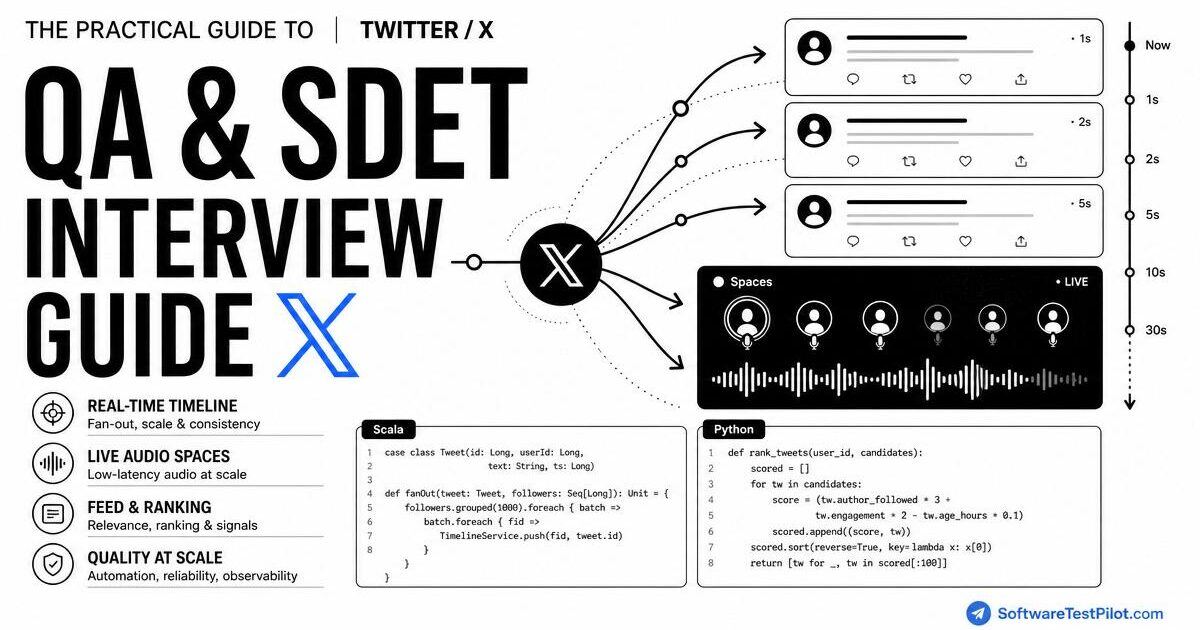
Securing an interview for a Software Engineer in Test (L4 / L5) or Quality Infrastructure Engineer role at Twitter / X places you inside one of the most lean, high-velocity real-time systems in modern software history. Operating global microblogging, live audio streaming (Spaces), real-time news propagation, and algorithmic feeds for over 500 million users with an exceptionally streamlined engineering team requires extreme automation leverage.
At X, quality engineering centers around high-throughput Scala/Java backends, real-time fan-out timelines, and continuous delivery pipelines where every engineer pushes code directly to production.
When you scan live requisitions on our internal SoftwareTestPilot QA Jobs Radar offering $150,000 to $220,000+ base salaries in San Francisco/Austin ($320,000+ Total Comp) and ₹24 Lakhs to ₹48 Lakhs+ INR CTC across Indian engineering hubs (Bangalore), notice that X evaluates quality talent on extreme algorithmic coding speed, distributed system resilience, and hardcore ownership.
To pass the X quality screening loop in 2026, you must write bug-free Python, Scala, or Java code on whiteboards under tight timers, design automated test runners capable of evaluating real-time fan-out architectures, and demonstrate hardcore engineering agency.
Here is an exhaustive, deconstructed guide to the exact Twitter/X quality engineering interview loop, reported 2026 compensation bands across US Dollars ($) and Indian Rupees (₹), the top five technical coding prompts asked during onsite screens, and exactly 9 detailed FAQs paired with complete JSON-LD schema.
1. The Exact Twitter / X QA & SDET Interview Loop Deconstructed
X’s recruitment process is exceptionally fast, direct, and focused on practical execution speed. For mid-level (L4) and senior (L5) SDET roles, expect a streamlined 4-stage evaluation loop:
+-----------------------------------------------------------------------------------+
| THE TWITTER / X L4 / L5 SDET RECRUITMENT LIFECYCLE |
+-----------------------------------------------------------------------------------+
| STAGE 1: TECHNICAL ALIGNMENT & CODE SCREENING (30 - 45 Minutes) |
| - Verifying Python/Scala/Java coding speed, high-scale API automation exposure, |
| on-site readiness (San Francisco, Austin, Bangalore), and compensation. |
+-----------------------------------------------------------------------------------+
| STAGE 2: LIVE TECHNICAL CODING ROUND (60 Minutes) |
| - Live coding over HackerRank or CoderPad. Solving TWO LeetCode Medium string/heap|
| problems within 45 minutes + discussion around high-throughput API verification.|
+-----------------------------------------------------------------------------------+
| STAGE 3: THE 3 TO 4-ROUND ONSITE TECHNICAL LOOP (Executed over 1 day via Zoom) |
| ├── Round 1: Systems Algorithms & Stream Parsing (Clean Python/Scala code). |
| ├── Round 2: Real-Time Fan-Out & Timeline Quality System Design. |
| ├── Round 3: Practical Framework Coding (Playwright / REST/gRPC API suites). |
| └── Round 4: Engineering VP / Leadership Fit (Hardcore Ownership & Velocity). |
+-----------------------------------------------------------------------------------+
| STAGE 4: HIRING CONSENSUS & EXECUTIVE APPROVAL |
| - Engineering leads review code cleanliness and delivery velocity for approval. |
+-----------------------------------------------------------------------------------+
2. Reported 2026 Twitter / X QA & SDET Compensation Matrix
Aggregating self-reported filings from Levels.fyi, AmbitionBox, and SoftwareTestPilot Jobs Radar reveals where X compensation sits across internal L (Level) engineering grades in both United States ($ USD) and India (₹ INR CTC) R&D hubs. X offers heavy cash and equity packages rewards for lean engineering impact.
| Twitter / X Level | Job Title Equivalent | North America Base Salary ($ USD) | North America Total Comp ($ USD) | India R&D Hubs Base / Total (₹ INR CTC) | Core Role Responsibilities |
|---|---|---|---|---|---|
| Level L3 | Software Eng I in Test | $120,000 – $145,000 | $155,000 – $190,000 | ₹14.0L – ₹18.0L / ₹18L – ₹25L CTC | Script execution, REST/GraphQL API regression, Playwright suites. |
| Level L4 | Software Eng II / SDET | $150,000 – $180,000 | $220,000 – $290,000 | ₹24.0L – ₹34.0L / ₹32L – ₹46L CTC | Component automation architecture, CI/CD pipeline gating, API mocks. |
| Level L5 | Senior SDET / Lead QE | $180,000 – $220,000 | $320,000 – $430,000 | ₹36.0L – ₹48.0L / ₹48L – ₹68L+ CTC | Real-time fan-out V&V design, timeline cache replication testing. |
| Level L6 | Staff Quality Architect | $220,000 – $260,000+ | $440,000 – $580,000+ | ₹52.0L – ₹68.0L+ / ₹70L – ₹95L+ CTC | Enterprise X cloud infrastructure quality scale, global timeline V&V. |
3. Top 5 Technical & Coding Questions Asked at Twitter / X
During onsite screens, X evaluators test algorithmic coding speed, tweet stream parsing, and web automation. Here are five top technical questions asked during X SDET loops.
Question 1: Real-Time Trending Topic Rate Auditor ($O(N)$ Parsing)
Prompt: "Twitter/X trending algorithms ingest real-time tweet telemetry strings formatted as[TIMESTAMP] [HASHTAG] [USER_ID] [RETWEET_COUNT]. Write a Python or TypeScript method that identifies anyHASHTAGwhere averageRETWEET_COUNTexceeded 500 per tweet across at least 5 telemetry beats within a rolling 3-minute window."
# Production Python Solution: Clean Hash Map Parsing & Windowed Audit
from collections import defaultdict
from typing import List, Set, Tuple

class HashtagTrendHistory:
 def __init__(self):
 self.events: List[Tuple[int, int]] = [] # List of (timestamp, retweet_count)

def detect_viral_trending_hashtags(telemetry_logs: List[str]) -> List[str]:
 hashtag_map = defaultdict(HashtagTrendHistory)
 viral_hashtags: Set[str] = set()

 for log in telemetry_logs:
 if not log or not log.strip():
 continue
 tokens = log.strip().split()
 if len(tokens) < 4:
 continue

 timestamp = int(tokens[0])
 hashtag = tokens[1]
 retweet_count = int(tokens[3])

 history = hashtag_map[hashtag].events
 history.append((timestamp, retweet_count))

 # Maintain rolling 3-minute window (180 seconds = 180,000ms)
 while history and (timestamp - history[0][0]) > 180000:
 history.pop(0)

 # Evaluate viral SLA condition (count >= 5 and average > 500)
 if len(history) >= 5:
 average_retweets = sum(count for _, count in history) / len(history)
 if average_retweets > 500.0:
 viral_hashtags.add(hashtag)

 return list(viral_hashtags)
Question 2: Testing Timeline Fan-Out Cache Invalidation
Prompt: "When a reported user with 50 million followers tweets, backend services execute Fan-Out-on-Write to push the tweet into subscriber Redis caches. How do you design an automated test harness that verifies timeline cache updates without database locking?"
Architectural Solution: To verify timeline fan-out:
- Programmatically publish a test post via internal REST API endpoints using an authenticated synthetic celebrity account.
- Subscribe a pool of 50 synthetic follower accounts to the timeline endpoint (
GET /2/users/{id}/timelines/reverse_chronological). - Assert strict SLA timing: verify that 100% of follower feeds render the new tweet within a 350 millisecond propagation window.
Question 3: Playwright Automation for X Web Post Publishing
Prompt: "Write a clean Playwright TypeScript test verifying that an authenticated user can compose a tweet containing text and hashtags, publish it, and assert timeline rendering."
// Production Playwright TypeScript X Web Suite
import {test, expect} from'@playwright/test';

test('Should compose and publish tweet deterministically within web feed', async ({page}) => {
 await page.goto('https://x.test/home');

 // Open composer and input tweet payload
 const composerInput = page.locator('[data-testid="tweetTextarea_0"]');
 await composerInput.click();
 await composerInput.fill('Verifying X continuous delivery quality pipelines! #SoftwareTestPilot #QA2026');

 // Submit post and assert timeline update feedback
 await page.locator('[data-testid="tweetButtonInline"]').click();

 const successToast = page.locator('[data-testid="toast"]');
 await expect(successToast).toBeVisible({timeout: 10000});

 const topFeedPost = page.locator('[data-testid="tweet"]').first();
 await expect(topFeedPost).toContainText('Verifying X continuous delivery quality pipelines!');
});
Question 4: Debugging WebSocket Stream Disconnections in Live Spaces
Prompt: "An automated regression suite verifying X Spaces audio broadcasting passes locally but drops connections during high-load CI runs. How do you troubleshoot this?"
Technical Breakdown: Explain that cloud CI containers suffer socket buffer exhaustion during sustained WebSocket packet bursts. Refactor the test harness to enforce WebSocket heartbeat ping/pong assertions (ws.ping()), adjust TCP socket read timeouts, and mock audio packet stream payloads over local WebRTC stubs.
Question 5: Test Strategy for X Premium Verification & Monetization Ledgers
Prompt: "How do you design a quality verification plan for X Premium monthly creator ad-revenue sharing payout ledgers?"
Apply the ACCORD Whiteboard Framework:
- Architecture: Assert Stripe/REST payout ledger calculation endpoints over automated Mock endpoints.
- Concurrency: Verify payment processing queues when 50,000 creators receive revenue splits simultaneously.
- Data State: Pre-seed creator impression metrics via API Data Factories before settlement verification.
4. System Design for Quality at Twitter / X Cloud Scale
During Round 2 (System Design), X evaluators test your ability to build real-time timeline test infrastructure.
The Whiteboard Prompt:
"Design a continuous integration automation harness capable of executing overnight regression cycles across 10,000 concurrent simulated timeline feeds without polluting production user graphs."
+-----------------------------------------------------------------------------------+
| MULTI-TENANT TWITTER / X TIMELINE TEST HARNESS |
+-----------------------------------------------------------------------------------+
| [GITHUB ACTIONS CRON TRIGGER] ---> Initiates Nightly Timeline Regression |
| | |
| v |
| [CONTAINERIZED PYTHON / PLAYWRIGHT CLUSTER] |
| - Automatically provisions 100 ephemeral Linux container runners. |
| - Shards 20,000 API and UI timeline checks across parallel container workers. |
| | |
| v |
| [SCALA / REST API TEST DATA FACTORY] |
| - Pre-seeds synthetic follower graphs and tweets via high-speed internal APIs. |
| | |
| v |
| [AUTOMATED TEARDOWN & TIMELINE TELEMETRY] |
| - Purges test records post-run -> Emails visual Allure report to X engineering! |
+-----------------------------------------------------------------------------------+
5. Your 30-Day Twitter / X Interview Turnaround Plan
To prepare for your Twitter/X onsite loop, upload your resume immediately to our SoftwareTestPilot ATS Resume Reviewer. Ensure your bullet points highlight Scala, Python, Playwright, real-time fan-out, and high-throughput testing keywords ("Architected timeline regression harness evaluating 20,000 real-time workflows").
. Practice articulating your stream parsing and database rollback trade-offs out loud before facing executive X quality leads.
### Preparing For Twitter / X Quality Interviews? Share This Guide! X loops require extreme coding velocity and real-time backend clarity.[LinkedIn] or [X/Twitter]. .
Frequently asked questions
1.How long does the entire Twitter / X QA & SDET interview process take in 2026?
2.Is LeetCode required for Quality Engineering roles at Twitter / X?
3.What is the average compensation for a Senior SDET (Level L5) at Twitter / X in US vs India?
4.Can I interview in Python or Playwright, or does Twitter / X strictly require Scala/Java?
5.How strict is Twitter / X on academic degrees versus commercial automation certifications?
6.What is the cool-off period if I get rejected after the Twitter / X onsite loop?
7.Does Twitter / X allow remote work for QA and automation engineers in 2026?
8.How should I tailor my resume specifically for Twitter / X ATS parsers?
9.What is the #1 reason experienced QA engineers fail the Twitter / X technical screen?
Was this article helpful?
Keep building your QA edge
Pillar guides- SDET Rolebecome an SDET in 2026What SDETs actually do — skills, salary bands, and interview prep for 2026.
- Company QA Interview GuidesQA interview questions by companyReal interview loops from Google, Amazon, Meta, Apple, Microsoft, Adobe, and 40+ other tech employers.
- Automation QA Engineer RoleAutomation QA Engineer career guideAutomation QA Engineer job scope, tools, salary, and hiring pipeline.