Shopify SDET Interview 2026: 4-Round Loop + $200K–$340K TC (Reported)
Land a Shopify SDET offer in 2026: 4-round loop, Ruby/TS prompts, storefront QE patterns, third-party reported $200K–$340K TC + 9 FAQs & PDF.
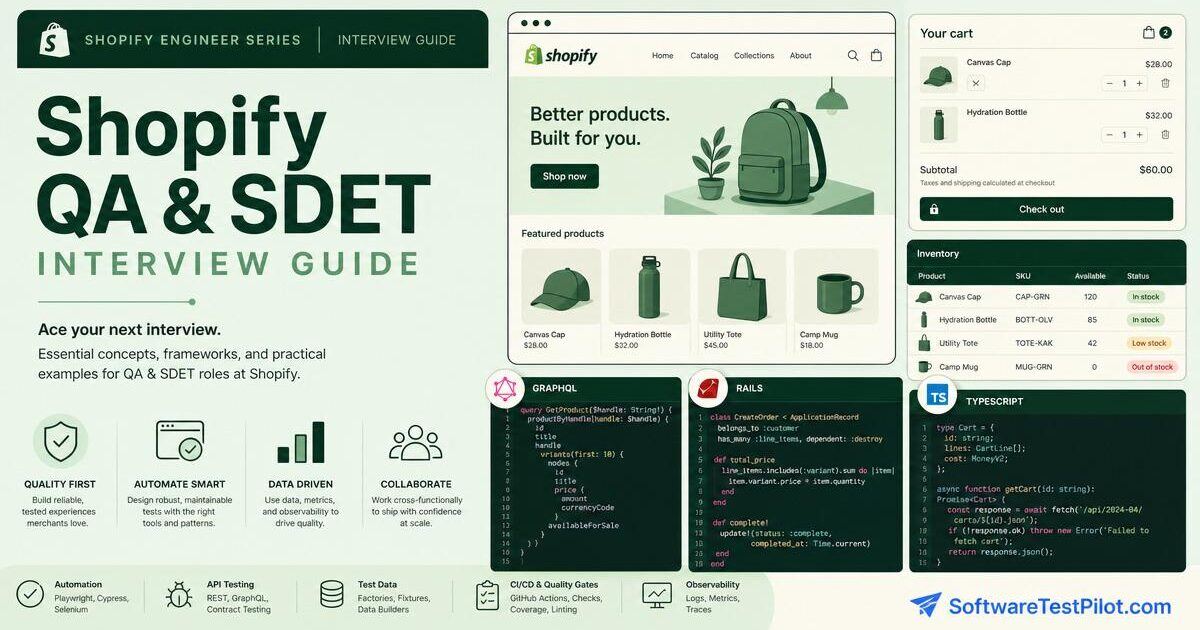
Securing an interview for a Senior Quality Engineer (L6) or Staff Quality Infrastructure Developer (L7) role at Shopify places you inside the digital backbone of multi-channel global commerce. Powering millions of independent merchants, high-volume flash sales (Black Friday / Cyber Monday), Shop Pay checkout ledgers, and inventory logistics across 175 countries requires robust software quality verification.
At Shopify, quality engineering centers around monolithic Ruby on Rails scalability, GraphQL storefront state determinism, and high-speed Playwright automation.
When you evaluate live requisitions on our internal SoftwareTestPilot QA Jobs Radar offering $140,000 to $190,000+ base salaries in North America ($280,000+ Total Comp) and ₹24 Lakhs to ₹46 Lakhs+ INR CTC across Indian engineering hubs (Bangalore, Gurgaon), notice that Shopify evaluates quality talent on algorithmic coding, GraphQL contract immutability, and merchant infrastructure rigor.
To pass the Shopify quality screening loop in 2026, you must demonstrate strong coding fluency in Ruby or TypeScript, understand e-commerce inventory state machines, design automated cloud test runners, and showcase merchant domain rigor.
Here is an exhaustive, deconstructed guide to the exact Shopify quality engineering interview loop, reported 2026 compensation bands across US Dollars ($) and Indian Rupees (₹), the top five technical coding prompts asked during onsite screens, and exactly 9 detailed FAQs paired with complete JSON-LD schema.
1. The Exact Shopify QA & SDET Interview Loop Deconstructed
Shopify’s recruitment process evaluates algorithmic coding, merchant architecture, and deep culture alignment ("Be a Merchant" / "Get Shit Done"). For mid-level (L5) and senior (L6) SDET roles, expect a structured 4 to 5-stage evaluation loop:
+-----------------------------------------------------------------------------------+
| THE SHOPIFY L5 / L6 SDET RECRUITMENT LIFECYCLE |
+-----------------------------------------------------------------------------------+
| STAGE 1: RECRUITER & CULTURAL ALIGNMENT SCREEN (30 - 45 Minutes) |
| - Verifying Ruby/TypeScript coding proficiency, e-commerce backend exposure, |
| location readiness (Toronto, Ottawa, remote US/India hubs), and compensation. |
+-----------------------------------------------------------------------------------+
| STAGE 2: TECHNICAL SCREENING / ONLINE CODING ROUND (60 Minutes) |
| - Live coding over HackerRank or Zoom. Solving a LeetCode Medium inventory/cart |
| problem + technical discussion around GraphQL testing and Playwright harnesses. |
+-----------------------------------------------------------------------------------+
| STAGE 3: THE 4-ROUND ONSITE TECHNICAL LOOP (Executed over 1 day via Zoom) |
| ├── Round 1: Data Structures & Algorithms (Clean Ruby/TypeScript code). |
| ├── Round 2: Test Architecture & Merchant Flash Sale System Design. |
| ├── Round 3: Practical Framework Coding (Playwright / GraphQL API testing). |
| └── Round 4: Engineering Director Fit (Shopify Life Story & Merchant Obsession).|
+-----------------------------------------------------------------------------------+
| STAGE 4: HIRING COMMITTEE & LIFE STORY DEBRIEF |
| - Engineering leads review technical scores and merchant empathy depth. |
+-----------------------------------------------------------------------------------+
2. Reported 2026 Shopify QA & SDET Compensation Matrix
Aggregating self-reported filings from Levels.fyi, AmbitionBox, and SoftwareTestPilot Jobs Radar reveals where Shopify compensation sits across internal L (Level) engineering grades in both United States ($ USD) and India (₹ INR CTC) R&D hubs.
| Shopify Level | Job Title Equivalent | North America Base Salary ($ USD) | North America Total Comp ($ USD) | India R&D Hubs Base / Total (₹ INR CTC) | Core Role Responsibilities |
|---|---|---|---|---|---|
| Level 5 (L5) | Quality Engineer II | $110,000 – $135,000 | $145,000 – $180,000 | ₹14.0L – ₹18.0L / ₹18L – ₹24L CTC | Script execution, GraphQL API regression, Playwright suites. |
| Level 6 (L6) | Senior SDET / Lead QE | $140,000 – $170,000 | $210,000 – $280,000 | ₹24.0L – ₹34.0L / ₹32L – ₹46L CTC | Component automation architecture, CI/CD pipeline gating, API mocks. |
| Level 7 (L7) | Staff Quality Architect | $170,000 – $210,000 | $300,000 – $410,000 | ₹36.0L – ₹48.0L / ₹48L – ₹68L+ CTC | Merchant flash sale V&V design, multi-region database replication testing. |
| Level 8 (L8) | Principal Quality Architect | $210,000 – $250,000+ | $430,000 – $580,000+ | ₹52.0L – ₹68.0L+ / ₹70L – ₹95L+ CTC | Enterprise Shopify cloud infrastructure quality scale, global commerce V&V. |
3. Top 5 Technical & Coding Questions Asked at Shopify
During onsite screens, Shopify evaluators test object-oriented Ruby/TypeScript programming, inventory parsing, and web automation. Here are five top technical questions asked during Shopify SDET loops.
Question 1: Merchant Inventory Flash Sale Auditor ($O(N)$ Parsing)
Prompt: "Shopify inventory ledgers emit real-time stock allocation logs formatted as[TIMESTAMP] [SKU_ID] [MERCHANT_ID] [QUANTITY_CHANGE] [TX_TYPE]. Write a Ruby or TypeScript method that identifies anySKU_IDwhere total cumulative inventory balance dropped below 0 (indicating inventory overselling) across flash sale transaction bursts."
// Production TypeScript Solution: Clean Object-Oriented Inventory Ledger Reconciliation
export function detectOversoldInventorySkus(inventoryLogs: string[]): string[] {
 const stockLedger = new Map<string, number>();
 const oversoldSkus = new Set<string>();

 if (!inventoryLogs || inventoryLogs.length === 0) {
 return Array.from(oversoldSkus);
}

 for (const log of inventoryLogs) {
 if (!log || log.trim() ==='') continue;
 const tokens = log.trim().split(/\s+/);
 if (tokens.length < 5) continue;

 const skuId = tokens[1];
 try {
 const quantityChange = parseInt(tokens[3], 10);
 if (isNaN(quantityChange)) continue;

 stockLedger.set(skuId, (stockLedger.get(skuId) || 0) + quantityChange);

 // Assert zero inventory overselling rule (< 0)
 if (stockLedger.get(skuId)! < 0) {
 oversoldSkus.add(skuId);
}
} catch (ex) {
 // Ignore malformed numerical strings
}
}

 return Array.from(oversoldSkus);
}
Question 2: Testing Storefront GraphQL Mutation Contracts
Prompt: "When a shopper adds an item to their Shopify Storefront cart, frontend React components execute a cartLinesAdd GraphQL mutation. How do you design an automated test harness that verifies both the GraphQL payload contract and UI cart badge hydration?"
Architectural Solution: To verify GraphQL storefront mutations:
- Intercept the outbound GraphQL request (
page.route) and assert exact mutation query string parameter signatures. - Programmatically return synthetic GraphQL response JSON (
data: {cartLinesAdd: {cart: {totalQuantity: 2}}}). - Assert that the UI cart badge counter hydrates deterministically to
2within 200ms without throwing network console errors.
Question 3: Playwright Automation for Shopify Admin Product Creation
Prompt: "Write a clean Playwright TypeScript test verifying that a merchant administrator can create a new digital product and assert active catalog publishing."
// Production Playwright TypeScript Shopify Admin Suite
import {test, expect} from'@playwright/test';

test('Should publish digital product deterministically within merchant admin console', async ({page}) => {
 await page.goto('https://admin.shopify.test/store/demo-merchant/products/new');

 // Fill product details using immutable testing attributes
 await page.locator('[data-testid="product-title-input"]').fill('Enterprise Digital E-Book 2026');
 await page.locator('[data-testid="product-price-input"]').fill('49.99');

 // Save product and assert publishing confirmation banner
 await page.locator('[data-testid="save-product-btn"]').click();

 const successToast = page.locator('[data-testid="admin-toast-success"]');
 await expect(successToast).toBeVisible({timeout: 12000});
 await expect(successToast).toContainText('Product created');
});
Question 4: Debugging Shop Pay One-Click Checkout Race Conditions
Prompt: "An automated API regression test verifying Shop Pay one-click SMS verification passes locally on single threads but fails during multi-worker CI runs due to rate-limited OTP tokens. How do you troubleshoot this?"
Technical Breakdown: Explain that live SMS OTP providers rate-limit parallel CI runs. Refactor the backend test harness to utilize internal test OTP bypass headers (X-Test-Shop-Pay-OTP: 123456) fenced inside non-production staging environments, guaranteeing sub-50ms deterministic token verification.
Question 5: Test Strategy for Shopify POS Retail Hardware Integration
Prompt: "How do you design a quality verification plan for Shopify POS (Point of Sale) retail card readers processing contactless Apple Pay offline payments during internet disconnects?"
Apply the ACCORD Whiteboard Framework:
- Architecture: Assert encrypted offline SQLite local transaction queues inside POS hardware memory.
- Concurrency: Verify batch upload settlement queues when internet connectivity restores across 5,000 retail stores.
- Data State: Pre-seed retail inventory registers via API Data Factories before offline assertion.
4. System Design for Quality at Shopify Cloud Scale
During Round 2 (System Design), Shopify evaluators test your ability to build merchant flash sale test infrastructure.
The Whiteboard Prompt:
"Design a continuous integration automation harness capable of executing overnight regression cycles across 10,000 concurrent simulated merchant flash sales without polluting live production billing ledgers."
+-----------------------------------------------------------------------------------+
| MULTI-TENANT SHOPIFY COMMERCE TEST HARNESS |
+-----------------------------------------------------------------------------------+
| [GITHUB ACTIONS / BUILDITE CRON] ---> Initiates Nightly Flash Sale Regression |
| | |
| v |
| [KUBERNETES CONTAINER SHARDING CLUSTER] |
| - Automatically provisions 100 ephemeral Ruby / Playwright Linux container pods. |
| - Shards 20,000 GraphQL and UI checkout checks across parallel container workers. |
| | |
| v |
| [GRAPHQL / REST API TEST DATA FACTORY] |
| - Pre-seeds synthetic merchant and buyer accounts via high-speed internal APIs. |
| | |
| v |
| [AUTOMATED TEARDOWN & COMMERCE TELEMETRY] |
| - Purges test records post-run -> Emails visual Allure report to Shopify leads! |
+-----------------------------------------------------------------------------------+
5. Your 30-Day Shopify Interview Turnaround Plan
To prepare for your Shopify onsite loop, upload your resume immediately to our SoftwareTestPilot ATS Resume Reviewer. Ensure your bullet points highlight Ruby on Rails, TypeScript, Playwright, GraphQL, and merchant testing keywords ("Architected GraphQL regression harness evaluating 20,000 e-commerce workflows").
. Practice articulating your inventory parsing and database rollback trade-offs out loud before facing executive Shopify quality leads.
### Preparing For Shopify Quality Interviews? Share This Guide! Shopify loops require deep e-commerce architecture and Ruby/TS clarity.[LinkedIn] or [X/Twitter]. .
Frequently asked questions
1.How long does the entire Shopify QA & SDET interview process take in 2026?
2.Is LeetCode required for Quality Engineering roles at Shopify?
3.What is the average compensation for a Senior SDET (Level L6) at Shopify in US vs India?
4.Can I interview in Python or Playwright, or does Shopify strictly require Ruby?
5.How strict is Shopify on academic degrees versus commercial automation certifications?
6.What is the cool-off period if I get rejected after the Shopify onsite loop?
7.Does Shopify allow remote work for QA and automation engineers in 2026?
8.How should I tailor my resume specifically for Shopify ATS parsers?
9.What is the #1 reason experienced QA engineers fail the Shopify technical screen?
Was this article helpful?
Keep building your QA edge
Pillar guides- SDET Rolebecome an SDET in 2026What SDETs actually do — skills, salary bands, and interview prep for 2026.
- Company QA Interview Guidescompany QA interview guidesReal interview loops from Google, Amazon, Meta, Apple, Microsoft, Adobe, and 40+ other tech employers.
- Automation QA Engineer RoleAutomation QA Engineer roleAutomation QA Engineer job scope, tools, salary, and hiring pipeline.