Salesforce SDET Interview 2026: 4-Round Loop + $220K–$370K TC (Reported)
Crack the Salesforce SDET loop in 2026: 4 rounds, Apex/Java prompts, third-party reported $220K–$370K TC + ₹22–48 LPA India CTC, 9 FAQs.
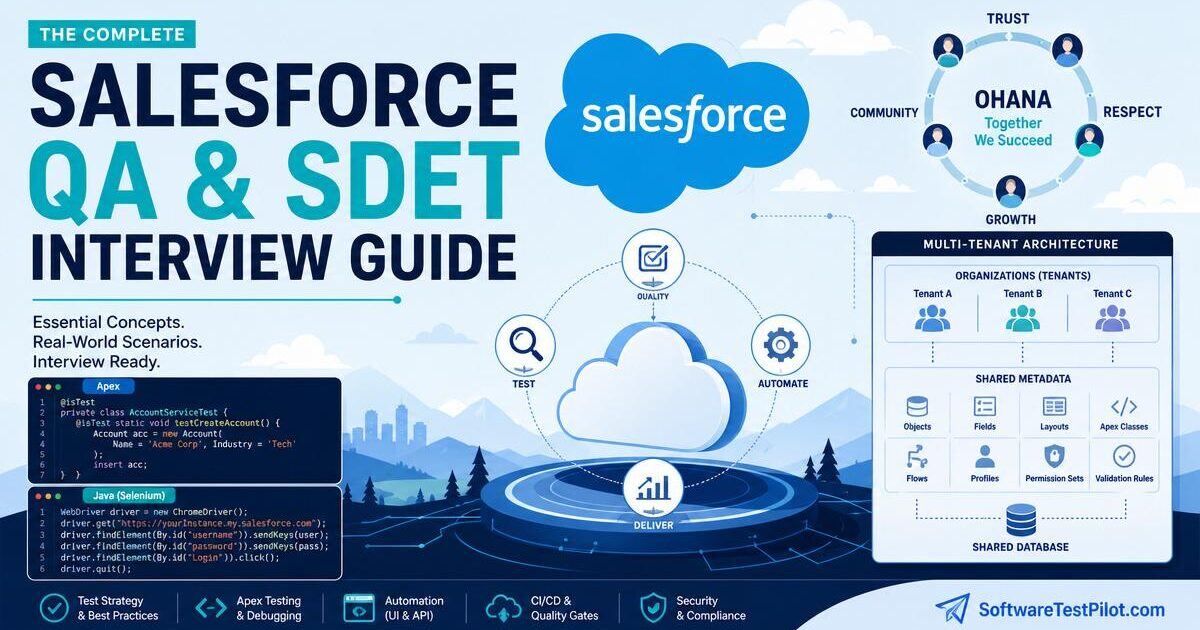
Securing an interview for a Quality Engineer (LMTS / SMTS) or Software Development Engineer in Test (SDET) role at Salesforce puts you inside the global enterprise cloud leader that pioneered SaaS. Operating multi-tenant CRM platforms, Sales Cloud, Service Cloud, Marketing Cloud, MuleSoft, Tableau, and Slack across millions of enterprise customers requires rigorous software quality architecture.
At Salesforce, quality engineering centers around multi-tenant isolation, metadata-driven architecture, and continuous deployment reliability.
When you scan live requisitions on our internal SoftwareTestPilot QA Jobs Radar offering $140,000 to $190,000+ base salaries in North America ($240,000+ Total Comp) and ₹18 Lakhs to ₹36 Lakhs+ INR CTC across Indian R&D centers (Hyderabad, Bangalore), notice that Salesforce evaluates quality talent on algorithmic coding, Apex/Java integration, and CRM platform scalability.
To pass the Salesforce quality screening loop in 2026, you must write clean Java/Apex code, understand multi-tenant database governors, design automated Selenium/Playwright harnesses, and exhibit alignment with Salesforce’s core value of Trust.
Here is an exhaustive, deconstructed guide to the exact Salesforce quality engineering interview loop, reported 2026 compensation bands across US Dollars ($) and Indian Rupees (₹), the top five technical coding prompts asked during onsite screens, and exactly 9 detailed FAQs paired with complete JSON-LD schema.
1. The Exact Salesforce QA & SDET Interview Loop Deconstructed
Salesforce recruitment evaluates algorithmic coding, framework design, and Ohana culture alignment. For mid-level (Member of Technical Staff - LMTS) and senior (Senior Member of Technical Staff - SMTS) SDET roles, expect a structured 4 to 5-stage evaluation loop:
+-----------------------------------------------------------------------------------+
| THE SALESFORCE LMTS / SMTS RECRUITMENT LIFECYCLE |
+-----------------------------------------------------------------------------------+
| STAGE 1: RECRUITER & TECHNICAL ALIGNMENT SCREEN (30 - 45 Minutes) |
| - Verifying Java/Apex/TypeScript stack, enterprise SaaS exposure, location |
| readiness (San Francisco, Bellevue, Hyderabad, Bangalore), and compensation. |
+-----------------------------------------------------------------------------------+
| STAGE 2: TECHNICAL CODING SCREEN (60 Minutes) |
| - Live coding over HackerRank or Teams. Solving a LeetCode Medium string/collection|
| problem + detailed discussion around Selenium/Playwright framework patterns. |
+-----------------------------------------------------------------------------------+
| STAGE 3: THE 4-ROUND ONSITE TECHNICAL LOOP (Executed over 1 day via Teams/Zoom) |
| ├── Round 1: Data Structures & Algorithms (Clean Java/Apex code, optimization). |
| ├── Round 2: Quality Systems & Multi-Tenant Test Architecture Design. |
| ├── Round 3: Practical Automation Framework & API Verification (Postman/Java). |
| └── Round 4: Engineering Director / Culture Fit (Salesforce Trust & Ohana). |
+-----------------------------------------------------------------------------------+
| STAGE 4: HIRING COMMITTEE & VP DEBRIEF |
| - Engineering leads review interviewer scores and code snapshots for consensus. |
+-----------------------------------------------------------------------------------+
2. Reported 2026 Salesforce QA & SDET Compensation Matrix
Aggregating self-reported filings from Levels.fyi, AmbitionBox, and SoftwareTestPilot Jobs Radar reveals where Salesforce compensation sits across internal Member of Technical Staff (MTS) grade levels in both US Dollars ($ USD) and Indian Rupees (₹ INR CTC).
| Salesforce Level | Job Title Equivalent | North America Base Salary ($ USD) | North America Total Comp ($ USD) | India R&D Hubs Base / Total (₹ INR CTC) | Core Role Responsibilities |
|---|---|---|---|---|---|
| Level AMTS | Associate Quality Eng | $105,000 – $125,000 | $130,000 – $155,000 | ₹10.0L – ₹14.0L / ₹13L – ₹18L CTC | Executing Selenium/Java scripts, API checks, defect triage. |
| Level LMTS | SDET / Quality Eng II | $135,000 – $160,000 | $180,000 – $230,000 | ₹18.0L – ₹25.0L / ₹22L – ₹32L CTC | POM architecture, RestAssured suites, CI/CD pipeline runs. |
| Level SMTS | Senior SDET / Lead QE | $160,000 – $190,000 | $240,000 – $320,000 | ₹26.0L – ₹36.0L / ₹35L – ₹50L+ CTC | Multi-tenant framework design, Apex test governance, API mocks. |
| Level Lead MTS | Lead Quality Architect | $190,000 – $230,000+ | $330,000 – $450,000+ | ₹38.0L – ₹52.0L+ / ₹55L – ₹78L+ CTC | Enterprise Salesforce cloud infrastructure V&V, CI/CD scale. |
3. Top 5 Technical & Coding Questions Asked at Salesforce
During onsite screens, Salesforce evaluators test object-oriented Java/Apex programming, multi-tenant data parsing, and CRM UI automation. Here are five top technical questions asked during Salesforce SDET loops.
Question 1: Multi-Tenant Governor Limit & Log Auditor ($O(N)$ Parsing)
Prompt: "Salesforce Apex enforces strict multi-tenant governor limits (e.g., max 100 SOQL queries per transaction). Given an array of transaction execution log strings formatted as[TIMESTAMP] [ORG_ID] [TX_ID] [SOQL_COUNT], write a Java method that identifies anyORG_IDwhere averageSOQL_COUNTexceeded 80 across at least 4 transactions."
// Production Java 17 Solution: Clean Object-Oriented Single-Pass Aggregation
import java.util.HashMap;
import java.util.HashSet;
import java.util.Map;
import java.util.Set;

public class SalesforceGovernorLimitAuditor {

 private static class OrgGovernorStats {
 int totalSoqlQueries = 0;
 int transactionCount = 0;
}

 public static Set<String> detectGovernorLimitRiskOrgs(String[] executionLogs) {
 Map<String, OrgGovernorStats> statsMap = new HashMap<>();
 Set<String> highRiskOrgs = new HashSet<>();

 if (executionLogs == null || executionLogs.length == 0) {
 return highRiskOrgs;
}

 for (String log : executionLogs) {
 if (log == null || log.trim().isEmpty()) continue;
 String[] tokens = log.trim().split("\\s+");
 if (tokens.length < 4) continue;

 String orgId = tokens[1];
 try {
 int soqlCount = Integer.parseInt(tokens[3]);
 statsMap.putIfAbsent(orgId, new OrgGovernorStats());
 OrgGovernorStats current = statsMap.get(orgId);
 current.totalSoqlQueries += soqlCount;
 current.transactionCount += 1;

 // Evaluate governor limit threshold (average > 80 across >= 4 transactions)
 if (current.transactionCount >= 4) {
 double averageSoql = (double) current.totalSoqlQueries / current.transactionCount;
 if (averageSoql > 80.0) {
 highRiskOrgs.add(orgId);
}
}
} catch (NumberFormatException ex) {
 // Ignore malformed numerical strings
}
}

 return highRiskOrgs;
}
}
Question 2: Testing Salesforce Lightning Web Component (LWC) Shadow DOM
Prompt: "Salesforce Lightning UI encapsulates web components inside strict browser Shadow DOM boundaries (#shadow-root). Traditional Selenium locators (driver.findElement(By.id(...))) fail to pierce Shadow DOM trees. How do you design reliable locators?"
Architectural Solution: To pierce LWC Shadow DOM reliably:
- In Selenium Java, utilize explicit JavaScript execution traversal (
JavascriptExecutor) or upgrade to Selenium 4 native Shadow DOM lookups (element.getShadowRoot()). - In Playwright TypeScript, leverage native Web-First Piercing Locators. Playwright automatically pierces open Shadow DOM trees out of the box (
page.locator('lightning-input[data-testid="account-name"] input')).
Question 3: API Contract Automation Using RestAssured & SOQL
Prompt: "Write a clean RestAssured Java test verifying that Salesforce REST API endpoint (POST /services/data/v60.0/sobjects/Account/) successfully creates an Account record and returns HTTP201 Created."
// Production RestAssured Java Salesforce API Suite
import io.restassured.RestAssured;
import io.restassured.http.ContentType;
import org.testng.annotations.Test;
import static io.restassured.RestAssured.given;
import static org.hamcrest.Matchers.*;

public class SalesforceAccountCreationApiTest {

 @Test
 public void verifyAccountCreationSchemaContract() {
 RestAssured.baseURI = "https://your-org.my.salesforce.com";

 String accountPayload = "{\n"+
 "\"Name\": \"SoftwareTestPilot Enterprise Client\",\n"+
 "\"Industry\": \"Technology\",\n"+
 "\"AnnualRevenue\": 5000000.00\n"+
 "}";

 given()
 .header("Authorization", "Bearer "+ System.getenv("SF_OAUTH_ACCESS_TOKEN"))
 .contentType(ContentType.JSON)
 .body(accountPayload)
 .when()
 .post("/services/data/v60.0/sobjects/Account/")
 .then()
 .statusCode(201)
 .contentType(ContentType.JSON)
 .body("id", notNullValue())
 .body("success", equalTo(true));
}
}
Question 4: Debugging Apex Unit Test Isolation & SeeAllData
Prompt: "An Apex unit test verifying automated Opportunity closed-won triggers fails in staging when@isTest(SeeAllData=true)is annotated. Why isSeeAllData=trueconsidered a lethal practice?"
Technical Breakdown: Explain that @isTest(SeeAllData=true) couples unit test execution to live production or staging database records. If staging sandbox data changes or undergoes a refresh, tests fail with false-negative errors. Enforce strict Apex Test Data Factories (@TestSetup) that programmatically generate isolated, ephemeral test records in memory.
Question 5: Test Strategy for MuleSoft AnyPoint API Integrations
Prompt: "How do you design a quality verification plan for Salesforce MuleSoft AnyPoint data transformations synchronizing SAP ERP invoice data into Salesforce Opportunity objects?"
Apply the ACCORD Whiteboard Framework:
- Architecture: Assert XML/JSON DataWeave mapping transformations over automated Mocking Service endpoints.
- Concurrency: Verify batch processing queues when 50,000 invoice records sync simultaneously.
- Data State: Implement ephemeral WireMock servers simulating SAP backend responses.
4. System Design for Quality at Salesforce Cloud Scale
During Round 2 (System Design), Salesforce evaluators test your ability to build multi-tenant test infrastructure.
The Whiteboard Prompt:
"Design a continuous integration automation harness capable of executing overnight regression cycles across 10 distinct Salesforce Org sandboxes without data collision."
+-----------------------------------------------------------------------------------+
| MULTI-TENANT SALESFORCE TEST HARNESS |
+-----------------------------------------------------------------------------------+
| [GITHUB ACTIONS / AZURE DEVOPS CRON] ---> Initiates Nightly Regression Cycle |
| | |
| v |
| [SFDX CLI EPHEMERAL SCRATCH ORG PROVISIONING] |
| - Automatically provisions 10 clean Salesforce Scratch Orgs via sfdx CLI. |
| - Pushes metadata packages and Apex classes to sandboxes in sub-seconds. |
| | |
| v |
| [APEX TEST DATA FACTORY & PLAYWRIGHT SHARDING] |
| - Pre-seeds Account and Opportunity records via REST APIs. |
| - Shards 10,000 UI/API regression checks across containerized Playwright runners. |
| | |
| v |
| [AUTOMATED TEARDOWN & OHANA DASHBOARD] |
| - Deletes Scratch Orgs post-run -> Posts Allure summary to Slack channel! |
+-----------------------------------------------------------------------------------+
5. Your 30-Day Salesforce Interview Turnaround Plan
To prepare for your Salesforce onsite loop, upload your resume immediately to our SoftwareTestPilot ATS Resume Reviewer. Ensure your bullet points highlight Java, Apex, Selenium/Playwright, SFDX CLI, and CRM testing keywords ("Architected Scratch Org regression harness evaluating 10,000 CRM workflows").
. Practice articulating your multi-tenant isolation algorithms out loud before facing executive Salesforce quality leads.
### Preparing For Salesforce Quality Interviews? Share This Guide! Salesforce loops require deep multi-tenant and LWC Shadow DOM clarity.[LinkedIn] or [X/Twitter]. .
Frequently asked questions
1.How long does the entire Salesforce QA & SDET interview process take in 2026?
2.Is LeetCode required for Quality Engineering roles at Salesforce?
3.What is the average compensation for a Senior SDET (SMTS) at Salesforce in US vs India?
4.Can I interview in Python or Playwright, or does Salesforce strictly require Java/Apex?
5.How strict is Salesforce on academic degrees versus Salesforce certifications?
6.What is the cool-off period if I get rejected after the Salesforce onsite loop?
7.Does Salesforce allow remote work for QA and automation engineers in 2026?
8.How should I tailor my resume specifically for Salesforce ATS parsers?
9.What is the #1 reason experienced QA engineers fail the Salesforce technical screen?
Was this article helpful?
Keep building your QA edge
Pillar guides- SDET Rolebecome an SDET in 2026What SDETs actually do — skills, salary bands, and interview prep for 2026.
- Company QA Interview GuidesQA interview questions by companyReal interview loops from Google, Amazon, Meta, Apple, Microsoft, Adobe, and 40+ other tech employers.
- Automation QA Engineer Roleexplore this role in depthAutomation QA Engineer job scope, tools, salary, and hiring pipeline.