Oracle SDET Interview 2026: 4-Round Loop + $170K–$280K TC (Reported)
Crack Oracle SDET/OCI in 2026: 4-round loop, Java/SQL prompts, third-party reported $170K–$280K TC + ₹15–38 LPA India CTC, 9 FAQs & PDF.
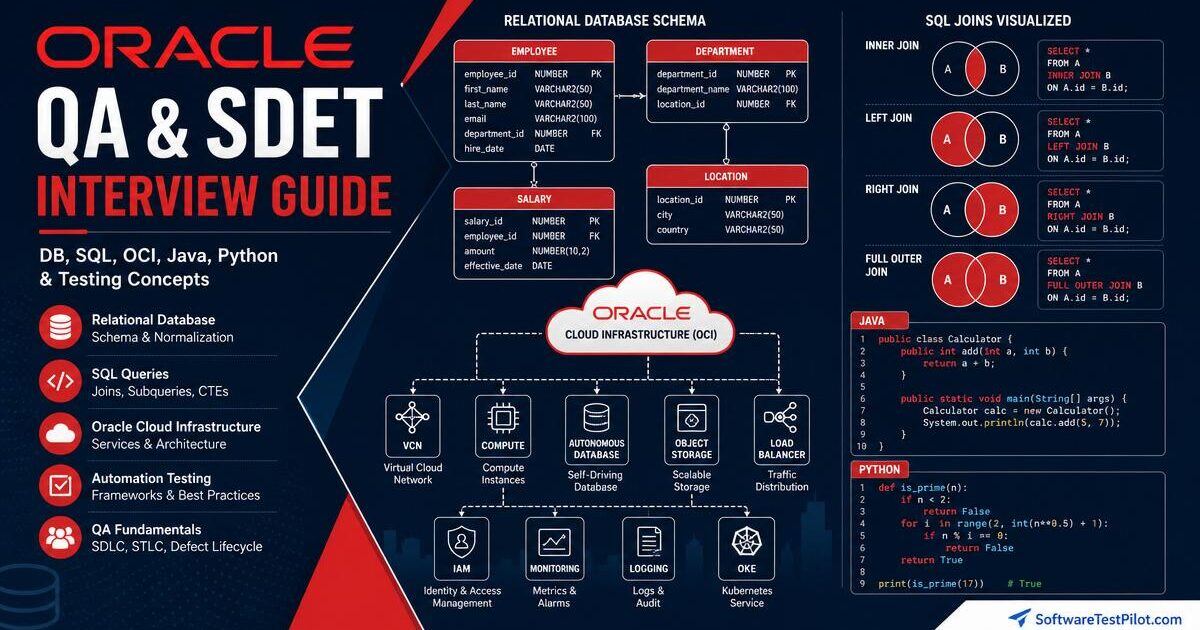
Securing an interview for a Software Development Engineer in Test (IC3 / IC4) or Principal Quality Architect (IC5) role at Oracle puts you inside the foundational titan of enterprise database engines and cloud infrastructure. Operating Oracle Cloud Infrastructure (OCI), autonomous databases, Oracle Fusion Cloud ERP, NetSuite, and Cerner across enterprise government and corporate sectors requires uncompromising software quality verification.
At Oracle, quality engineering centers around relational database transactional consistency, high-availability cloud node replication, and multi-tenant SaaS integration.
When you scan live requisitions on our internal SoftwareTestPilot QA Jobs Radar offering $130,000 to $180,000+ base salaries in North America ($240,000+ Total Comp) and ₹16 Lakhs to ₹35 Lakhs+ INR CTC across Indian R&D hubs (Bangalore, Hyderabad, Pune), notice that Oracle evaluates quality talent on algorithmic coding, core Java concurrency, and complex SQL schema verification.
To pass the Oracle quality screening loop in 2026, you must write clean Java or Python code, construct advanced SQL join queries on whiteboards, design automated OCI cloud test runners, and showcase deep database systems intuition.
Here is an exhaustive, deconstructed guide to the exact Oracle quality engineering interview loop, reported 2026 compensation bands across US Dollars ($) and Indian Rupees (₹), the top five technical coding prompts asked during onsite screens, and exactly 9 detailed FAQs paired with complete JSON-LD schema.
1. The Exact Oracle QA & SDET Interview Loop Deconstructed
Oracle’s recruitment process evaluates core algorithmic coding, SQL database mastery, and infrastructure scaling. For mid-level (IC3) and senior (IC4) SDET roles, expect a structured 4 to 5-stage evaluation loop:
+-----------------------------------------------------------------------------------+
| THE ORACLE IC3 / IC4 SDET RECRUITMENT LIFECYCLE |
+-----------------------------------------------------------------------------------+
| STAGE 1: RECRUITER TECHNICAL SCREENING (30 - 45 Minutes) |
| - Verifying Java/SQL coding proficiency, cloud infrastructure (OCI/AWS) exposure, |
| location readiness (Austin, Seattle, Bangalore, Hyderabad), and compensation. |
+-----------------------------------------------------------------------------------+
| STAGE 2: TECHNICAL SCREENING / ONLINE CODING ROUND (60 Minutes) |
| - Live coding over HackerRank or Zoom. Solving a LeetCode Medium array/string |
| problem + complex SQL query construction (Joins, Window Functions, Group By). |
+-----------------------------------------------------------------------------------+
| STAGE 3: THE 4-ROUND ONSITE TECHNICAL LOOP (Executed over 1 day via Zoom) |
| ├── Round 1: Data Structures & Algorithms (Clean Java code, concurrency logic). |
| ├── Round 2: Database Schema & Cloud Quality System Design. |
| ├── Round 3: Practical Framework Coding (Playwright / REST API verification). |
| └── Round 4: Engineering Director / Manager Fit (Execution & OCI Culture). |
+-----------------------------------------------------------------------------------+
| STAGE 4: HIRING COMMITTEE & VP DEBRIEF |
| - Engineering managers review technical scores and database verification depth. |
+-----------------------------------------------------------------------------------+
2. Reported 2026 Oracle QA & SDET Compensation Matrix
Aggregating self-reported filings from Levels.fyi, AmbitionBox, and SoftwareTestPilot Jobs Radar reveals where Oracle compensation sits across internal IC (Individual Contributor) grade levels in both United States ($ USD) and India (₹ INR CTC) R&D hubs.
| Oracle Level | Job Title Equivalent | North America Base Salary ($ USD) | North America Total Comp ($ USD) | India R&D Hubs Base / Total (₹ INR CTC) | Core Role Responsibilities |
|---|---|---|---|---|---|
| Level IC2 | Quality Engineer I | $95,000 – $118,000 | $120,000 – $145,000 | ₹10.0L – ₹14.0L / ₹12L – ₹17L CTC | Script execution, REST API regression, SQL data validation. |
| Level IC3 | SDET / Quality Eng II | $125,000 – $155,000 | $165,000 – $210,000 | ₹16.0L – ₹24.0L / ₹20L – ₹30L CTC | Component automation architecture, OCI CI/CD pipeline gating, API mocks. |
| Level IC4 | Senior SDET / Lead QE | $155,000 – $185,000 | $220,000 – $300,000 | ₹25.0L – ₹35.0L / ₹32L – ₹48L+ CTC | Cloud node replication testing, autonomous database V&V design. |
| Level IC5 | Principal Quality Architect | $185,000 – $225,000+ | $310,000 – $430,000+ | ₹38.0L – ₹52.0L+ / ₹50L – ₹75L+ CTC | Enterprise OCI infrastructure quality scale, multi-region failover. |
3. Top 5 Technical & Coding Questions Asked at Oracle
During onsite screens, Oracle evaluators test object-oriented Java programming, SQL relational parsing, and cloud infrastructure automation. Here are five top technical questions asked during Oracle SDET loops.
Question 1: Database Replication Lag Auditor ($O(N)$ Parsing)
Prompt: "Oracle Cloud Infrastructure (OCI) database nodes emit replication telemetry strings formatted as[TIMESTAMP] [CLUSTER_ID] [PRIMARY_LSN] [REPLICA_LSN]. Write a Java method that identifies anyCLUSTER_IDwhere average replication lag (PRIMARY_LSN - REPLICA_LSN) exceeded 500 log sequence numbers across at least 4 telemetry beats."
// Production Java 17 Solution: Clean Object-Oriented Replication Lag Auditor
import java.util.HashMap;
import java.util.HashSet;
import java.util.Map;
import java.util.Set;

public class OracleReplicationLagAuditor {

 private static class ClusterLagStats {
 long totalLag = 0;
 int beatCount = 0;
}

 public static Set<String> detectLaggingClusters(String[] replicationLogs) {
 Map<String, ClusterLagStats> statsMap = new HashMap<>();
 Set<String> laggingClusters = new HashSet<>();

 if (replicationLogs == null || replicationLogs.length == 0) {
 return laggingClusters;
}

 for (String log : replicationLogs) {
 if (log == null || log.trim().isEmpty()) continue;
 String[] tokens = log.trim().split("\\s+");
 if (tokens.length < 4) continue;

 String clusterId = tokens[1];
 try {
 long primaryLsn = Long.parseLong(tokens[2]);
 long replicaLsn = Long.parseLong(tokens[3]);
 long lag = primaryLsn - replicaLsn;

 statsMap.putIfAbsent(clusterId, new ClusterLagStats());
 ClusterLagStats current = statsMap.get(clusterId);
 current.totalLag += lag;
 current.beatCount += 1;

 // Evaluate replication SLA threshold (average lag > 500 across >= 4 beats)
 if (current.beatCount >= 4) {
 double averageLag = (double) current.totalLag / current.beatCount;
 if (averageLag > 500.0) {
 laggingClusters.add(clusterId);
}
}
} catch (NumberFormatException ex) {
 // Ignore malformed numerical LSN tokens
}
}

 return laggingClusters;
}
}
Question 2: Advanced SQL Joins & Window Functions for Ledger Reconciliation
Prompt: "Write an advanced SQL query using window functions (ROW_NUMBER()) against an Oracle relational database to select the most recent financial transaction per customer account wherestatus ='FAILED', joining customer demographic details."
-- Advanced Oracle SQL Query: Window Function Transaction Audit
WITH RankedFailedTransactions AS (
 SELECT
 t.transaction_id,
 t.account_id,
 t.amount_usd,
 t.failed_reason,
 t.created_at,
 ROW_NUMBER() OVER (PARTITION BY t.account_id ORDER BY t.created_at DESC) as rank_num
 FROM cloud_transactions t
 WHERE t.status ='FAILED'
 AND t.created_at >= SYSDATE - INTERVAL'30'DAY
)
SELECT
 r.account_id,
 c.email AS customer_email,
 c.enterprise_tier,
 r.transaction_id,
 r.amount_usd,
 r.failed_reason,
 r.created_at
FROM RankedFailedTransactions r
INNER JOIN customer_accounts c ON r.account_id = c.account_id
WHERE r.rank_num = 1
ORDER BY r.amount_usd DESC;
Question 3: Playwright Automation for OCI Cloud Management Console
Prompt: "Write a clean Playwright TypeScript test verifying that an OCI tenant administrator can provision an Autonomous Database instance and assert its active provisioning status."
// Production Playwright TypeScript OCI Management Console Suite
import {test, expect} from'@playwright/test';

test('Should provision Autonomous Database deterministically within cloud console', async ({page}) => {
 await page.goto('https://console.us-ashburn-1.oraclecloud.com/db/autonomous');

 // Locate create button and submit instance parameters
 await page.locator('[data-testid="create-autonomous-db-btn"]').click();
 await page.locator('[data-testid="db-display-name-input"]').fill('QA_Auto_Test_DB_2026');
 await page.locator('[data-testid="cpu-core-count-select"]').selectOption('2');
 await page.locator('[data-testid="submit-provision-btn"]').click();

 // Assert cloud provisioning status notification renders deterministically
 const statusBadge = page.locator('[data-testid="db-instance-status-QA_Auto_Test_DB_2026"]');
 await expect(statusBadge).toBeVisible({timeout: 15000});
 await expect(statusBadge).toHaveText('PROVISIONING');
});
Question 4: Debugging JDBC Database Connection Pool Starvation
Prompt: "An automated integration suite testing Oracle Fusion ERP passes on individual threads but fails during multi-worker CI runs with JDBC SQLTimeoutException: Timeout after 30000ms waiting for connection. How do you troubleshoot this?"
Technical Breakdown: Explain that parallel test workers opening persistent JDBC connections exhaust the database connection pool (HikariCP). Refactor the test harness to enforce strict connection autoclosing (try-with-resources statements), adjust CI Hikari pool sizing (maximumPoolSize = 50), and utilize ephemeral containerized schema schemas per worker.
Question 5: Test Strategy for Oracle NetSuite Multi-Subsidiary Ledgers
Prompt: "How do you design a quality verification plan for Oracle NetSuite inter-company multi-subsidiary currency consolidation reporting?"
Apply the ACCORD Whiteboard Framework:
- Architecture: Assert SOAP/REST SuiteTalk API exchange rate conversion tables.
- Concurrency: Verify period-end ledger locking when 10 subsidiaries run consolidation jobs simultaneously.
- Data State: Pre-seed subsidiary financial accounts via API Data Factories before report verification.
4. System Design for Quality at Oracle Cloud Scale
During Round 2 (System Design), Oracle evaluators test your ability to build database test infrastructure.
The Whiteboard Prompt:
"Design a continuous integration automation harness capable of executing overnight regression cycles across 20 distinct Oracle Autonomous Database cloud instances without data collision."
+-----------------------------------------------------------------------------------+
| MULTI-TENANT OCI CLOUD DATABASE TEST HARNESS |
+-----------------------------------------------------------------------------------+
| [OCI DEVOPS CRON TRIGGER] ---> Initiates Nightly Cloud Regression Cycle |
| | |
| v |
| [OCI CONTAINER INSTANCES (DYNAMIC SHARDING)] |
| - Automatically provisions 100 ephemeral Playwright / Java Linux containers. |
| - Shards 20,000 UI/API regression checks across parallel container workers. |
| | |
| v |
| [SQL / REST API TEST DATA FACTORY] |
| - Pre-seeds transaction records via high-speed JDBC batches into isolated schemas.|
| - Guarantees zero data collisions across parallel database execution environments.|
| | |
| v |
| [AUTOMATED TEARDOWN & OCI TELEMETRY] |
| - Purges test records post-run -> Emails visual Allure report to OCI leads! |
+-----------------------------------------------------------------------------------+
5. Your 30-Day Oracle Interview Turnaround Plan
To prepare for your Oracle onsite loop, upload your resume immediately to our SoftwareTestPilot ATS Resume Reviewer. Ensure your bullet points highlight Java, SQL, OCI Cloud, Playwright, and database testing keywords ("Architected JDBC regression harness evaluating 20,000 cloud transactions").
. Practice articulating your SQL window functions and database isolation trade-offs out loud before facing executive Oracle quality leads.
### Preparing For Oracle Quality Interviews? Share This Guide! Oracle loops require deep database and Java clarity.[LinkedIn] or [X/Twitter]. .
Frequently asked questions
1.How long does the entire Oracle QA & SDET interview process take in 2026?
2.Is LeetCode required for Quality Engineering roles at Oracle?
3.What is the average compensation for a Senior SDET (Level IC4) at Oracle in US vs India?
4.Can I interview in Python or Playwright, or does Oracle strictly require Java/SQL?
5.How strict is Oracle on academic degrees versus commercial cloud certifications?
6.What is the cool-off period if I get rejected after the Oracle onsite loop?
7.Does Oracle allow remote work for QA and automation engineers in 2026?
8.How should I tailor my resume specifically for Oracle ATS parsers?
9.What is the #1 reason experienced QA engineers fail the Oracle technical screen?
Was this article helpful?
Keep building your QA edge
Pillar guides- SDET Rolesee what this role really looks likeWhat SDETs actually do — skills, salary bands, and interview prep for 2026.
- Company QA Interview GuidesSoftwareTestPilot's company interview libraryReal interview loops from Google, Amazon, Meta, Apple, Microsoft, Adobe, and 40+ other tech employers.
- Automation QA Engineer RoleAutomation QA Engineer roleAutomation QA Engineer job scope, tools, salary, and hiring pipeline.