IBM QA & Verification Interview 2026: 4-Round Loop + $140K–$240K TC
Prep IBM QA/Verification in 2026: 4-round loop, Python/OpenShift prompts, third-party reported $140K–$240K TC + ₹8–28 LPA India CTC, 9 FAQs.
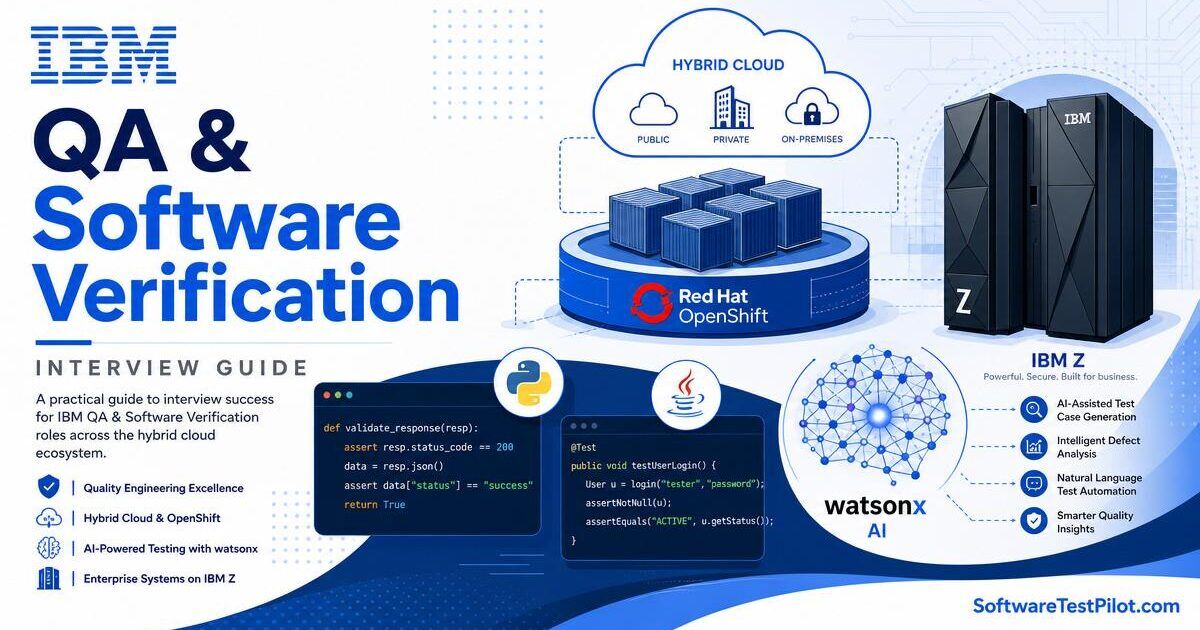
Securing an interview for a Software Verification Engineer (Band 7 / Band 8) or Quality Automation Specialist role at IBM places you inside the centennial institution of global computing. Operating hybrid cloud platforms through Red Hat OpenShift, enterprise artificial intelligence via IBM watsonx, mainframes (IBM Z), and enterprise storage clusters across Fortune 500 banks and governments requires industrial reliability.
At IBM, software verification spans complex Linux container clusters, enterprise hybrid cloud networking, and AI model evaluation.
When you scan live requisitions on our internal SoftwareTestPilot QA Jobs Radar offering $125,000 to $175,000+ base salaries in North America ($220,000+ Total Comp) and ₹16 Lakhs to ₹34 Lakhs+ INR CTC across Indian R&D Labs (Bangalore, Hyderabad, Pune, Kochi), notice that IBM evaluates quality talent on Python automation, Linux/OpenShift infrastructure, and AI evaluation.
To pass the IBM quality screening loop in 2026, you must demonstrate strong coding fluency in Python or Java, understand container orchestration, design automated hybrid cloud pipelines, and showcase enterprise rigor.
Here is an exhaustive, deconstructed guide to the exact IBM quality engineering interview loop, reported 2026 compensation bands across US Dollars ($) and Indian Rupees (₹), the top five technical coding prompts asked during onsite screens, and exactly 9 detailed FAQs paired with complete JSON-LD schema.
1. The Exact IBM QA & Verification Interview Loop Deconstructed
IBM’s recruitment process evaluates technical execution, hybrid cloud fluency, and rigorous collaborative alignment. For mid-level (Band 7) and senior (Band 8) verification roles, expect a structured 4-stage evaluation loop:
+-----------------------------------------------------------------------------------+
| THE IBM BAND 7 / BAND 8 QUALITY RECRUITMENT LIFECYCLE |
+-----------------------------------------------------------------------------------+
| STAGE 1: TALENT ACQUISITION SCREENING (30 - 45 Minutes) |
| - Verifying Python/Java coding proficiency, hybrid cloud (OpenShift/AWS) exposure,|
| location readiness (Armonk, Austin, Bangalore, Hyderabad), and compensation. |
+-----------------------------------------------------------------------------------+
| STAGE 2: TECHNICAL SCREENING / ONLINE CODING ROUND (60 Minutes) |
| - Live coding over HackerRank or Webex. Solving a practical Python string/array |
| parsing problem + technical discussion around Linux containers and API testing. |
+-----------------------------------------------------------------------------------+
| STAGE 3: THE 3 TO 4-ROUND ONSITE TECHNICAL LOOP (Executed over 1 day via Webex) |
| ├── Round 1: Data Structures & Algorithms (Clean Python/Java code). |
| ├── Round 2: Test Architecture & Red Hat OpenShift Cloud System Design. |
| ├── Round 3: Practical Framework Coding (Playwright / REST API testing). |
| └── Round 4: Engineering Manager / Product Owner Fit (IBM Core Values & Agile). |
+-----------------------------------------------------------------------------------+
| STAGE 4: HIRING CONSENSUS & VP ALIGNMENT |
| - Engineering managers review technical scores and hybrid cloud suitability. |
+-----------------------------------------------------------------------------------+
2. Reported 2026 IBM QA & Verification Compensation Matrix
Aggregating self-reported filings from Levels.fyi, AmbitionBox, and SoftwareTestPilot Jobs Radar reveals where IBM compensation sits across internal Band levels in both United States ($ USD) and India (₹ INR CTC) R&D hubs.
| IBM Band Level | Job Title Equivalent | North America Base Salary ($ USD) | North America Total Comp ($ USD) | India R&D Labs Base / Total (₹ INR CTC) | Core Role Responsibilities |
|---|---|---|---|---|---|
| Band 6 | Staff Quality Engineer | $88,000 – $110,000 | $105,000 – $130,000 | ₹8.0L – ₹13.0L / ₹10L – ₹15L CTC | Executing Python/Java scripts, REST API regression, Linux triage. |
| Band 7 | Advisory Quality Eng / SDET | $115,000 – $142,000 | $140,000 – $175,000 | ₹16.0L – ₹23.0L / ₹18L – ₹26L CTC | POM architecture, RestAssured suites, OpenShift CI/CD runs. |
| Band 8 | Senior Staff Quality Eng | $142,000 – $175,000 | $180,000 – $230,000 | ₹24.0L – ₹34.0L / ₹30L – ₹44L+ CTC | Hybrid cloud framework design, watsonx AI evaluation, API mocks. |
| Band 9 | Senior Technical Staff (STSM) | $180,000 – $220,000+ | $245,000 – $320,000+ | ₹36.0L – ₹50.0L+ / ₹48L – ₹68L+ CTC | Enterprise IBM cloud infrastructure V&V, hybrid cloud quality scale. |
3. Top 5 Technical & Coding Questions Asked at IBM
During onsite screens, IBM evaluators test Python automation, Linux container diagnostics, and hybrid cloud verification. Here are five top technical questions asked during IBM verification loops.
Question 1: OpenShift Container Pod Restart Auditor ($O(N)$ Parsing)
Prompt: "Red Hat OpenShift clusters emit pod health telemetry logs formatted as[TIMESTAMP] [NAMESPACE] [POD_NAME] [RESTART_COUNT] [STATUS]. Write a Python method that identifies anyPOD_NAMEwhereRESTART_COUNTincreased by more than 3 restarts across a rolling 5-minute window whileSTATUSequaledCrashLoopBackOff."
# Production Python Solution: Clean Hash Map Parsing & Windowed Audit
from collections import defaultdict
from typing import List, Set, Tuple

class PodRestartHistory:
 def __init__(self):
 self.events: List[Tuple[int, int]] = [] # List of (timestamp, restart_count)

def detect_unstable_openshift_pods(telemetry_logs: List[str]) -> List[str]:
 pod_map = defaultdict(PodRestartHistory)
 unstable_pods: Set[str] = set()

 for log in telemetry_logs:
 if not log or not log.strip():
 continue
 tokens = log.strip().split()
 if len(tokens) < 5:
 continue

 timestamp = int(tokens[0])
 pod_name = tokens[2]
 restart_count = int(tokens[3])
 status = tokens[4]

 if status != "CrashLoopBackOff":
 continue

 history = pod_map[pod_name].events
 history.append((timestamp, restart_count))

 # Check rolling 5-minute window (300 seconds = 300,000ms)
 # Compare current restart count against oldest event in window
 while history and (timestamp - history[0][0]) > 300000:
 history.pop(0)

 if history and (restart_count - history[0][1]) >= 3:
 unstable_pods.add(pod_name)

 return list(unstable_pods)
Question 2: Testing IBM watsonx AI Generative Prompt Responses
Prompt: "IBM watsonx AI outputs generative enterprise responses. How do you design an automated test harness that verifies whether watsonx models generate deterministic factual answers without leaking confidential training prompts?"
Architectural Solution: To verify AI enterprise models reliably:
- Programmatically inject structured prompt injection attacks and adversarial boundary inputs using Python request suites.
- Implement automated semantic similarity evaluation (using cosine distance embeddings or exact JSON contract validation) against reported gold-standard reference answers.
- Assert strict response filtering: verify that system guardrails block PII or proprietary prompt leaks before returning HTTP
200 OK.
Question 3: Playwright Automation for IBM Cloud Console
Prompt: "Write a clean Playwright TypeScript test verifying that an IBM Cloud administrator can navigate to the Kubernetes cluster dashboard and assert cluster active status."
// Production Playwright TypeScript IBM Cloud Console Suite
import {test, expect} from'@playwright/test';

test('Should verify Red Hat OpenShift cluster status deterministically', async ({page}) => {
 await page.goto('https://cloud.ibm.com/kubernetes/clusters');

 // Filter cluster list using immutable data testing locators
 const searchInput = page.locator('[data-testid="cluster-search-input"]');
 await searchInput.fill('QA-OpenShift-Staging-2026');

 // Assert target cluster row renders and status badge reads normal
 const clusterRow = page.locator('[data-testid="cluster-row-QA-OpenShift-Staging-2026"]');
 await expect(clusterRow).toBeVisible();

 const statusBadge = clusterRow.locator('[data-testid="cluster-status-badge"]');
 await expect(statusBadge).toHaveText('Normal', {timeout: 15000});
});
Question 4: Debugging Linux Container Network Latency inside OpenShift
Prompt: "An automated API test suite verifying microservices deployed inside Red Hat OpenShift passes locally but fails intermittently with ECONNRESET during high-volume CI runs. How do you troubleshoot this?"
Technical Breakdown: Explain that Linux container software overlay networks (OpenShift SDN / OVN-Kubernetes) suffer packet drops when ephemeral TCP port exhaustion occurs under high test burst concurrency. Refactor HTTP client connection pooling to reuse keep-alive sockets (Connection: keep-alive), adjust container DNS lookup timeouts, and implement exponential backoff retry wrappers.
Question 5: Test Strategy for Mainframe IBM Z Hybrid Cloud Storage Sync
Prompt: "How do you design a quality verification plan for IBM Z mainframe DB2 transactional data replicating asynchronously into IBM Cloud Object Storage?"
Apply the ACCORD Whiteboard Framework:
- Architecture: Assert REST/Kafka ingestion stream contracts over automated mocking endpoints.
- Concurrency: Verify data synchronization queues when 50,000 DB2 transactions commit simultaneously.
- Data State: Pre-seed mainframe DB2 schemas via Python JDBC wrappers before storage assertion.
4. System Design for Quality at IBM Cloud Scale
During Round 2 (System Design), IBM evaluators test your ability to build hybrid cloud test infrastructure.
The Whiteboard Prompt:
"Design a continuous integration automation harness capable of executing overnight regression cycles across 10 distinct Red Hat OpenShift hybrid cloud tenant environments without data collision."
+-----------------------------------------------------------------------------------+
| MULTI-TENANT IBM OPENSHIFT CLOUD TEST HARNESS |
+-----------------------------------------------------------------------------------+
| [GITHUB ACTIONS / TEKTON CRON] ---> Initiates Nightly Cloud Regression Cycle |
| | |
| v |
| [OPENSHIFT EPHEMERAL TEST PODS (DYNAMIC SHARDING)] |
| - Automatically provisions 50 ephemeral Python / Playwright container pods. |
| - Shards 15,000 API and UI regression checks across parallel container pods. |
| | |
| v |
| [REST API TEST DATA FACTORY] |
| - Pre-seeds transaction records via high-speed REST batches into isolated schemas.|
| - Guarantees zero data collisions across parallel cluster execution environments. |
| | |
| v |
| [AUTOMATED TEARDOWN & CLOUD TELEMETRY] |
| - Purges test records post-run -> Emails visual Allure report to IBM leads! |
+-----------------------------------------------------------------------------------+
5. Your 30-Day IBM Interview Turnaround Plan
To prepare for your IBM onsite loop, upload your resume immediately to our SoftwareTestPilot ATS Resume Reviewer. Ensure your bullet points highlight Python, Java, Red Hat OpenShift, Playwright, and hybrid cloud verification keywords ("Architected OpenShift regression harness evaluating 15,000 hybrid cloud workflows").
. Practice articulating your container networking and AI evaluation trade-offs out loud before facing executive IBM quality leads.
### Preparing For IBM Quality Interviews? Share This Guide! IBM loops require deep hybrid cloud and Python clarity.[LinkedIn] or [X/Twitter]. .
Frequently asked questions
1.How long does the entire IBM QA & Verification interview process take in 2026?
2.Is LeetCode required for Software Verification Engineer roles at IBM?
3.What is the average compensation for a Senior Verification Engineer (Band 8) at IBM in US vs India?
4.Can I interview in Python or Playwright, or does IBM strictly require Java?
5.How strict is IBM on academic degrees versus commercial cloud certifications?
6.What is the cool-off period if I get rejected after the IBM onsite loop?
7.Does IBM allow remote work for QA and automation engineers in 2026?
8.How should I tailor my resume specifically for IBM ATS parsers?
9.What is the #1 reason experienced QA engineers fail the IBM technical screen?
Was this article helpful?
Keep building your QA edge
Pillar guides- SDET Rolebecome an SDET in 2026What SDETs actually do — skills, salary bands, and interview prep for 2026.
- Company QA Interview Guidessee how top tech firms interview QAReal interview loops from Google, Amazon, Meta, Apple, Microsoft, Adobe, and 40+ other tech employers.
- Automation QA Engineer RoleAutomation QA Engineer roleAutomation QA Engineer job scope, tools, salary, and hiring pipeline.