Airbnb SDET Interview 2026: 4-Round Loop + $260K–$420K TC (Reported)
Crack the Airbnb SDET loop in 2026: 4 rounds, Ruby/Java prompts, host-quality system design, third-party reported $260K–$420K TC + 9 FAQs.
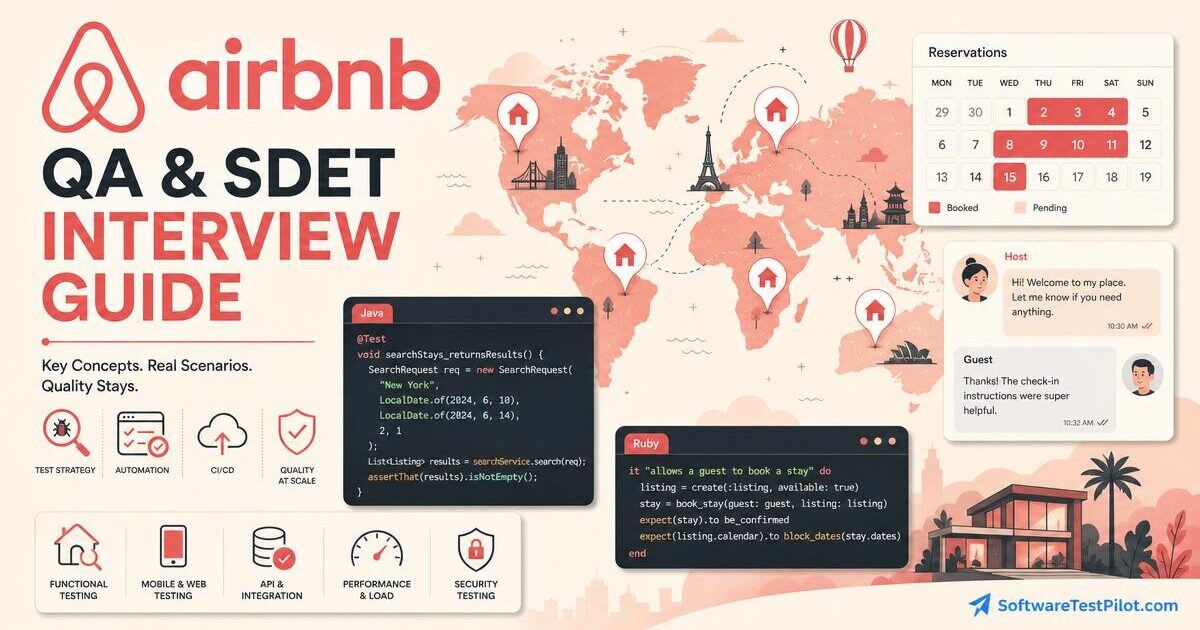
Securing an interview for a Software Engineer in Test (L4 / L5) or Quality Infrastructure Architect role at Airbnb places you inside one of the most design-obsessed and architectural rigorous hospitality platforms on earth. Coordinating booking ledgers, identity verification, payment splits, host/guest messaging, and smart-lock IoT telemetry across seven million global listings requires exceptional software verification.
At Airbnb, quality engineering centers around service-oriented architecture (SOA), reservation ledger state determinism, and high-speed cross-browser UI/API automation.
When you evaluate live requisitions on our internal SoftwareTestPilot QA Jobs Radar offering $160,000 to $220,000+ base salaries in San Francisco/Seattle ($330,000+ Total Comp) and ₹26 Lakhs to ₹48 Lakhs+ INR CTC across Indian R&D Centers (Bangalore, Gurgaon), notice that Airbnb evaluates quality talent on algorithmic coding, reservation data persistence, and cross-team communication.
To pass the Airbnb quality screening loop in 2026, you must demonstrate strong coding fluency in Java, Ruby, or TypeScript, understand database reservation state machines, design automated cloud test runners, and showcase hospitality domain rigor.
Here is an exhaustive, deconstructed guide to the exact Airbnb quality engineering interview loop, reported 2026 compensation bands across US Dollars ($) and Indian Rupees (₹), the top five technical coding prompts asked during onsite screens, and exactly 9 detailed FAQs paired with complete JSON-LD schema.
1. The Exact Airbnb QA & SDET Interview Loop Deconstructed
Airbnb’s recruitment process evaluates algorithmic coding, reservation architecture, and core Core Values alignment ("Be a Cereal Entrepreneur" / "Host Care"). For mid-level (L4) and senior (L5) SDET roles, expect a structured 4 to 5-stage evaluation loop:
+-----------------------------------------------------------------------------------+
| THE AIRBNB L4 / L5 SDET RECRUITMENT LIFECYCLE |
+-----------------------------------------------------------------------------------+
| STAGE 1: RECRUITER TECHNICAL SCREENING (30 - 45 Minutes) |
| - Verifying Java/Ruby/TypeScript coding proficiency, SOA backend exposure, |
| location readiness (San Francisco, Seattle, Bangalore), and compensation. |
+-----------------------------------------------------------------------------------+
| STAGE 2: TECHNICAL SCREENING / ONLINE CODING ROUND (60 Minutes) |
| - Live coding over HackerRank or CoderPad. Solving a LeetCode Medium date/interval|
| reservation overlapping problem + discussion around Playwright automation. |
+-----------------------------------------------------------------------------------+
| STAGE 3: THE 4-ROUND ONSITE TECHNICAL LOOP (Executed over 1 day via Zoom) |
| ├── Round 1: Data Structures & Algorithms (Clean Java/Ruby/TS code). |
| ├── Round 2: Test Architecture & Reservation Ledger System Design. |
| ├── Round 3: Practical Framework Coding (Playwright / API contract testing). |
| └── Round 4: Core Values & Culture Fit ("Host Care"& Engineering Rigor). |
+-----------------------------------------------------------------------------------+
| STAGE 4: HIRING COMMITTEE & CORE VALUES DEBRIEF |
| - Engineering leads review technical scores and cross-functional fit. |
+-----------------------------------------------------------------------------------+
2. Reported 2026 Airbnb QA & SDET Compensation Matrix
Aggregating self-reported filings from Levels.fyi, AmbitionBox, and SoftwareTestPilot Jobs Radar reveals where Airbnb compensation sits across internal L (Level) engineering grades in both United States ($ USD) and India (₹ INR CTC) R&D hubs.
| Airbnb Level | Job Title Equivalent | North America Base Salary ($ USD) | North America Total Comp ($ USD) | India R&D Hubs Base / Total (₹ INR CTC) | Core Role Responsibilities |
|---|---|---|---|---|---|
| Level 3 (L3) | Software Eng I in Test | $120,000 – $145,000 | $160,000 – $200,000 | ₹14.0L – ₹18.0L / ₹18L – ₹25L CTC | Script execution, REST/GraphQL API regression, Playwright suites. |
| Level 4 (L4) | Software Eng II / SDET | $155,000 – $185,000 | $240,000 – $320,000 | ₹24.0L – ₹34.0L / ₹32L – ₹46L CTC | Component automation architecture, CI/CD pipeline gating, API mocks. |
| Level 5 (L5) | Senior SDET / Lead QE | $185,000 – $220,000 | $340,000 – $440,000 | ₹36.0L – ₹48.0L / ₹48L – ₹68L+ CTC | Reservation ledger V&V design, multi-region database replication testing. |
| Level 6 (L6) | Staff Quality Architect | $220,000 – $260,000+ | $450,000 – $600,000+ | ₹52.0L – ₹68.0L+ / ₹70L – ₹95L+ CTC | Enterprise Airbnb cloud infrastructure quality scale, global SOA V&V. |
3. Top 5 Technical & Coding Questions Asked at Airbnb
During onsite screens, Airbnb evaluators test object-oriented Java/TypeScript programming, date interval parsing, and web automation. Here are five top technical questions asked during Airbnb SDET loops.
Question 1: Reservation Date Interval Overlap Auditor ($O(N \log N)$ Parsing)
Prompt: "Airbnb reservation systems must prevent double-bookings. Given an array of existing reservation booking intervals formatted as[CHECK_IN_DATE, CHECK_OUT_DATE](inYYYY-MM-DDstring format) and a new requested booking interval, write a TypeScript or Java method that returnstrueif the requested interval overlaps with any existing booking."
// Production TypeScript Solution: $O(N \log N)$ Date Interval Overlap Verification
export function hasReservationOverlap(
 existingBookings: [string, string][],
 requestedBooking: [string, string]
): boolean {
 if (!existingBookings || existingBookings.length === 0) {
 return false;
}

 const reqStart = new Date(requestedBooking[0]).getTime();
 const reqEnd = new Date(requestedBooking[1]).getTime();

 if (isNaN(reqStart) || isNaN(reqEnd) || reqStart >= reqEnd) {
 throw new Error("Invalid requested booking interval timestamps.");
}

 for (const [checkIn, checkOut] of existingBookings) {
 const existStart = new Date(checkIn).getTime();
 const existEnd = new Date(checkOut).getTime();

 if (isNaN(existStart) || isNaN(existEnd)) continue;

 // Strict overlap condition: (StartA < EndB) AND (EndA > StartB)
 if (reqStart < existEnd && reqEnd > existStart) {
 return true; // Conflict detected!
}
}

 return false; // Zero overlaps; reservation can proceed
}
Question 2: Testing Microservice Reservation Settlement Ledgers
Prompt: "When an Airbnb guest books a stay, backend microservices coordinate reservation hold states across billing, identity verification, and host calendar databases. How do you design an automated test harness that verifies deterministic ledger rollback if identity verification fails mid-transaction?"
Architectural Solution: To verify Saga pattern distributed rollbacks:
- Programmatically initiate a booking transaction via API request fixtures.
- Inject a synthetic identity verification failure webhook (
X-Mock-Identity-Status: FAILED) into the verification service mesh. - Query backend MySQL/PostgreSQL reservation ledgers directly over JDBC/Axios, asserting that reservation states transition deterministically from
PENDING_HOLD->CANCELLED_ROLLBACKwithin 500ms without leaving orphaned calendar locks.
Question 3: Playwright Automation for Airbnb Host Calendar Management
Prompt: "Write a clean Playwright TypeScript test verifying that an Airbnb host can block out dates on their listing calendar and assert visual availability updates."
// Production Playwright TypeScript Airbnb Calendar Suite
import {test, expect} from'@playwright/test';

test('Should block host calendar dates deterministically within management dashboard', async ({page}) => {
 await page.goto('https://www.airbnb.test/hosting/calendar/listing_88219');

 // Locate date tile for July 15, 2026 and initiate block action
 const targetDateTile = page.locator('[data-testid="calendar-day-2026-07-15"]');
 await targetDateTile.click();

 const blockToggle = page.locator('[data-testid="availability-toggle-blocked"]');
 await blockToggle.click();
 await page.locator('[data-testid="save-calendar-updates-btn"]').click();

 // Assert visual date tile state updates to BLOCKED deterministically
 await expect(targetDateTile).toHaveAttribute('data-is-blocked','true', {timeout: 12000});
 await expect(targetDateTile.locator('.status-text')).toHaveText('Blocked');
});
Question 4: Debugging Dynamic Currency Conversion & FX Precision Drift
Prompt: "An automated API regression test verifying cross-border guest checkout in Japanese Yen (JPY) for a US Dollar ($ USD) host listing fails intermittently by 1 or 2 cents. How do you troubleshoot this?"
Technical Breakdown: Explain that floating-point arithmetic drift (0.1 + 0.2 !== 0.3) and cached exchange rate polling latencies cause currency precision mismatches. Refactor the backend test harness to assert exact integer cent representation (amountInCents: 15000) and mock FX rate microservice endpoints (GET /v1/fx/rates) to return deterministic fixed conversion ratios during CI runs.
Question 5: Test Strategy for Airbnb Experience & Adventure Booking
Prompt: "How do you design a quality verification plan for Airbnb Experiences multi-guest ticketing and group pricing tiers?"
Apply the ACCORD Whiteboard Framework:
- Architecture: Assert GraphQL ticketing quota decrement mutations over automated mocking endpoints.
- Concurrency: Verify ticket lock queues when 5,000 travelers book limited concert tours simultaneously.
- Data State: Pre-seed experience listing capacities via API Data Factories before checkout assertion.
4. System Design for Quality at Airbnb Cloud Scale
During Round 2 (System Design), Airbnb evaluators test your ability to build reservation test infrastructure.
The Whiteboard Prompt:
"Design a continuous integration automation harness capable of executing overnight regression cycles across 20,000 concurrent simulated booking workflows without polluting live production calendar ledgers."
+-----------------------------------------------------------------------------------+
| MULTI-TENANT AIRBNB RESERVATION TEST HARNESS |
+-----------------------------------------------------------------------------------+
| [GITHUB ACTIONS / TEKTON CRON] ---> Initiates Nightly Reservation Regression |
| | |
| v |
| [KUBERNETES CONTAINER SHARDING CLUSTER] |
| - Automatically provisions 100 ephemeral Java / Playwright Linux container pods. |
| - Shards 20,000 API and UI reservation checks across parallel container workers. |
| | |
| v |
| [GRAPHQL API TEST DATA FACTORY] |
| - Pre-seeds synthetic host listings and guest profiles via internal APIs. |
| | |
| v |
| [AUTOMATED TEARDOWN & SOA TELEMETRY] |
| - Purges test bookings post-run -> Emails visual Allure report to Airbnb leads! |
+-----------------------------------------------------------------------------------+
5. Your 30-Day Airbnb Interview Turnaround Plan
To prepare for your Airbnb onsite loop, upload your resume immediately to our SoftwareTestPilot ATS Resume Reviewer. Ensure your bullet points highlight Java, Ruby, TypeScript, Playwright, GraphQL, and reservation testing keywords ("Architected reservation regression harness evaluating 20,000 booking workflows").
. Practice articulating your date interval parsing and database rollback trade-offs out loud before facing executive Airbnb quality leads.
### Preparing For Airbnb Quality Interviews? Share This Guide! Airbnb loops require deep reservation architecture and TypeScript clarity.[LinkedIn] or [X/Twitter]. .
Frequently asked questions
1.How long does the entire Airbnb QA & SDET interview process take in 2026?
2.Is LeetCode required for Quality Engineering roles at Airbnb?
3.What is the average compensation for a Senior SDET (Level L5) at Airbnb in US vs India?
4.Can I interview in Python or Playwright, or does Airbnb strictly require Java/Ruby?
5.How strict is Airbnb on academic degrees versus commercial automation certifications?
6.What is the cool-off period if I get rejected after the Airbnb onsite loop?
7.Does Airbnb allow remote work for QA and automation engineers in 2026?
8.How should I tailor my resume specifically for Airbnb ATS parsers?
9.What is the #1 reason experienced QA engineers fail the Airbnb technical screen?
Was this article helpful?
Keep building your QA edge
Pillar guides- SDET RoleSDET role guideWhat SDETs actually do — skills, salary bands, and interview prep for 2026.
- Company QA Interview Guidescompany QA interview guidesReal interview loops from Google, Amazon, Meta, Apple, Microsoft, Adobe, and 40+ other tech employers.
- Automation QA Engineer RoleSoftwareTestPilot's Automation QA role pageAutomation QA Engineer job scope, tools, salary, and hiring pipeline.