Adobe QA & SDET Interview 2026: 4-Round Loop + $180K–$310K TC
Land an Adobe SDET offer in 2026: exact 4-round loop, C++/TypeScript prompts, third-party reported $180K–$310K TC + ₹20–55 LPA India CTC, 9 FAQs.
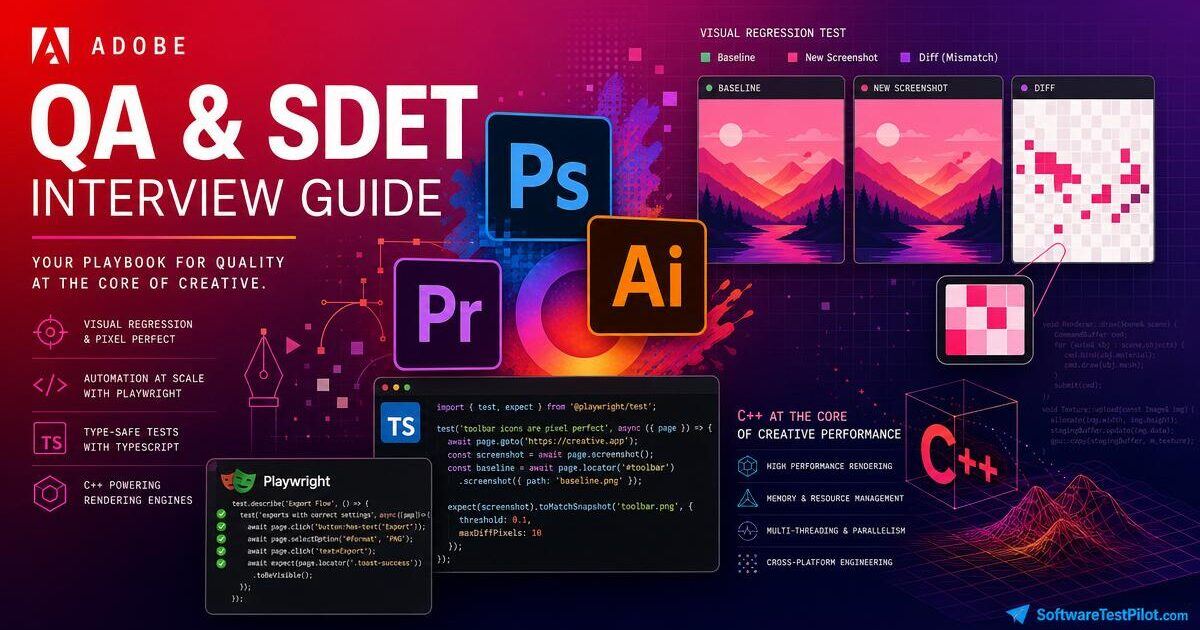
Securing an interview for a Quality Engineer (QE), Software Development Engineer in Test (SDET), or Computer Scientist (Quality) role at Adobe places you inside one of the most enduring and architecturally sophisticated SaaS giants in the tech industry. Powering the creative workflows of tens of millions of designers, filmmakers, and enterprise marketers through Creative Cloud (Photoshop, Premiere Pro, Illustrator), Document Cloud (Acrobat/Sign), and Experience Cloud requires flawless performance across desktop rendering engines and cloud APIs.
At Adobe, software verification spans both complex native desktop C++ rendering engines and high-concurrency cloud browser applications (Adobe Express, Firefly generative AI).
When you scan live requisitions on our internal SoftwareTestPilot QA Jobs Radar offering $135,000 to $185,000+ base salaries in the US ($220,000+ Total Comp) and ₹18 Lakhs to ₹38 Lakhs+ INR CTC across Indian R&D centers (Noida, Bangalore), notice that Adobe evaluates quality talent on algorithmic clean coding, pixel-perfect visual regression architecture, and cross-platform memory management.
To pass the Adobe quality screening loop in 2026, you must demonstrate strong coding fluency in TypeScript or C++/Java, understand visual canvas diffing algorithms, design automated cloud CI pipelines, and showcase obsessive attention to user experience precision.
Here is an exhaustive, deconstructed guide to the exact Adobe quality engineering interview loop, reported 2026 compensation bands across US Dollars ($) and Indian Rupees (₹), the top five technical coding prompts asked during onsite screens, and exactly 9 detailed FAQs paired with complete JSON-LD schema.
1. The Exact Adobe QA & SDET Interview Loop Deconstructed
Adobe’s recruitment process evaluates algorithmic coding, system architecture, and deep collaborative culture alignment. For mid-level (P2 / CS II) and senior (P3 / Senior CS) SDET roles, expect a structured 4 to 5-stage evaluation loop:
+-----------------------------------------------------------------------------------+
| THE ADOBE P2 / P3 SDET RECRUITMENT LIFECYCLE |
+-----------------------------------------------------------------------------------+
| STAGE 1: TALENT ACQUISITION SCREENING (30 - 45 Minutes) |
| - Verifying C++/TypeScript/Java coding proficiency, cloud vs desktop exposure, |
| location readiness (San Jose, Seattle, Noida, Bangalore), and compensation. |
+-----------------------------------------------------------------------------------+
| STAGE 2: TECHNICAL SCREENING / ONLINE CODING ROUND (60 Minutes) |
| - Live coding over HackerRank or MS Teams. Solving a LeetCode Medium string/tree |
| problem + technical discussion around visual regression and CI/CD pipelines. |
+-----------------------------------------------------------------------------------+
| STAGE 3: THE 4-ROUND ONSITE TECHNICAL LOOP (Executed over 1 day via Teams/Zoom) |
| ├── Round 1: Data Structures & Algorithms (Clean code, optimization, $O(N)$). |
| ├── Round 2: Test Architecture & Visual Verification System Design. |
| ├── Round 3: Practical Framework Coding (Playwright / API contract testing). |
| └── Round 4: Engineering Director / Manager Fit (Adobe Core Values & Ownership).|
+-----------------------------------------------------------------------------------+
| STAGE 4: HIRING COMMITTEE & VP DEBRIEF |
| - Engineering leads convene to review code cleanliness and cultural alignment. |
+-----------------------------------------------------------------------------------+
2. Reported 2026 Adobe QA & SDET Compensation Matrix
Aggregating self-reported filings from Levels.fyi, AmbitionBox, and SoftwareTestPilot Jobs Radar reveals where Adobe compensation sits across internal numerical grade levels in both United States ($ USD) and India (₹ INR CTC) R&D hubs.
| Adobe Level | Job Title Equivalent | North America Base Salary ($ USD) | North America Total Comp ($ USD) | India R&D Hubs Base / Total (₹ INR CTC) | Core Role Responsibilities |
|---|---|---|---|---|---|
| Level P1 / CS I | Quality Engineer I | $105,000 – $125,000 | $135,000 – $165,000 | ₹12.0L – ₹16.0L / ₹15L – ₹20L CTC | Script execution, Playwright test creation, API verification. |
| Level P2 / CS II | SDET / Quality Eng II | $135,000 – $160,000 | $185,000 – $235,000 | ₹18.0L – ₹26.0L / ₹24L – ₹35L CTC | Component automation architecture, CI/CD pipeline gating, API mocks. |
| Level P3 / Sr CS | Senior SDET / Lead QE | $165,000 – $195,000 | $250,000 – $330,000 | ₹28.0L – ₹38.0L / ₹38L – ₹55L+ CTC | Visual regression engine design, multi-cloud testing governance. |
| Level P4 / Principal | Principal Quality Architect | $195,000 – $235,000+ | $350,000 – $480,000+ | ₹42.0L – ₹55.0L+ / ₹60L – ₹85L+ CTC | Cross-cloud generative AI verification (Firefly), enterprise V&V. |
3. Top 5 Technical & Coding Questions Asked at Adobe
During onsite screens, Adobe evaluators test algorithmic cleanliness, canvas graphics diffing logic, and asynchronous web automation. Here are five top technical questions asked during Adobe SDET loops.
Question 1: Canvas Graphics Layer Anomaly Detection ($O(N)$ Parsing)
Prompt: "Adobe Creative Cloud web applications output canvas rendering telemetry strings formatted as[TIMESTAMP] [CANVAS_ID] [RENDER_TIME_MS] [MEMORY_MB]. Write a TypeScript or Java method that identifies anyCANVAS_IDwhere averageRENDER_TIME_MSexceeded 16.6ms (60 FPS threshold) across at least 5 rendering frames."
// Production TypeScript Solution: $O(N)$ Single-Pass Aggregation
interface CanvasRenderStats {
 totalRenderTimeMs: number;
 frameCount: number;
}

export function detectSluggishCanvasLayers(telemetryLogs: string[]): string[] {
 const canvasMap = new Map<string, CanvasRenderStats>();
 const sluggishLayers = new Set<string>();

 for (const log of telemetryLogs) {
 if (!log || log.trim() ==='') continue;
 const parts = log.trim().split(/\s+/);
 if (parts.length < 4) continue;

 const canvasId = parts[1];
 const renderTimeMs = parseFloat(parts[2]);

 if (isNaN(renderTimeMs)) continue;

 if (!canvasMap.has(canvasId)) {
 canvasMap.set(canvasId, {totalRenderTimeMs: 0, frameCount: 0});
}

 const stats = canvasMap.get(canvasId)!;
 stats.totalRenderTimeMs += renderTimeMs;
 stats.frameCount += 1;

 // Evaluate 60 FPS frame drop condition (1000ms / 60 frames = 16.66ms per frame)
 if (stats.frameCount >= 5) {
 const averageRenderTime = stats.totalRenderTimeMs / stats.frameCount;
 if (averageRenderTime > 16.66) {
 sluggishLayers.add(canvasId);
}
}
}

 return Array.from(sluggishLayers);
}
Question 2: Designing a Pixel-Perfect Visual Regression Engine
Prompt: "How do you architect an automated visual regression testing engine for Adobe Photoshop Web that distinguishes between genuine UI layout defects and harmless anti-aliasing color rendering differences across OS GPUs?"
Architectural Solution: To prevent false-positive visual flakiness:
- Execute screenshots inside standardized headless Docker containers (
mcr.microsoft.com/playwright) to ensure identical Linux font kerning and CPU rasterization. - Implement perceptual color-distance image diffing algorithms (such as pixelmatch utilizing YIQ color space) with a strict color threshold threshold (
threshold: 0.1). - Programmatically apply dynamic masking locators over non-deterministic canvas layers (such as live generative AI output tiles or user cursors) prior to diffing.
Question 3: Playwright Automation for Web Canvas Tool Selection
Prompt: "Write a clean Playwright TypeScript test verifying that selecting the'Pen Tool'in an Adobe web canvas editor updates the active tool state and displays correct inspector properties."
// Production Playwright TypeScript Creative Cloud Suite
import {test, expect} from'@playwright/test';

test('Should select Pen Tool deterministically and update inspector properties', async ({page}) => {
 await page.goto('https://express.adobe.test/canvas/proj_881');

 // Locate toolbar and select Pen Tool using immutable testing attributes
 const penToolBtn = page.locator('[data-testid="tool-btn-pen"]');
 await penToolBtn.click();

 // Assert toolbar visual state active feedback
 await expect(penToolBtn).toHaveAttribute('aria-pressed','true');

 // Assert properties panel renders stroke width controls deterministically
 const strokeInspector = page.locator('[data-testid="inspector-stroke-width"]');
 await expect(strokeInspector).toBeVisible();
 await expect(strokeInspector).toHaveValue('2px');
});
Question 4: Debugging C++ Desktop to Web Cloud Sync Conflicts
Prompt: "An automated integration suite testing file synchronization between desktop Photoshop (C++) and Creative Cloud web storage fails intermittently with file lock race conditions. How do you troubleshoot this?"
Technical Breakdown: Explain that local OS file handles outlive rapid cloud API sync events. Replace arbitrary sleeps with Idempotent API Polling Loops against Document Cloud REST endpoints (GET /v2/files/{id}/sync_status), pausing browser actions until cloud file state explicitly returns SYNCED.
Question 5: Test Strategy for Adobe Firefly Generative AI
Prompt: "How do you design a quality verification plan for Adobe Firefly Text-to-Image generative AI prompts across web and mobile interfaces?"
Apply the ACCORD Whiteboard Framework:
- Architecture: Assert prompt sanitization and safety guardrails at the API network gateway.
- Concurrency: Verify GPU inference queue stability when 10,000 users request image generation simultaneously.
- Observability: Assert that generated image metadata properly embeds Content Credentials (C2PA) provenance tags.
4. System Design for Quality at Adobe Cloud Scale
During Round 2 (System Design), Adobe evaluators test your ability to build visual verification infrastructure.
The Whiteboard Prompt:
"Design a continuous visual regression test harness capable of evaluating 25,000 UI component screens across Adobe Experience Cloud web applications overnight."
+-----------------------------------------------------------------------------------+
| ADOBE EXPERIENCE CLOUD VISUAL HARNESS |
+-----------------------------------------------------------------------------------+
| [GITHUB ACTIONS CRON OR PR TRIGGER] ---> Initiates Visual Verification Pipeline |
| | |
| v |
| [EPHEMERAL DOCKER PLAYWRIGHT CLUSTER] |
| - Provisions 100 isolated Linux containers with fixed font rendering libraries. |
| - Executes component snapshots across 25,000 screens in parallel (~250/pod). |
| | |
| v |
| [PERCEPTUAL YIQ COLOR DIFFING ENGINE] |
| - Evaluates baseline snapshots against new captures using strict pixel thresholds.|
| - Filters out minor GPU anti-aliasing noise automatically! |
| | |
| v |
| [VISUAL REVIEW REPORT DASHBOARD] |
| - Generates composite visual diff overlay UI -> Posts PR summary comment! |
+-----------------------------------------------------------------------------------+
5. Your 30-Day Adobe Interview Turnaround Plan
To prepare for your Adobe onsite loop, upload your resume immediately to our SoftwareTestPilot ATS Resume Reviewer. Ensure your bullet points highlight TypeScript, C++, visual regression, Playwright, and cloud sync keywords ("Architected visual regression suite across 10,000 Creative Cloud components").
. Practice articulating your visual diffing algorithms and TypeScript fluency out loud before facing executive Adobe quality leads.
### Preparing For Adobe Quality Interviews? Share This Guide! Adobe loops require deep visual and architectural precision.[LinkedIn] or [X/Twitter]. .
Frequently asked questions
1.How long does the entire Adobe QA & SDET interview process take in 2026?
2.Is LeetCode required for Quality Engineering roles at Adobe?
3.What is the average compensation for a Senior SDET (Level P3) at Adobe in US vs India?
4.Can I interview in Python or Playwright, or does Adobe strictly require C++?
5.How strict is Adobe on academic Computer Science degrees versus practical portfolios?
6.What is the cool-off period if I get rejected after the Adobe onsite loop?
7.Does Adobe allow remote work for QA and automation engineers in 2026?
8.How should I tailor my resume specifically for Adobe ATS parsers?
9.What is the #1 reason experienced QA engineers fail the Adobe technical screen?
Was this article helpful?
Keep building your QA edge
Pillar guides- SDET Rolebecome an SDET in 2026What SDETs actually do — skills, salary bands, and interview prep for 2026.
- Company QA Interview GuidesQA interview questions by companyReal interview loops from Google, Amazon, Meta, Apple, Microsoft, Adobe, and 40+ other tech employers.
- Automation QA Engineer Roleexplore this role in depthAutomation QA Engineer job scope, tools, salary, and hiring pipeline.