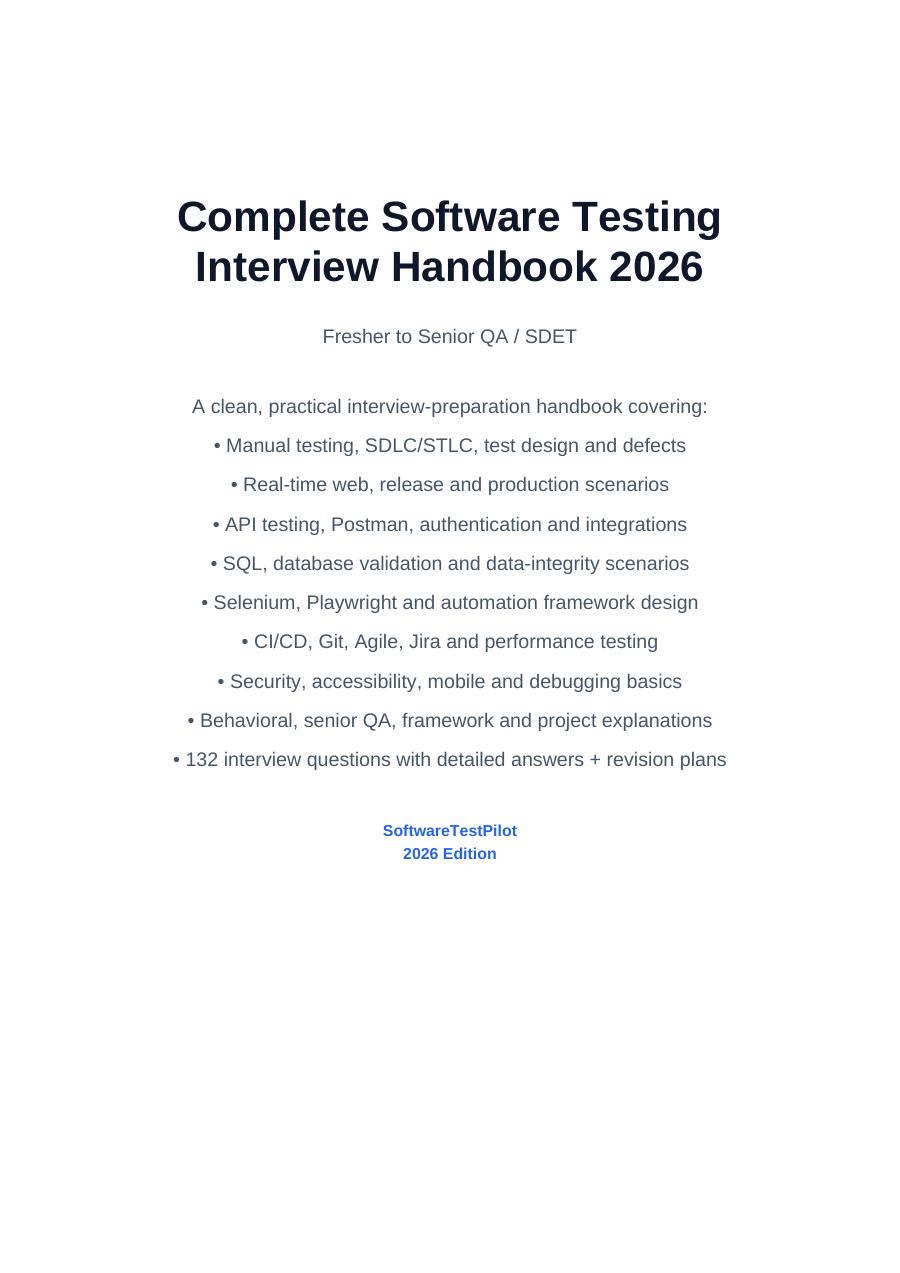
Complete Software Testing Interview Handbook 2026
Published by SoftwareTestPilot
PDF • 30 pages • Interview Questions • Beginner to Advanced • Interview Preparation
Published 21 September 2026 • Updated 22 September 2026
Included in QA Notes Vault
Preview this resource below, or unlock the complete QA Notes Vault for ₹199 lifetime access.
Walk into any QA interview in 2026 knowing what will be asked and how to answer it.
Already bought the Vault?
Read Complete Software Testing Interview Handbook 2026
Like this resource? Unlock this plus 89+ other QA notes with lifetime Vault access.
Overview
Testing Fundamentals 6 Q&A; 12. Selenium WebDriver 6 Q&A; 2. SDLC, STLC & Risk-Based Testing 6 Q&A; 13. Selenium Scenario Questions 6 Q&A; 3. Test Design Techniques 6 Q&A; 14. Defects & Root-Cause Thinking 6 Q&A; 15. Playwright Scenario Questions 6 Q&A; 5.
What you'll learn
- Testing fundamentals and test design techniques
- SDLC, STLC and risk-based testing
- API testing fundamentals and failure scenarios
- Selenium WebDriver and scenario questions
- Playwright and modern automation
- Automation framework design and strategy
- CI/CD, Git and containers
- Agile, Scrum and Jira
Topics covered
- selenium
- playwright
- api-testing
Table of contents
- 1. Testing Fundamentals
- 2. SDLC, STLC & Risk-Based Testing
- 3. Test Design Techniques
- 4. Defects & Root-Cause Thinking
- 5. Web Application Scenarios
- 6. Release, Production & Exploratory
- 7. API Testing Fundamentals
- 8. API Failure & Integration Scenarios
- 9. Postman, Authentication & API Tooling
- 12. Selenium WebDriver
- 13. Selenium Scenario Questions
- 14. Playwright
- 15. Playwright Scenario Questions
- 16. Automation Framework Design
- 17. Automation Strategy & Test Pyramid
- 18. CI/CD, Git & Containers
- 19. Agile, Scrum & Jira
- 20. Performance Testing
Preview from this resource
How to Answer Scenario Questions
Strong interview answers are structured, risk-aware and evidence-based. You do not need to know every product detail. Show how you would investigate and make a safe decision. 1. Clarify Restate the problem and ask for missing context: user, environment, frequency, business impact, expected behavior and recent changes. 2. Prioritize risk Mention what could be lost: money, security, data, availability, compliance, customer trust or release confidence. 3. Investigate Use the right evidence: logs, API traffic, database state, browser console, traces, metrics, test data and comparisons. 4. Test systematically Cover happy path, negative path, boundaries, permissions, failure modes, integrations
2. You receive a feature with unclear requirements. What do you test first?
Answer: Start by identifying the user goal, business rule, inputs, outputs, permissions, dependencies, and failure behavior. Write assumptions and questions, then discuss them with the product owner or developer. Meanwhile, design tests for obvious happy paths, negative paths, boundaries, and integration risks without pretending uncertain behavior is confirmed. 3. How do you decide when testing is sufficient? Answer: Use risk rather than a fixed number of test cases. Confirm critical acceptance criteria, major user journeys, high-risk integrations, important negative paths, regression impact, and known defects. Consider severity of remaining risks, coverage, time, and release context. Testing is sufficient when stakeholders understand and accept the remaining
4. A requirement changes one day before release. What is your approach?
Answer: Perform impact analysis first: affected flows, APIs, data, automation, regression areas, and dependencies. Clarify whether the change is mandatory. Prioritize targeted tests around the change plus critical regression. Communicate reduced coverage and residual risk clearly rather than silently trying to run the original full scope. 5. What is the difference between verification and validation in a real project? Answer: Verification asks whether artifacts are being built correctly - reviews of requirements, designs, test
A short extract taken from the first 8 of 30 pages. The complete notes are in the QA Vault.
Tools covered
- Playwright
- Selenium
- Postman
- Git
- Jira
- SQL
Skills covered
- Interview Preparation
Who this resource is for
- Fresher
- Manual Tester
- Automation Tester
- SDET
- Senior QA
Complete Software Testing Interview Handbook 2026: common questions
1.What does Complete Software Testing Interview Handbook 2026 cover?
2.How long is this PDF and what format is it in?
3.Who is this resource for?
4.How do I get the full PDF?
QA Notes Vault
Get Complete Software Testing Interview Handbook 2026 and the complete Vault
Download this resource in full, plus 89+ other quick-revision QA notes — all for ₹199 with lifetime access.
- One-time payment
- Lifetime access
- Secure checkout
Related QA Resources
More notes on this topic, all included in the same Vault purchase.
QA Interview Cheat Sheet
Included in QA Notes VaultCheat Sheet· Advanced· 20 pages
SDET Interview Handbook: Coding, API, Automation and CI/CD
Included in QA Notes VaultInterview Questions· Intermediate· 30 pages
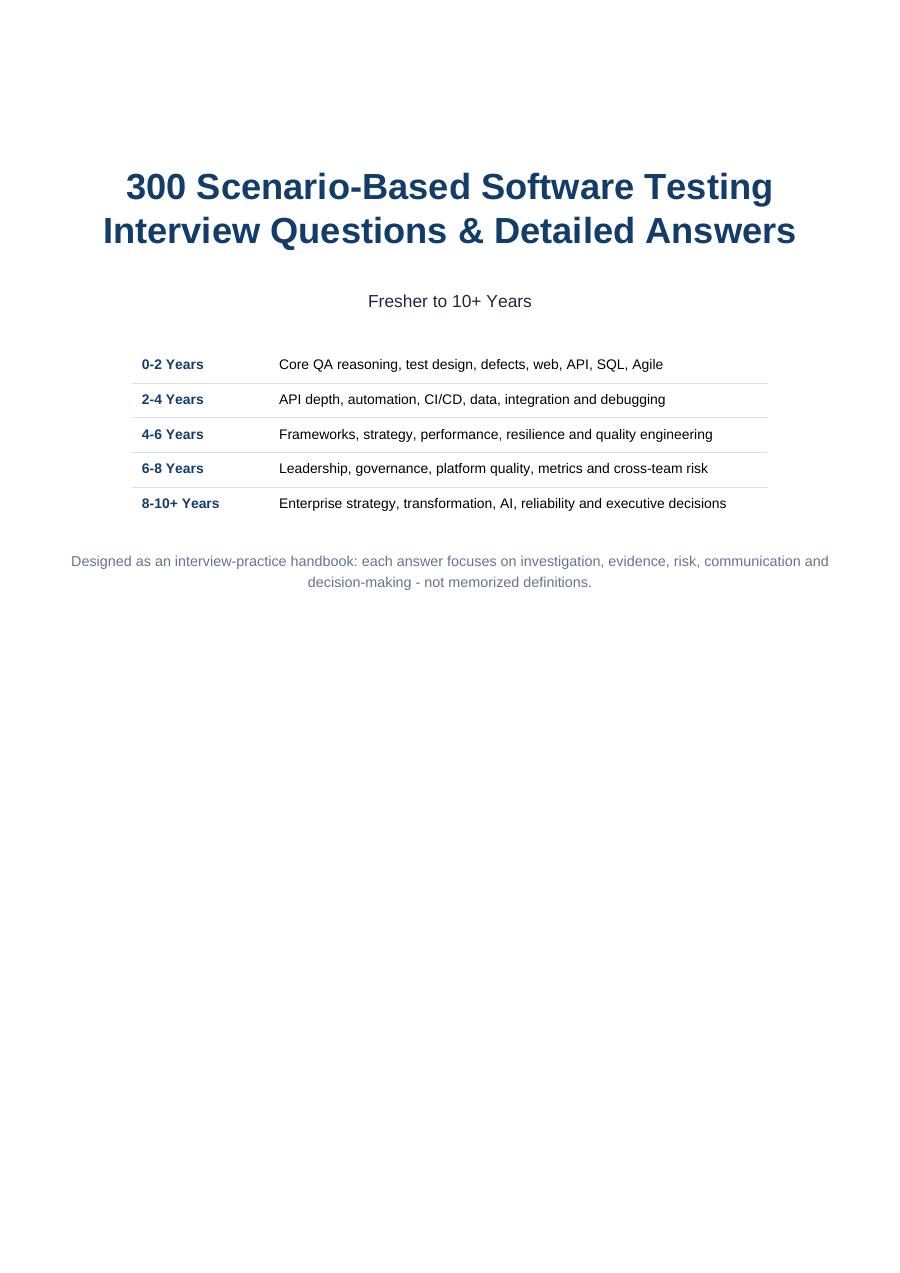
300 Scenario Based QA Interview Questions
Included in QA Notes VaultScenario Questions· Beginner to Advanced· 27 pages